

This article has not yet been professionally approved. The information is based on the sources listed below.
Sugar beet pulp for horses: soaking, sugar and the ration
What sugar beet pulp provides in energy, fibre, sugar and minerals, how to soak it safely and how to fit molassed and molasses-free versions into the total ration.
The short answer
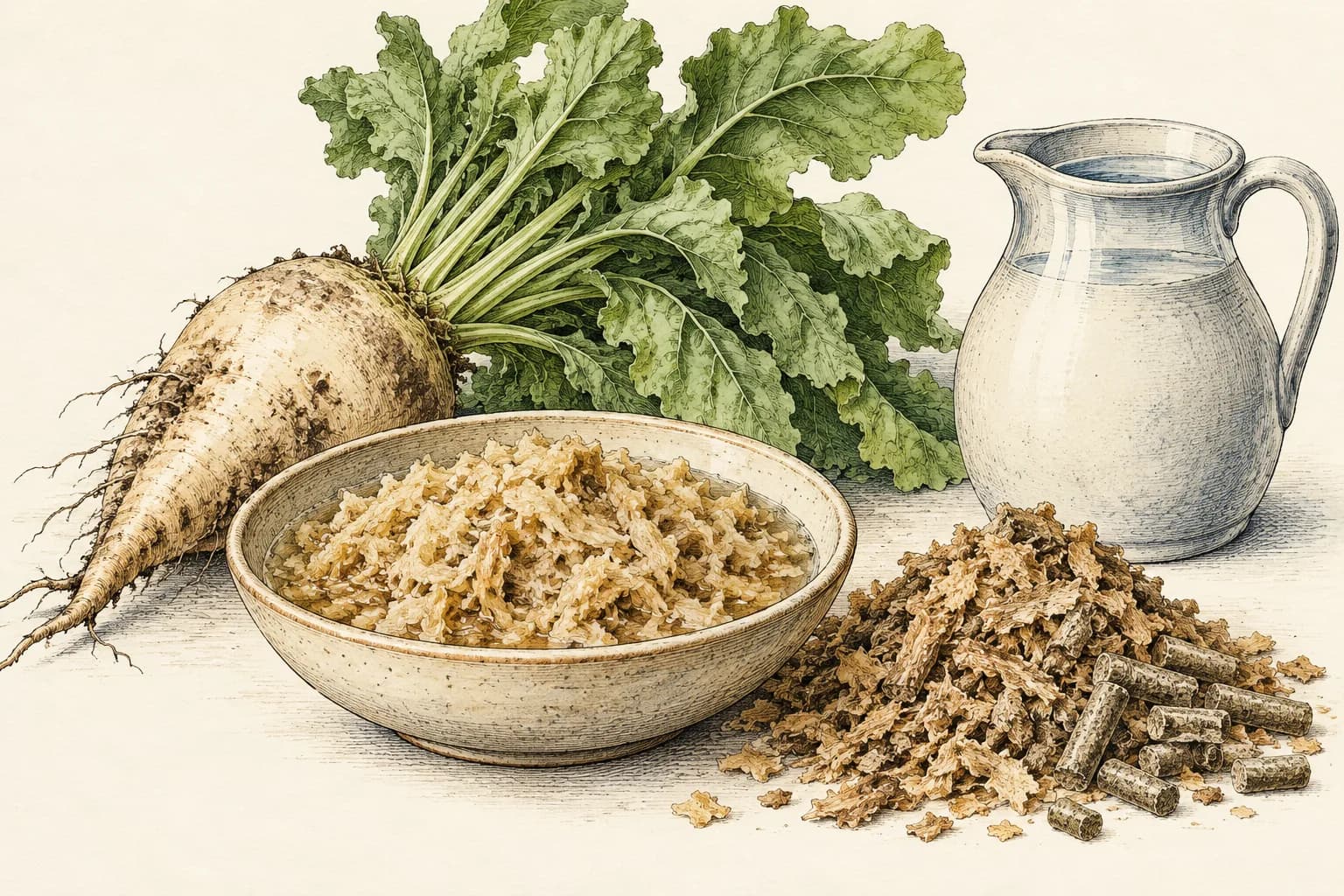
Sugar beet pulp is the dried, desugared residue of sugar beet. The Gruber Table lists it as starch-free, rich in pectin and calcium, but low in phosphorus. Because it swells considerably, it must be fully swollen before feeding, as a guide with at least 4 litres of water per kilogram 1. Molassed versions contain considerably more sugar. Include the dry amount in the total ration.
What is in sugar beet pulp?
Sugar beet pulp is produced during sugar manufacture from cleaned, shredded and desugared sugar beet. The Gruber Table describes it as rich in pectin and calcium and low in protein; it is digested mainly in the large intestine 1. The veterinary reference overview classifies it as a source of energy and fibre 2.
The table values show why sugar beet pulp is often discussed as an alternative to cereals: no starch, but appreciable energy. On the other hand, it provides a lot of calcium and little phosphorus. Values from a table average do not replace the declaration of your product 1.
| Per kg dry matter | Dried pulp (unmolassed) | Molassed pulp, 14% sugar | Molassed pulp, 23% sugar | Oats |
|---|---|---|---|---|
| Metabolisable energy | 10.1 MJ | 10.1 MJ | 10.2 MJ | 12.7 MJ |
| Sugar | 86 g | 150 g | 250 g | 16 g |
| Starch | 0 g | 0 g | 0 g | 447 g |
| Crude fibre | 157 g | 160 g | 134 g | 113 g |
| Calcium | 9.2 g | 11.0 g | 10.0 g | 1.2 g |
| Phosphorus | 1.1 g | 0.8 g | 0.8 g | 3.6 g |
Table values per kg dry matter according to the Gruber Table (LfL, Bavarian State Research Center for Agriculture); oats for comparison only. Individual products may differ.
How do you soak sugar beet pulp correctly?
Dry shreds and especially pellets swell considerably. The Gruber Table therefore considers soaking until fully swollen essential and gives at least 4 litres of water per kg of pulp. It cites the risk of choke and stomach ruptures as the reason 1. The veterinary reference overview also recommends soaking shreds and pellets before feeding 2.
There is no universal soaking time. One manufacturer of quick-soaking flakes gives 1 part flakes to 3 parts water and 10 minutes in lukewarm or 20 minutes in cold water for its product 3. This only applies to that product. For loose product without instructions, the table figure is your starting point, and checking before feeding remains decisive.
- Weigh the dry portion before you add water.
- Follow the instructions on the pack; if there are none, use at least 4 litres of water per kg 1.
- Only feed once you can no longer feel any hard pieces and the mass is no longer swelling.
- Store your supply so that no horse can get to dry pulp.
Molassed or molasses-free – what is the difference?
If molasses is added to dried pulp, the result is molassed pulp. The Gruber Table gives about 8% sugar on an as-fed basis for unmolassed dried pulp and 14 to 23% for molassed pulp 1. Molasses-free therefore means less sugar, not sugar-free.
The American reference overview, by contrast, describes sugar beet pulp as mostly below 12% starch and sugar, even for products with added molasses, and advises asking the manufacturer for the analysis 2. The contradiction with the German table values shows that the product name is not enough. Read the analytical constituents on the declaration and ask for missing sugar and starch values 4.
For horses with insulin dysregulation, the EMS consensus guideline recommends forage with less than 10% non-structural carbohydrates; it does not give a separate limit for sugar beet pulp. With suspected EMS or a history of laminitis, the whole ration belongs under veterinary supervision 5.
What role does sugar beet pulp play in the ration?
The Gruber Table lists dried and molassed pulp in the concentrates chapter; at 10.1 MJ per kg dry matter, they are above the limit of 9.7 MJ given there, even though they are high in fibre 1. They can supply energy without bringing starch with them. Whether a horse needs this energy at all can only be answered by comparing requirements with the current ration; a good doer usually does not need an additional energy source.
For the mineral balance, the ratio of calcium to phosphorus is important. The Gruber Table gives 1.5 to 2 : 1 as a guide value for the total ration for adult horses 1. With 9.2 g calcium and 1.1 g phosphorus per kg dry matter, unmolassed dried pulp works out at just over 8 : 1. It can balance a phosphorus-rich bran mix, but in a ration that is already rich in calcium it can also contribute to an imbalance 2.
How much sugar beet pulp fits – and how do you include it in the calculation?
The Gruber Table gives a maximum amount of 1 kg dry pulp per 100 kg body weight per day 1. That is an upper limit. The right amount depends on the gap you want to fill and on what the pulp replaces.
A freely chosen worked example, not a feeding recommendation: 300 g of dry, unmolassed pulp with 890 g dry matter per kg supplies, according to table values, around 2.7 MJ metabolisable energy, 2.5 g calcium, 0.3 g phosphorus and 23 g sugar 1. For the same energy from oats, it would take around 240 g, which would bring about 95 g of starch with it. At least 1.2 litres of water would be needed for soaking.
For comparison, the table gives a calcium requirement of 17.5 g per day for a 500 kg horse 1. The portion from the example already covers about one seventh of this. That is why it belongs in the same calculation as hay and mineral feed.
- Enter the dry amount, not the weight of the soaked mass.
- Note the product, added molasses and declared values.
- Record whether the pulp replaces concentrates or hay or is fed in addition.
- After a change, also check your current mineral feed.
How do you keep the soaked portion hygienic?
The Gruber Table explicitly warns that soaked pulp spoils quickly 1. It does not give a fixed shelf life in hours, and we are not aware of any reliable study on this for sugar beet pulp.
For soaked hay, the EMS consensus guideline describes concerns about microbial growth with long soaking in warm water 5. This cannot be transferred one to one to sugar beet pulp, but it argues for a short time between preparing and feeding, especially in warm weather.
- Only prepare the amount that will be eaten promptly.
- Use clean buckets and fresh water.
- Remove leftovers after the meal and do not feed any mass that smells sour or fermented.
- Do not mix an old leftover portion into a freshly prepared one.
Key takeaways
- Dry shreds and pellets are only fed once fully swollen; soaked portions spoil quickly 1.
- Molasses-free does not mean sugar-free: according to the table value, even unmolassed dried pulp contains about 8% sugar on an as-fed basis 1.
- Sugar beet pulp shifts the calcium-phosphorus balance; so assess it together with hay, concentrates and mineral feed 1.
Frequently asked questions
How long does sugar beet pulp need to soak?
Until it is fully swollen. The Gruber Table gives at least 4 litres of water per kg of pulp for this, but no fixed time 1. According to the manufacturer, quick-soaking flakes can be ready after just 10–20 minutes; this time only applies to that particular product 3.
Can you feed sugar beet pulp dry?
The Gruber Table considers soaking until fully swollen essential because of the risk of choke 1. The veterinary reference overview also recommends soaking shreds and pellets before feeding 2. Store the bag so that horses cannot get to the dry product.
Is molasses-free sugar beet pulp suitable for horses with EMS?
It contains less sugar than molassed pulp but is not sugar-free 1. With insulin dysregulation or a history of EMS or laminitis, the whole ration should be planned with veterinary supervision; a single ingredient does not decide this 5.
How much sugar beet pulp can a horse have per day?
The Gruber Table gives an upper limit of 1 kg dry pulp per 100 kg body weight per day 1. That is a maximum amount, not a recommendation. How much makes sense depends on which gap the pulp is meant to fill in your ration.
Sources & studies
The content is based on the references listed below. It does not replace individual veterinary or feeding advice.
Show list of sources (5)
- Bayerische Landesanstalt für Landwirtschaft (LfL): Gruber Tabelle zur PferdefütterungPractical reference table with requirement and feed values based on the GfE recommendations; the basis of many ration calculations in German-speaking countries. Chapter 9.3, Table 39: most common poisonous plants for horses with habitat, toxicity and risk level (after Kamphues et al. 2014)
- Liburt NR (2026): Feeding Practices in Horses and Other Equids. Merck Veterinary ManualSpecialist overview, as of February 2026: forage basis, concentrates as required, bran/mash and Ca:P balance, gradual feed changes. No efficacy study on commercial mash products.
- Pavo: SpeediBeet – Produktseite mit Fütterungs- und ZubereitungshinweisManufacturer's information, checked on 30 September 2026: soak 1 part product in 3 parts water, 10 minutes in (luke)warm or 20 minutes in cold water; must not be fed dry. Only evidence of preparation for this fast-soaking product, not a general soaking time for loose sugar beet pulp and not an efficacy assessment.
- Verordnung (EG) Nr. 767/2009Placing on the market and use of feed, labelling and claims; definitions of complete feed (Art. 3(2)(i)) and complementary feed (point (j)), content of feed additives (Art. 8), feeding instructions (Annex II No. 4). Link to the current EUR-Lex consolidated version (as of 26 December 2018).
- Durham AE et al. (2019): ECEIM consensus statement on equine metabolic syndrome. Journal of Veterinary Internal Medicine 33:335–349Sections 2–3 and 7: overweight is not an EMS diagnosis; ration adjustment, monitoring and exercise in at-risk horses must be supervised by a vet. Clinical restriction protocols are not adopted as a general recommendation for owners.