

This article has not yet been professionally approved. The information is based on the sources listed below.
Sugar and fructan in hay
Why sugar content matters for good doers and metabolically sensitive horses – and what soaking and steaming do.
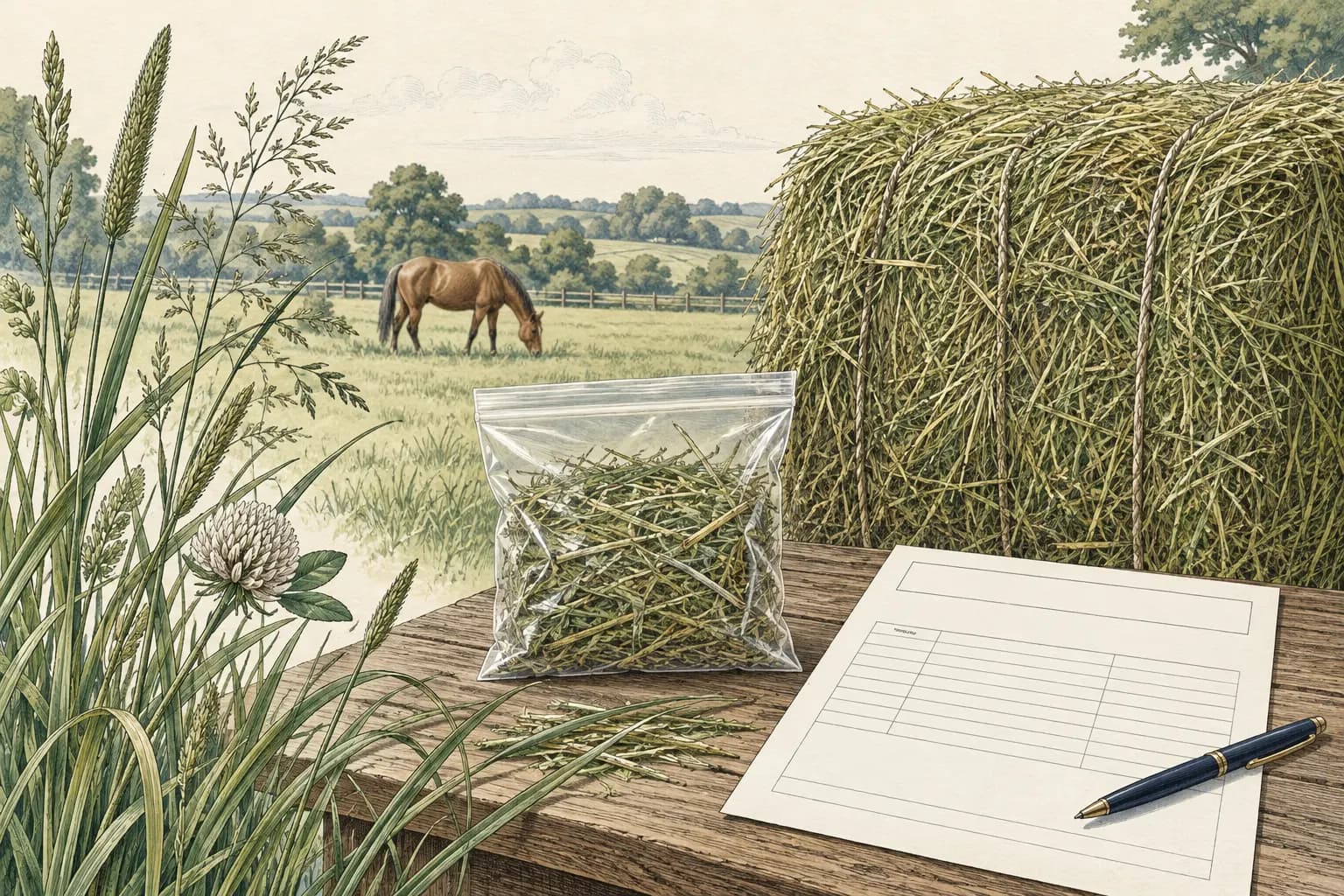
The sugar content of hay varies widely – depending on the grasses, cutting time, weather and location. For many horses this is not critical. For good doers, overweight or metabolically sensitive horses, however, a low sugar and starch content is an important feeding goal 1.
- Water-soluble carbohydrates (WSC) include sugars and fructans.
- Fructans are the grasses' own storage carbohydrates.
- The content can be read from the analysis and cannot be judged by appearance 2.
Soaking and steaming
Soaking reduces water-soluble carbohydrates by around 27% on average (study range 6–54%, depending on duration and water temperature, with soaking times of up to 16 hours) 3. At the same time, minerals are leached out: potassium and phosphorus most strongly, magnesium somewhat less – and considerably more with long (several hours) than with short soaking (up to about 1 hour) 4.
Steaming, by contrast, has a mainly hygienic effect according to the studies: less dust, fewer microbes and mould spores, but no notable change in sugar or mineral content 5.
According to the studies so far, usable protein remains largely unchanged with both methods – a general protein loss from soaking or steaming has not been independently demonstrated 3. If you soak regularly, you should nevertheless keep an eye mainly on potassium, phosphorus and magnesium supply, not on protein.
In the ration analysis, we therefore ask whether and for how long hay is soaked, and automatically factor the mineral correction into the requirement coverage.
Sources & studies
The content is based on the references listed below. It does not replace individual veterinary or feeding advice.
Show list of sources (7)
- Prof. Dr. Ingrid Vervuert – Institut für Tierernährung, Universität LeipzigResearch on starch digestion, glycaemic/insulinaemic responses and phytotherapeutics in horses
- Weender Futtermittelanalyse (Weender Analysensystem)Standard method for determining crude nutrients (crude protein, crude fibre, crude fat, crude ash) as the basis of feed and hay analyses
- Longland AC, Ince J, Harris PA (2011): Effects of soaking on the water-soluble carbohydrate and crude protein content of hay. Veterinary Record 168(23):618Soaking (up to 16 h, ~8 °C) reduces water-soluble carbohydrates by 27% on average (range 6–54%, fructan ~24%), crude protein remains statistically unchanged
- Martinson K, Jung H, Hathaway M, Sheaffer C (2012): The effect of soaking on protein and mineral loss in Orchardgrass and Alfalfa hay. Journal of Equine Veterinary Science 32(12):776–782Soaking (15–60 min or 12 h) reduces potassium (up to 80%), phosphorus (up to 65%) and magnesium (up to 45%) depending on duration/temperature; effect on crude protein inconsistent/small
- Moore-Colyer MJS, Lumbis K, Longland A, Harris P (2014): The Effect of Five Different Wetting Treatments on the Nutrient Content and Microbial Concentration in Hay for Horses. PLOS ONE 9(11):e114079Steaming does not significantly change sugar, nitrogen and mineral contents (incl. Na, Ca, Mg, P, K) – the effect is essentially hygienic (dust, microbes)
- GfE (2014) – Empfehlungen zur Energie- und Nährstoffversorgung von PferdenSpecialist reference in German-speaking countries (GfE, German Society of Nutrition Physiology), Committee for Requirement Standards
- NRC – Nutrient Requirements of Horses, 6th ed.International reference for the nutrient requirements of horses (National Research Council)