

This article has not yet been professionally approved. The information is based on the sources listed below.
Hay analysis for horses: values, costs and sampling
Which test suits your ration question, how to sample a hay batch and how to translate the lab report into daily feeding.
The short answer
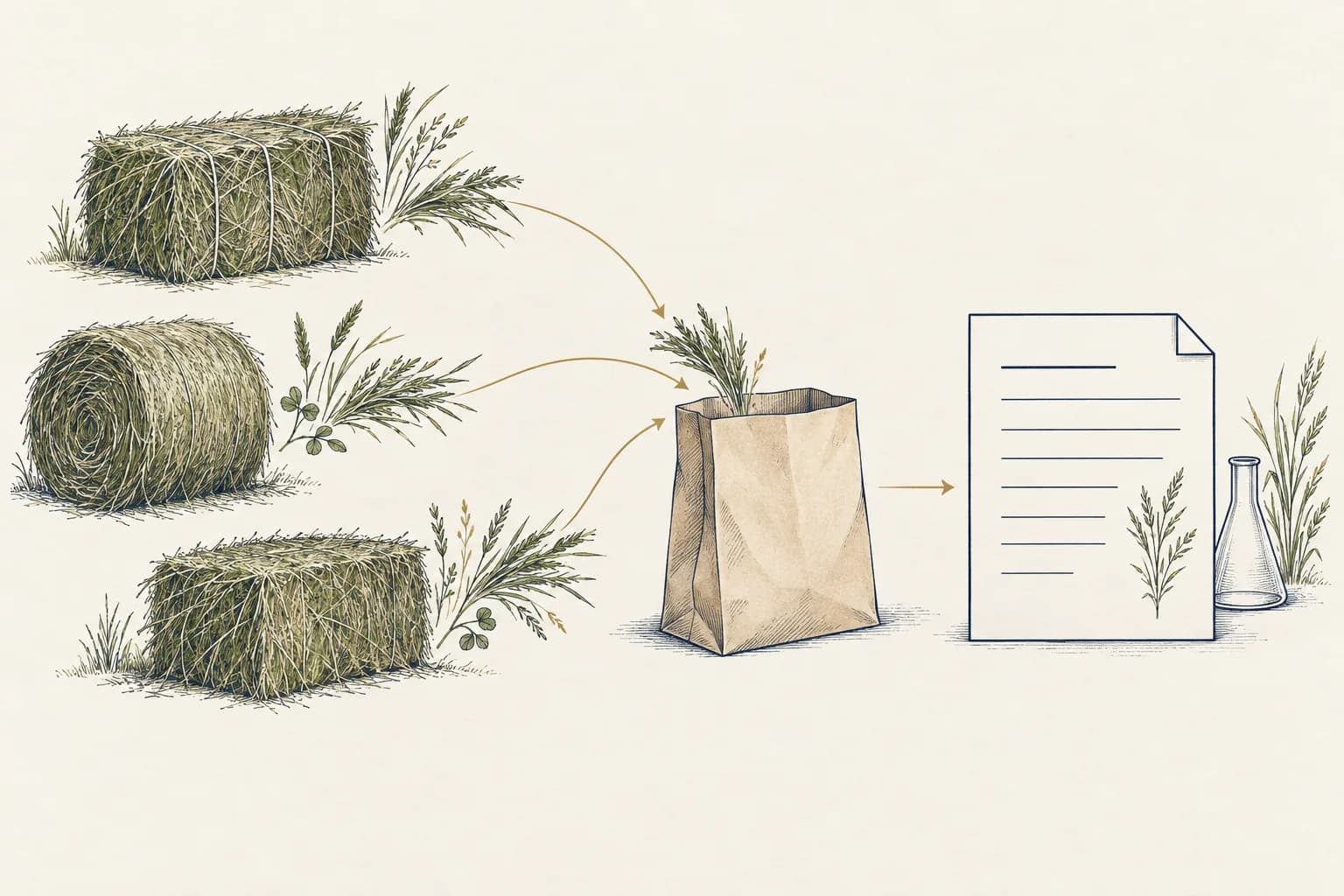
A hay analysis describes the sample you send in. For it to be a usable basis for the ration, this sample must represent your hay batch. The package you choose determines whether, for example, nutrients, trace elements or feed hygiene are tested. A nutrient package is not a complete safety check 12.
What does a hay analysis tell you – and what remains open?
The value starts with a concrete question: do you want to assess energy and protein, calculate the mineral supply or investigate unusual hay? Laboratory orders separate these testing focuses. A parameter that was not ordered cannot be read as an unremarkable result 2.
Even a properly measured sample only stands for the material selected. A study of hay samples from Upper Bavaria shows considerable differences in mineral composition; a table average is therefore not a measured value for your batch 3.
Which values do you need for your question?
The hay nutrient package from LUFA Nord-West (a German agricultural testing laboratory) includes, among other things, dry matter, crude nutrients, sugar and fructan as well as stated energy and protein values. Minerals, trace elements and microbial counts are separate order items. The name of a package alone is therefore not enough to compare different offers 2.
- Note the values together with their unit: per cent, g/kg and mg/kg are different figures.
- Check whether the value refers to the as-fed (fresh) basis or to dry matter.
- Record missing measurements as missing; do not let them be silently replaced by a table value.
How do you get from the lab value to the daily ration?
Contents and daily quantities must share the same reference basis. A worked example, explicitly not a real hay sample: 10 kg of hay with 85% dry matter gives 8.5 kg of dry matter. If the report shows 30 mg of zinc per kg of dry matter, that would be 8.5 × 30 = 255 mg of zinc from this hay per day. A value per kg on an as-fed basis would be multiplied directly by the 10 kg 4.
This contribution is not yet an assessment of the horse. Add pasture, other forage, concentrates and supplements before you compare the supply with a requirement reference 4.
How do you take a representative hay sample?
Follow the instructions of the laboratory you use. LUFA Nord-West requires a composite sample from several bales and layers rather than just pulling loose stalks from the edge of a bale. The labelling on the bag and the order must match 1.
- Define the batch before sampling: note the harvest, cut, supplier and storage area.
- Collect subsamples spread across this batch and mix them cleanly.
- Check the quantity and packaging required for the tests you have ordered.
- Please take the hay sample before steaming and send it in unsteamed.
- Keep a copy of the order and the batch assignment with the lab report.
What does the test cost and what is included?
As a price example, based on the 2026/27 order form: hay nutrient package €49.50, combined mineral and trace element package an additional €46, each per sample plus VAT. Selenium, iodine and hygiene parameters are charged separately. These laboratory prices do not describe an Equivora offer; ask for the current total price, including the parameters you want and shipping costs, before sending 2.
What do you do when hay batches change?
A sample from one batch is not a representative sample for another. Assign each lab report to its batch. When changing, check whether the new batch is adequately described and whether a new analysis is needed for the open ration question. Especially where a mineral deficit is possible, the old composition cannot be carried over without evidence 13.
- Document the old and new batches separately.
- If both are fed in parallel, record both quantities separately.
- Until the new results arrive, label the calculation as an estimate and discuss the uncertainty.
Key takeaways
Frequently asked questions
How much does a hay analysis cost?
At LUFA Nord-West (a German agricultural testing laboratory), the hay nutrient package costs €49.50 plus VAT in the 2026/27 order form; the combined mineral and trace element package costs an additional €46 plus VAT. Further parameters and shipping may be added. This is a dated laboratory example, not an Equivora price 2.
Can I simply send in hay from the hay rack?
For a representative batch sample, the laboratory recommends material from several bales and bale layers; feed from a rack or stable is unsuitable for this 1.
Which values do I need to choose a mineral feed?
Alongside dry matter, you need macrominerals such as calcium, phosphorus and magnesium, and trace elements such as zinc and copper. In the 2026/27 order form we reviewed, minerals and trace elements are not part of the nutrient package but of the additional mineral and trace element package 2.
Are selenium and iodine included automatically?
No. In the 2026/27 order form we reviewed, selenium and iodine are separate tests. Check the actual scope of your order before treating a missing value as measured 2.
Sources & studies
The content is based on the references listed below. It does not replace individual veterinary or feeding advice.
Show list of sources (4)
- LUFA Nord-West: Probenahme Pferdefutter – Wie gehe ich korrekt vor?Laboratory instructions: representative samples from several bales and layers, identical labelling of sample and order. Checked online on 28 September 2026.
- LUFA Nord-West: Untersuchungsauftrag Pferdefutter 2026/27p. 1: analysis packages and prices per sample plus VAT; p. 2: scope of analysis, sample quantities and shipping. Prices for 2026/27, checked on 28 September 2026; not an Equivora offer.
- Möllmann F (2007): Analysen und Abschätzung des Mineralstoffgehaltes in Heuproben aus oberbayerischen Pferdehaltungsbetrieben. Diss. med. vet., LMU MünchenGrass hay samples from horse yards in Upper Bavaria; empirical database for the mineral contents (Ca, P, Mg etc.) of German grass hay, with wide variation by location, soil and cut. Open access.
- Bayerische Landesanstalt für Landwirtschaft (LfL): Gruber Tabelle zur PferdefütterungPractical reference table with requirement and feed values based on the GfE recommendations; the basis of many ration calculations in German-speaking countries. Chapter 9.3, Table 39: most common poisonous plants for horses with habitat, toxicity and risk level (after Kamphues et al. 2014)