

This article has not yet been professionally approved. The information is based on the sources listed below.
Oats for horses: how much, whole or rolled?
How to check whether your horse needs oats, assess processing and chewing ability, and account for the quantity actually fed in the ration.
The short answer
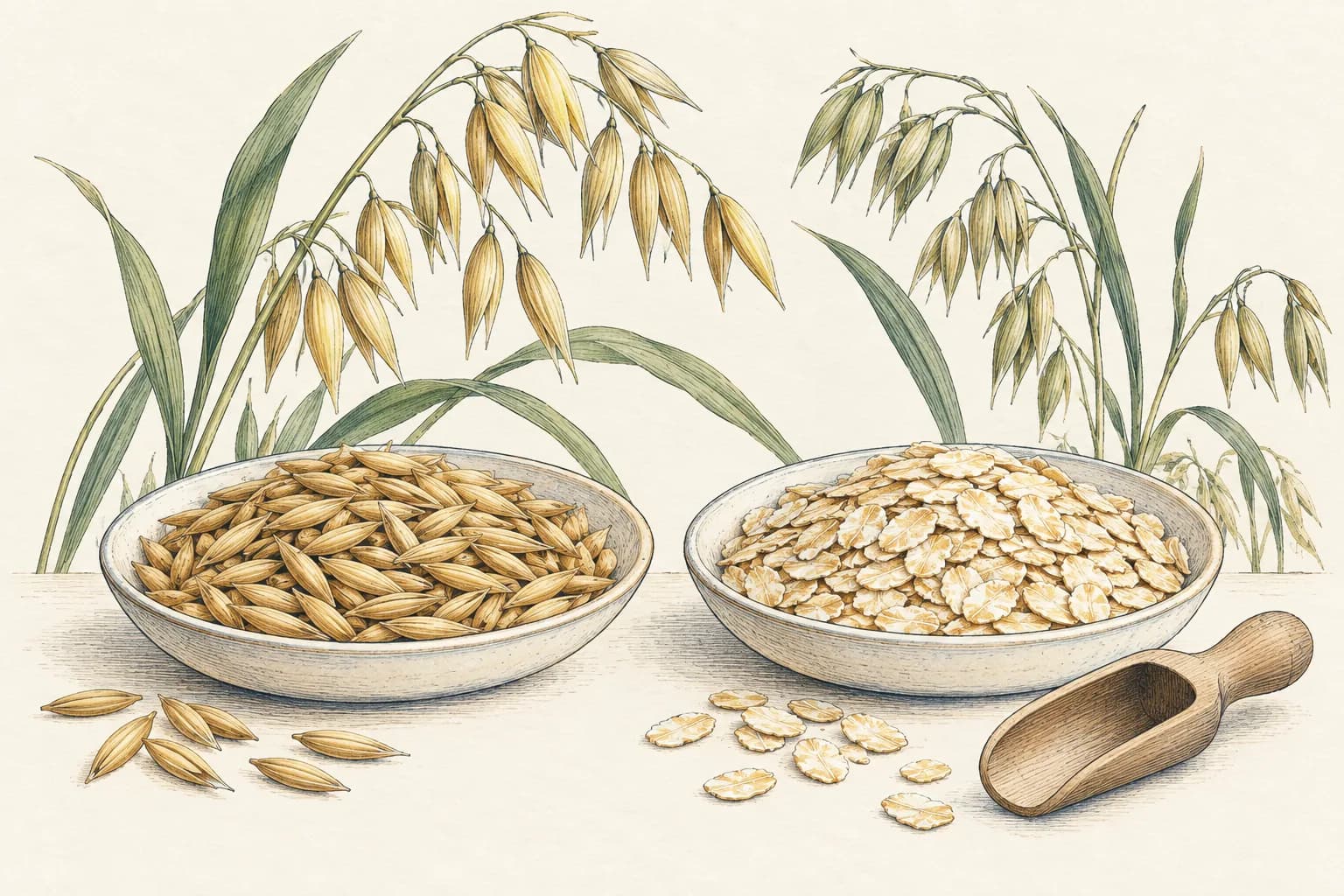
Oats are a cereal feed and not a mandatory part of every ration. First check whether forage and other feed already cover the energy requirement. Oats can be fed whole; processing and chewing ability play a role in the choice. A general quantity in kilograms does not suit every horse 12.
Does your horse need oats at all?
With suitable forage, many horses manage with little or no energy-rich concentrate feed. Additional requirements, for example from work or difficulty maintaining weight, must be considered case by case 1. So start with the current basic ration rather than with a desired scoop of oats.
- Record weight, body condition and actual work.
- Weigh the forage and concentrate quantities.
- Note grazing time and other energy sources.
- Define the open question: is energy, protein or another nutrient lacking?
Are rolled oats generally better than whole oats?
The Gruber Table describes whole oat grains as suitable for feeding and names dental problems and bolting feed as reasons to look at processing more closely 2. A general quality ranking between whole and rolled cannot be derived from this.
In a trial with seven horses, oat starch was well digestible before the large intestine; the results also depend on individual factors such as chewing. The variants and trial rations tested are not a universal green light for feeding a horse with dental or digestive problems 3.
- Assess the horse's chewing ability and feed intake.
- Have dental problems checked rather than simply masking them with a different grain form.
- Check storage condition, smell and the supplier's information.
How much oats is appropriate?
The quantity follows from the gap in the ration and the nutrient composition. Concentration per kg and daily quantity must be calculated together 2. Without information on the horse, hay and existing feed, a specific dose here would only be a guess.
- Weigh the contents of your usual scoop once.
- Note the daily quantity and its division across meals separately.
- Also enter other cereals and compound feeds.
- When making a change, compare the new overall ration with the previous one.
What do you need to consider regarding starch and minerals?
Good digestibility of a cereal is no proof that a meal is safe without limits. The digestion trial tested starch contributions under defined conditions, not every practical feeding scenario 3. So consider the starch contribution of all concentrates together and discuss larger changes with a specialist.
The Gruber Table identifies oats as a phosphorus-rich feed. Calcium and phosphorus must fit across the whole ration; a mineral supplement is therefore not chosen solely on the basis of the type of oats fed 2.
Key takeaways
Frequently asked questions
Do oats for horses always have to be rolled?
No. Whole grains can generally be fed; chewing ability and dental condition must suit the form of the feed 2.
How many kilograms of oats does a horse need?
A general quantity cannot be justified without the basic ration, requirement and body condition. Add up the requirement and the contributions of all feeds 2.
Are oats a mineral feed?
No. Oats are a cereal with their own nutrient contributions. The mineral supply is assessed on the basis of the whole ration 2.
Sources & studies
The content is based on the references listed below. It does not replace individual veterinary or feeding advice.
Show list of sources (3)
- Liburt NR (2026): Feeding Practices in Horses and Other Equids. Merck Veterinary ManualSpecialist overview, as of February 2026: forage basis, concentrates as required, bran/mash and Ca:P balance, gradual feed changes. No efficacy study on commercial mash products.
- Bayerische Landesanstalt für Landwirtschaft (LfL): Gruber Tabelle zur PferdefütterungPractical reference table with requirement and feed values based on the GfE recommendations; the basis of many ration calculations in German-speaking countries. Chapter 9.3, Table 39: most common poisonous plants for horses with habitat, toxicity and risk level (after Kamphues et al. 2014)
- Meyer H et al. (1995): Investigations on preileal digestion of starch from grain, potato and manioc in horses. Zentralblatt für Veterinärmedizin A 42(6):371–381Trial in seven fistulated horses, at least four animals per diet; high pre-ileal digestibility of oat starch, influence of individual factors. Abstract checked; no generally safe amount of oats derived from it.