

Our approach
First the whole ration, then the supplement.
How hay, existing feeding and the horse profile become a transparent assessment, and where that assessment ends.
Why we look at the whole ration
Complementary feed should make up for what is missing in the rest of the ration, not add something across the board. That is why we first count what hay and existing feed already provide.
Only this comparison shows whether something is missing, whether something is given twice, or whether the ration can stay as it is.
What we take into account and what comes of it
Hay, existing feeding and the horse profile give intake and requirement. For each nutrient, the analysis shows whether intake is below, within or above the target range. Keeping the ration as it is counts as an equally valid result.
Basis of the assessment
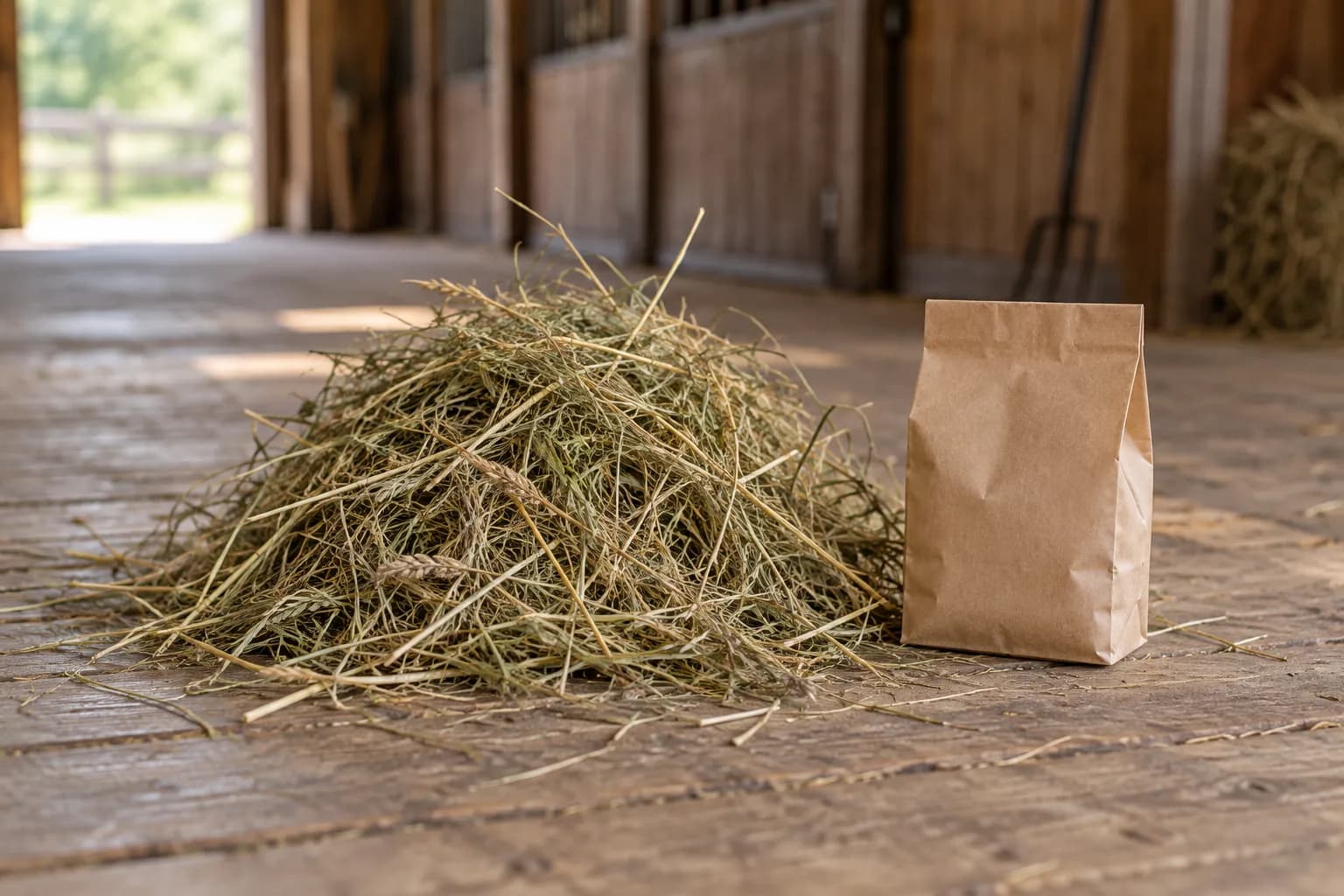 AI-generated
Hay analysis  AI-generated
Current feeding  AI-generated
Horse profile
Comparing requirement and intake
- Intake below requirement: Undersupply
- Intake at requirement level: Within target range
- Intake above requirement: Oversupply
What may follow
What we know, what we estimate and what we do not decide
Measured
Values from the lab report for your hay batch. If a parameter is missing from the report, it is not counted as zero. A lab analysis describes the hay; it is not a diagnosis.
Stated
You enter feeds, daily amounts and details about your horse yourself. These are used in the calculation; we do not measure them.
Estimated
Without lab results, we calculate with table values for the hay type or regionally estimated values and mark this on every value. We derive the requirement from body weight, workload and feed efficiency, based on the requirement references listed below. The values are reference model estimates and are to be professionally validated.
Not decided
Without a reliable basis, a value counts as not assessable, not as zero or “fine”. We only add selenium and iodine to the custom mix when a lab value is available. For pre-existing conditions, medication, pregnancy or lactation, young horses, and open or uncertain safety details, there is no automatic recommendation; instead, we refer you to a professional. The assessment replaces neither your vet nor feeding advice.
Evidence and responsibility
A calculated formula is not yet approved. Before anything is mixed, a responsible person at Equivora approves the saved formula. They cannot override safety blocks or statutory maximum levels.
Technical statements on this website and in the knowledge base are backed by sources. The basis of the calculation is listed here.
Sources
Requirement references for the calculation and the legal basis for additives and maximum levels. They do not replace individual advice from a vet or feeding specialist.
Show list of sources (5)
- GfE (2014) – Empfehlungen zur Energie- und Nährstoffversorgung von PferdenSpecialist reference in German-speaking countries (GfE, German Society of Nutrition Physiology), Committee for Requirement Standards
- Kienzle, Pankratz & Zeyner (2023) – Kompendium zur Rationsberechnung für PferdeAuthor group Pferdewissen (Kienzle/Pankratz, LMU Munich; Zeyner, University of Halle-Wittenberg); self-published, Oberschleißheim, ISBN 978-3-00-075668-9. No link – self-published, not freely accessible.
- NRC – Nutrient Requirements of Horses, 6th ed.International reference for the nutrient requirements of horses (National Research Council)
- Verordnung (EG) Nr. 1831/2003Feed additives – authorisation and use; “daily ration” based on 12% moisture (Art. 2(2)(f)), renewal of authorisation and automatic continuation (Art. 14(4)), general conditions of use (Annex IV: natural plus added amount; complementary feed, diluted as specified, at most at the level for complete feed). Link to the current EUR-Lex consolidated version (as of 27 March 2021).
- Verordnung (EG) Nr. 767/2009Placing on the market and use of feed, labelling and claims; definitions of complete feed (Art. 3(2)(i)) and complementary feed (point (j)), content of feed additives (Art. 8), feeding instructions (Annex II No. 4). Link to the current EUR-Lex consolidated version (as of 26 December 2018).
Have your ration assessed
Enter hay, feed and horse profile and see what is measured, estimated or open.
Who is behind Equivora