

This article has not yet been professionally approved. The information is based on the sources listed below.
Calculating your horse's weight: weight tape, calculator and limits of measurement
Heart girth and body length let you approximately calculate the weight of an adult horse. What matters are fixed measuring points, careful technique and an honest look at the limits of the formula.
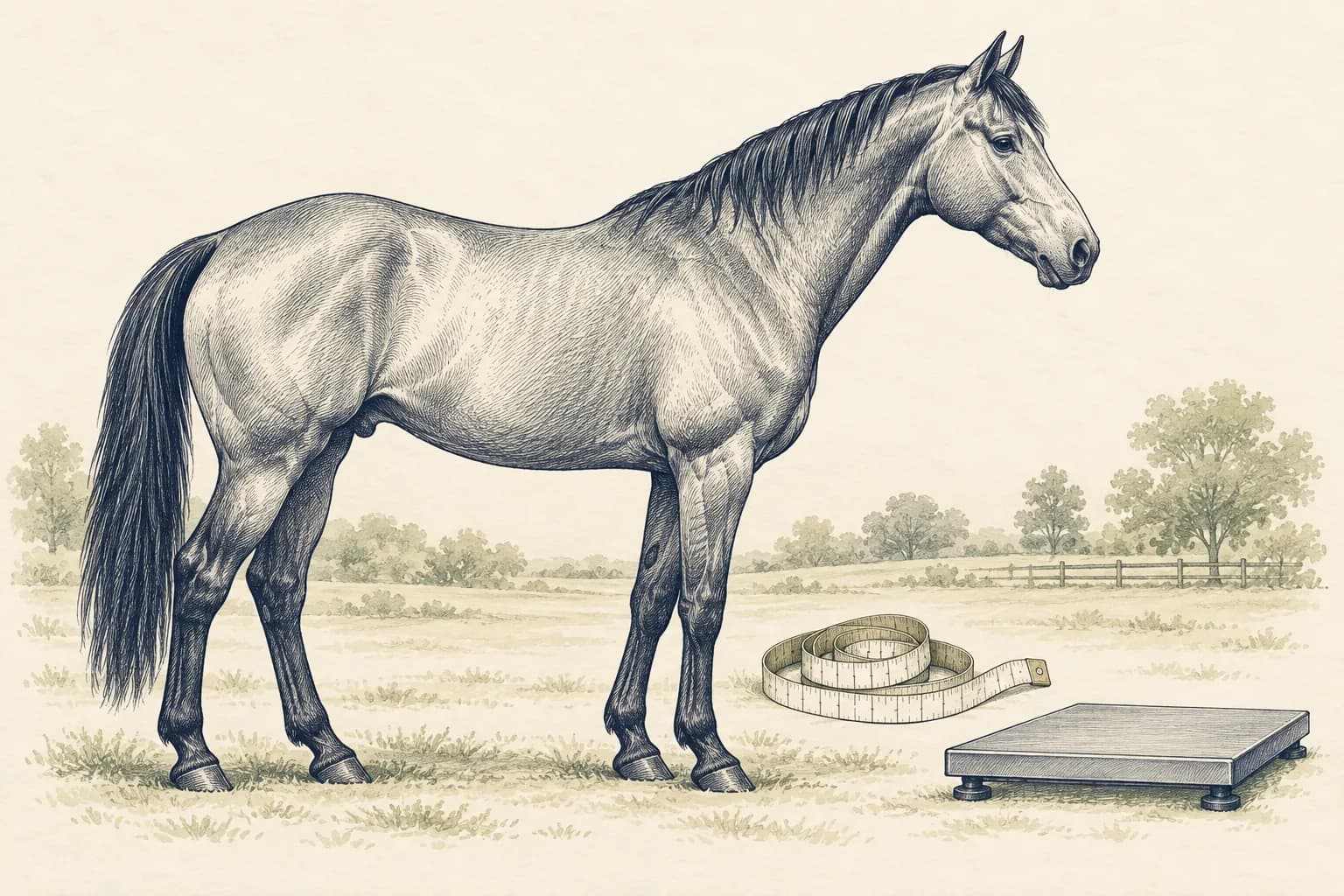
The short answer
A weighbridge measures weight. Without one, you can calculate a guide value for an adult horse using the formula heart girth² × body length ÷ 11,877, provided both measurements are in centimetres. Build and measuring points affect accuracy; the figure says nothing about whether the horse is too fat 12.
How do estimation and measurement differ?
If no weighbridge is available, you can estimate an adult horse's weight from heart girth and body length. The practical formula used was developed for adult horses and gives a guide value – not an exact weighbridge measurement 13.
Preparation: calm, straight and on level ground
Stand your horse calmly and as straight as possible on a level surface. A flexible, non-stretch tape measure should lie smoothly against the body without sagging or cutting into the coat. For tracking over time, consistent conditions help: ideally the same person, the same measuring points and a similar time of day 32.
- The horse should be relaxed and standing as evenly as possible on all four legs.
- Measure directly on the horse's body, not over a rug or a thick girth.
- Note both measurements and repeat the measurement if the tape has slipped 3.
1. Measure heart girth
Place the tape measure directly behind the elbow. Run it vertically over the highest point of the withers and back under the breastbone. The tape forms a closed circumference around the chest 3.
2. Measure body length
Measure in a straight line from the point of the shoulder to the point of the buttock – the rearmost bony point of the hindquarters. In the comparative study, this distance was more suitable for the formula than a shorter measurement to a point between the stifle and the tail 3.
3. Calculate weight
Enter both values in the formula. With a heart girth of 190 cm and a body length of 165 cm, the result is: 190 × 190 × 165 ÷ 11,877 = about 502 kg.
Use the result as an estimate. For the ration analysis, you can enter the rounded value and later replace it with a weighbridge weight as soon as one is available.
How accurate is the estimate?
The deviation is not the same for every horse. In a study of 145 adult horses, the formula using body length to the point of the buttock underestimated weighbridge weight by an average of 17.25 kg; individual results may deviate more 3.
Build, type and condition affect accuracy. Comparative studies show that no general estimation method works equally well for all types of horse 2.
When you should use a weighbridge
When the most accurate possible weight is crucial, the weighbridge remains the reference. Also use it if the estimate does not match the body condition you can see and feel 32.
For monitoring trends, the tape measure can still be useful: repeat the measurement regularly under conditions that are as similar as possible and assess weight together with the body condition score 4.
Key takeaways
Frequently asked questions
How do you calculate a horse's weight with a tape measure?
Square the heart girth in cm, multiply by the body length in cm and divide by 11,877. The calculator uses this formula for adult horses and rounds to whole kilograms 1.
Is the result as accurate as a weighbridge?
No. Comparative studies show deviations depending on the measuring method and type of horse. The formula is an estimate; the weighbridge remains the reference 32.
Can the calculator detect overweight?
No. Body weight alone does not assess fat deposits. For that, body condition is assessed using, among other things, the body condition score 4.
Sources & studies
The content is based on the references listed below. It does not replace individual veterinary or feeding advice.
Show list of sources (4)
- Carroll CL, Huntington PJ (1988): Body condition scoring and weight estimation of horses. Equine Veterinary Journal 20(1):41-45Practical formula for estimating the weight of adult horses from heart girth and body length; metric: heart girth cm x heart girth cm x body length cm / 11877 = kg.
- Górniak W et al. (2020): Evaluation of the Accuracy of Horse Body Weight Estimation Methods. Animals 10(10):1750Open-access comparison of several estimation methods in adult, non-pregnant horses; shows the limits of general formulas and differences by conformation and type.
- Wagner EL, Tyler PJ (2011): A Comparison of Weight Estimation Methods in Adult Horses. Journal of Equine Veterinary Science 31(12):706–710Comparison of scale weight, weight tape and formulas in 145 adult horses; describes the measuring points for heart girth and body length and quantifies the deviation from the scale.
- Henneke DR, Potter GD, Kreider JL, Yeates BF (1983): Relationship between condition score, physical measurements and body fat percentage in mares. Equine Veterinary Journal 15(4):371–372Original publication on the body condition score; bibliographically checked. Its application and limits are additionally supported by horse-specific specialist reviews.