

This article has not yet been professionally approved. The information is based on the sources listed below.
Stomach problems in horses: reviewing feeding and getting them checked
How to document forage, gaps between meals and feeds, what feeding management can achieve and why recurring problems need a veterinary examination.
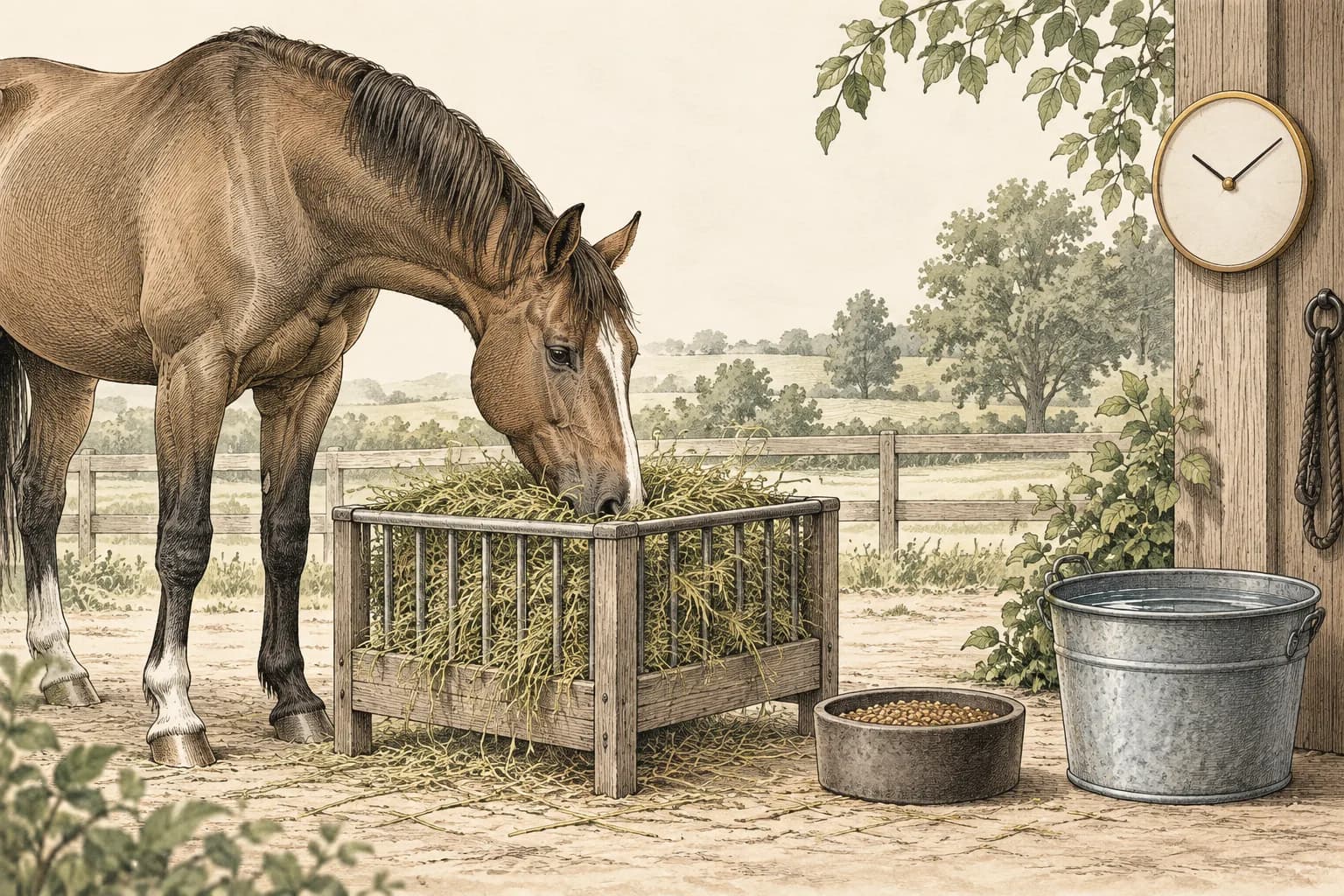
The short answer
Recurring stomach problems need to be investigated by a vet. Eating behaviour or weight loss do not allow a reliable diagnosis of gastric ulcers 1. For the discussion with your vet, you can document the amount of forage, gaps between feeds, starch per meal, water access and all supplements. The gastric guideline puts these factors into context; a feeding log does not replace an examination 2.
What needs to be checked first?
Persistent or recurring problems belong in your vet's hands. Observations such as changed eating, weight loss or recurring colic symptoms are non-specific and do not allow self-diagnosis. A ration analysis cannot attribute them to a gastric ulcer 1.
How are chewing and stomach management connected?
The horse's stomach differs fundamentally from the human one: it produces gastric acid continuously, even when the horse is not eating. In fasted young horses, a basal secretion of 278 ± 29 ml per 15 minutes at a pH of 2.00 was measured via a gastric fistula 3.
The body's most important counterpart is saliva – and that is only produced when chewing. When eating forage, the horse produces 400–480 g of saliva per 100 g of dry matter eaten, but with concentrates only 206 g per 100 g of dry matter, i.e. just over half 4.
This gives the chain this article is about: chewing time determines the amount of saliva, and the amount of saliva determines how much buffer reaches the stomach. Hay requires about three to four times the chewing time of concentrates 45.
Gaps between feeds: what is proven and what is a rule of thumb
The only properly documented figure comes from a cross-sectional study of 201 horses from 23 Danish yards: an interval between forage meals of more than six hours was significantly associated with findings in the non-glandular gastric mucosa 6. This six-hour limit has been adopted in the European specialist guideline, which recommends avoiding longer gaps and spreading forage over several portions 2.
Two limitations are important here. This is an association, not proof of causation. And it is a study limit, not a physiological threshold – it is not as if nothing at all happens at five hours and fifty minutes. Shorter rules of thumb circulate in practice; what is documented is the six-hour value.
That long feed withdrawal damages the mucosa has been established experimentally – but with an extreme protocol: alternating 24 hours of feed withdrawal and 24 hours of hay ad libitum added up to 84 hours without hay over seven days, and lesions developed in every horse 7. That proves the mechanism, not the everyday threshold.
How much forage – two answers
The European specialist guideline gives a lower limit of at least 1.5 kg of forage dry matter per 100 kg body weight per day 2. For a 600 kg horse that is 9 kg of dry matter, so at 88% dry matter content around 10 kg of hay.
The more recent review by the same working group sets the lower limit higher: at least 2% of body weight per day, preferably ad libitum – and recommends measuring actual intake rather than estimating it 8. For the same horse that would be 12 kg of forage; the paper does not state whether as dry matter or fresh weight.
These two values differ by one third, and both are deliberately shown side by side here. We do not average them: the 2015 guideline is the more established reference, the 2023 review the more recent assessment.
Concentrates: two thresholds, two reference values
Two values are documented for starch, both from the same study: an intake of more than 2 g per kg body weight per day or more than 1 g per kg body weight per meal was significantly associated with stomach findings 6. The guideline adopts both values and adds a practical upper limit of 1–2 kg of concentrates per meal 2.
For a 600 kg horse that is no more than 1,200 g of starch a day and 600 g per meal. How much feed that is depends on the starch content of the product in question – it is stated on the declaration and cannot be calculated across the board.
Timing and order
It is documented that exercise changes the conditions in the stomach: during exercise, abdominal pressure rises, the stomach contents are compressed, and the pH in the upper, non-glandular part of the stomach falls 10. This is the mechanism behind the common recommendation not to work horses on an empty stomach.
The amounts derived from this, however, are practical convention, not study results. There is no controlled study in horses for specific amounts and time windows before work – nor for the order “forage first, then concentrates”. Both are physiologically plausible and established in practice; they should not be sold as a proven effect.
What is documented, by contrast, is the lever behind it: the number of meals and how they are distributed 26. Grazing is considered favourable, although the guideline explicitly points out that the evidence is inconsistent – even in a free-living herd, findings in the non-glandular mucosa were around 61% 28.
What else counts – and how well it is documented
The most honest statement about this table: the two types of mucosa in the horse's stomach have different risk profiles. Feeding is documented mainly for the non-glandular mucosa; for the glandular mucosa, management and exercise factors dominate – in the 2019 study, there were no significant feeding differences at all between affected and unaffected horses 118. Good feeding management is the lever you have in your own hands. It is not a guarantee.
| Factor | What is documented | Level of evidence |
|---|---|---|
| Water access | Lack of water access in the turnout area was a significant risk factor 6 | cross-sectional study |
| Training volume | Training on at least 5 days per week was associated with disease of the glandular mucosa (OR 10.4) 11 | small sample, very wide confidence interval |
| Stereotypies | More frequent disease of the non-glandular mucosa (OR 5.0) 11 | direction of causation unclear |
| Change of carer | The person caring for the horse was a significant factor for the glandular mucosa 11 | qualitative |
| Stabling, isolation, transport | Named as risk factors in the review 8 | qualitative, no robust figures |
Management factors with their respective level of evidence. All studies cited show associations, not causation.
Complementary feeds: what the studies show
The authors of the current review explicitly prefer management changes to nutraceuticals – partly because many studies do not control for simultaneous changes in feeding and management, so observed effects cannot be cleanly attributed to the product 8.
For lucerne (alfalfa), which is often advertised as a stomach buffer, the findings point in opposite directions: in adult horses, stomach pH after a lucerne hay ration was higher in the first six hours and findings in the non-glandular mucosa were lower than with pure smooth meadow-grass hay 12. In weanlings, on the other hand, values at the stomach outlet were higher after coarsely chopped lucerne than after lucerne pellets; mechanical irritation is being discussed 13. Different age groups, different particle sizes – no general recommendation can be derived from this.
What live yeast really affects
Live yeast is often mentioned in the same breath, but it affects a different section of the gut: Saccharomyces cerevisiae limits drops in pH and lactate build-up in the caecum under starch-rich feeding 16. That is a statement about the large intestine, not the stomach – the two do not belong in the same paragraph, even if products like to lump them together.
How do you check a suspicion of too much protein?
Protein intake is a separate ration question. The amino acid review cited here deals with requirement, digestibility and excesses, but provides no basis for deriving a stomach finding from a protein suspicion 17. Have the supply checked based on amounts and analysis values, and have the symptoms investigated independently of that 1.
Which records help in the discussion with your vet?
- How much forage is offered and actually eaten?
- When do gaps between feeds occur over the course of the day and night?
- Which amounts of concentrates and starch values are documented?
- Which mineral, yeast and other supplements are given?
- Which findings, medications and changes in management are known?
What can a veterinary examination clarify?
Stomach findings are a veterinary diagnosis. In the living horse, they can only be confirmed by gastroscopy; clinical signs are not sufficient for this 21. Even gastroscopy has limits – for the glandular mucosa there is only weak agreement between the visible finding and the histological result 8. That is all the more reason not to rely on any self-assessment.
Observations such as recurring colic symptoms, teeth grinding, increased salivation, changed eating behaviour, weight loss, a drop in performance, sensitivity in the girth area or changes in behaviour under saddle are non-specific. They do not allow a diagnosis – they are a reason to involve your vet 21.
Key takeaways
Frequently asked questions
What should I feed a horse with stomach problems?
Without an examination and complete ration data, there is no individual feeding advice. Document forage, gaps, meals and supplements and discuss the plan with your vet. The guideline gives management orientation, not a universal product recommendation 2.
Are stomach problems a sign of too much protein?
This conclusion is not drawn from the protein sources cited here. Check protein supply and symptoms separately: stomach signs are non-specific and need to be assessed by a vet 171.
Does an improvement after changing feed prove a gastric ulcer?
No. A change over time is not clear diagnostic proof. The veterinary information describes gastroscopy as the definitive examination method; the choice and interpretation of diagnostics lie with your vet 1.
Sources & studies
The content is based on the references listed below. It does not replace individual veterinary or feeding advice.
Show list of sources (18)
- Merck Veterinary Manual: Gastric Ulcers in HorsesStandard veterinary reference work: a definitive diagnosis requires gastroscopic visualisation of the empty stomach; clinical signs alone are not sufficient
- Sykes BW, Hewetson M, Hepburn RJ, Luthersson N, Tamzali Y (2015): European College of Equine Internal Medicine Consensus Statement – Equine Gastric Ulcer Syndrome in Adult Horses. Journal of Veterinary Internal Medicine 29(5):1288–1299European specialist guideline: minimum of 1.5 kg forage dry matter per 100 kg body weight per day, avoid breaks in feeding of more than 6 hours, starch below 2 g/kg BW/day and below 1 g/kg BW/meal; gastroscopy as the only reliable diagnosis in the living horse; oral antacids act for ≤ 2 hours
- Campbell-Thompson ML, Merritt AM (1990): Basal and pentagastrin-stimulated gastric secretion in young horses. American Journal of Physiology 259(6 Pt 2):R1259–R1266Measurement of basal gastric secretion in fasted young horses via a gastric fistula: 278 ± 29 ml per 15 minutes at a pH of 2.00 ± 0.31. Evidence of continuous acid secretion; the frequently cited figure of 1.5 litres per hour is not supported by it
- Meyer H, Coenen M, Gurer C (1985): Investigations of saliva production and chewing in horses fed various feeds. Proceedings of the 9th Equine Nutrition and Physiology Symposium, East Lansing (MI), S. 38–41Classic measurement of saliva production: with forage 400–480 g saliva per 100 g dry matter consumed (4.0–4.8 litres per kg DM), with concentrates 206 g per 100 g DM (around 2.1 litres per kg DM). The reference basis is dry matter, not fresh matter
- Agroscope (2017): Was leisten Ergänzungsfuttermittel für die Kautätigkeit von Pferden? Agrarforschung SchweizComparison of chewing strokes and chewing time for hay versus complementary feed and concentrates
- Luthersson N, Nielsen KH, Harris P, Parkin TDH (2009): Risk factors associated with equine gastric ulceration syndrome (EGUS) in 201 horses in Denmark. Equine Veterinary Journal 41(7):625–630Cross-sectional study of 201 horses from 23 Danish yards. Significant risk factors: straw as the only forage, starch intake above 2 g/kg BW/day or above 1 g/kg BW/meal, no access to water in the turnout area; for the non-glandular mucosa additionally a feeding interval of more than 6 hours. Associations, not proof of causation
- Murray MJ, Eichorn ES (1996): Effects of intermittent feed deprivation, intermittent feed deprivation with ranitidine administration, and stall confinement with ad libitum access to hay on gastric ulceration in horses. American Journal of Veterinary Research 57(11):1599–1603Induction model: alternating 24 hours of feed withdrawal and 24 hours of hay ad libitum, totalling 84 hours without hay over 7 days. Erosions and ulcers of the non-glandular mucosa developed in every horse. Extreme protocol – demonstrates the mechanism, not an everyday threshold
- Vokes J, Lovett A, Sykes B (2023): Equine Gastric Ulcer Syndrome – An Update on Current Knowledge. Animals 13(7):1261Review: recommends at least 2% of body weight per day of good forage (dry matter), and thus more than the 2015 guideline; separates the risk profiles of non-glandular and glandular mucosa; classes nutraceuticals as weakly supported and puts management changes first. Also reports the strongly use-dependent prevalences – around 61% non-glandular findings for a free-living herd in Great Britain, 11% for university horses
- Coenen M, Vervuert I (2020): Pferdefütterung. Begründet von H. Meyer. 6., aktualisierte Aufl., Georg Thieme Verlag, Stuttgart. ISBN 978-3-13-241778-6Standard reference work on equine nutrition in German-speaking countries; Table 4.17 mineral recommendations (recommended supply and minimum requirement), Table 4.18 derived sweat volumes per work level and weight class, Table 4.19 electrolyte performance requirement per sweat volume (in addition to maintenance requirement)
- Lorenzo-Figueras M, Merritt AM (2002): Effects of exercise on gastric volume and pH in the proximal portion of the stomach of horses. American Journal of Veterinary Research 63(11):1481–1487Exercise increases intragastric pressure and lowers the pH in the proximal, non-glandular region of the stomach – the mechanistic basis for the recommendation not to work horses on an empty stomach
- Sykes BW, Bowen M, Habershon-Butcher JL, Green M, Hallowell GD (2019): Management factors and clinical implications of glandular and squamous gastric disease in horses. Journal of Veterinary Internal Medicine 33(1):233–240Cross-sectional study on management factors: training on at least 5 days a week was associated with glandular mucosal disease (OR 10.4; 95% CI 1.34–26.9), stereotypies with non-glandular mucosal disease (OR 5.0; 95% CI 1.6–15.9). No significant feeding differences were found between affected and unaffected horses
- Nadeau JA, Andrews FM, Mathew AG, et al. (2000): Evaluation of diet as a cause of gastric ulcers in horses. American Journal of Veterinary Research 61(7):784–790Ration of lucerne hay plus concentrates: higher gastric pH in the first 6 hours after feeding and fewer and less severe lesions of the non-glandular mucosa than with Kentucky bluegrass hay alone. Adult horses
- Vondran S, Venner M, Vervuert I (2016): Effects of two alfalfa preparations with different particle sizes on the gastric mucosa in weanlings – alfalfa chaff versus alfalfa pellets. BMC Veterinary Research 12:110Contrary finding on lucerne as a stomach buffer: in weanlings, higher ulcer scores at the pylorus after coarse chopped lucerne than after lucerne pellets with a smaller particle size; mechanical irritation is discussed. Weanlings, not adult horses
- Sanz MG, Viljoen A, Saulez MN, Olorunju S, Andrews FM (2014): Efficacy of a pectin-lecithin complex for treatment and prevention of gastric ulcers in horses. Veterinary Record 175(6):147Blinded crossover study in 10 mares (5 treated, 5 control): five weeks of feeding a commercial pectin-lecithin complex did not prevent or reduce the risk of non-glandular mucosal lesions in the subsequent feed-withdrawal model
- Huff NK, Auer AD, Garza F Jr, et al. (2012): Effect of sea buckthorn berries and pulp in a liquid emulsion on gastric ulcer scores and gastric juice pH in horses. Journal of Veterinary Internal Medicine 26(5):1186–1191Study in 8 stabled horses: no effect on lesions of the non-glandular mucosa, indication of a benefit for the glandular mucosa. Very small sample; two earlier studies showed no effect
- Medina B, Girard ID, Jacotot E, Julliand V (2002): Effect of a preparation of Saccharomyces cerevisiae on microbial profiles and fermentation patterns in the large intestine of horses fed a high fiber or a high starch diet. Journal of Animal Science 80(10):2600–2609Live yeast limits pH drops and lactate accumulation in the caecum on a starch-rich diet
- Mok CH, Urschel KL (2020): Amino acid requirements in horses (Invited Review). Asian-Australasian Journal of Animal Sciences 33(5):679–695Review of amino acid requirements: in horses essentially only lysine is quantitatively established; there are no robust requirement figures for methionine/threonine
- Verordnung (EG) Nr. 767/2009Placing on the market and use of feed, labelling and claims; definitions of complete feed (Art. 3(2)(i)) and complementary feed (point (j)), content of feed additives (Art. 8), feeding instructions (Annex II No. 4). Link to the current EUR-Lex consolidated version (as of 26 December 2018).