
This article has not yet been professionally approved. The information is based on the sources listed below.
Interpreting a hay analysis: which mineral feed suits your hay?
Your lab report has arrived. Here is how to check the scope of testing and the units, convert the values to the daily ration and work out which supplement suits your hay.
The short answer
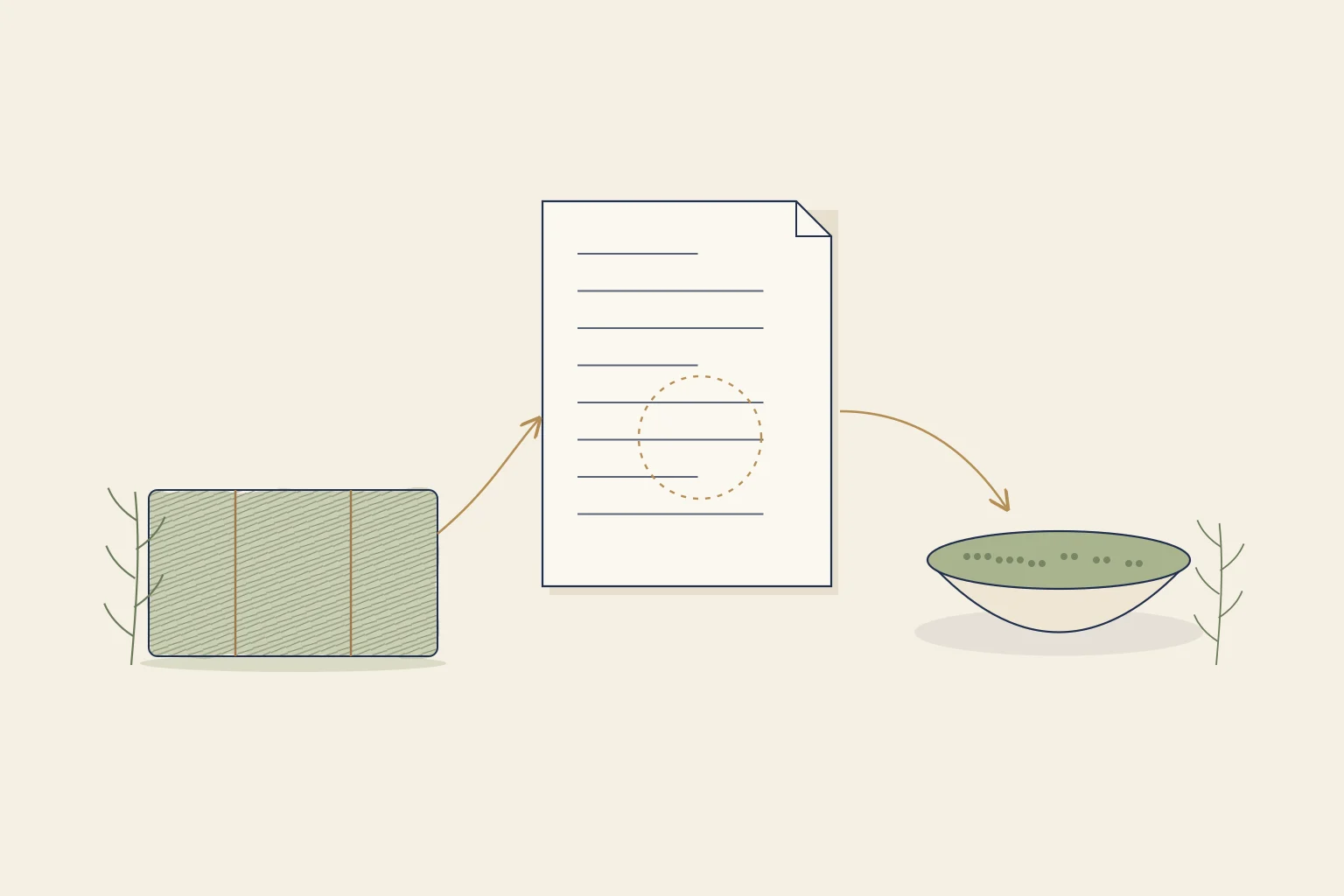
A lab report describes contents per kilogram of hay, not yet supply. Convert the values to a daily intake using the amount of hay actually fed, add the other feeds and compare the total with your horse's requirements 12. A suitable mineral feed then fills the calculated gaps without increasing substances that are already sufficient. Check beforehand which values were tested at all: trace elements, selenium and iodine are often separate order items 3.
What do you need besides the lab report?
The lab report gives the composition of your hay sample. To say anything about your horse, three more pieces of information are missing: how much hay it actually eats, what else it gets and what its requirements should be calculated for. Weight, work, age and breeding status change the requirement values 12.
- Lab report with sample name and date
- Daily amount of hay, weighed if possible
- All other feeds and supplements with their daily amounts
- Weight or estimated weight and the horse's use
Step 1: Which values were actually tested?
Laboratories split their tests into packages. At LUFA Nord-West (a German agricultural testing laboratory), the hay nutrient package includes, among other things, dry matter, crude nutrients, sugar and fructan; minerals and trace elements are a separate order item, and selenium and iodine are ordered separately 3.
So first mark which values were measured and which are missing. For the question of a suitable mineral feed, you need at least macrominerals and trace elements. A missing value stays missing and is not quietly replaced by an average.
Step 2: Convert lab values to the daily ration
Check the unit and reference basis: multiply values per kg of dry matter by the dry matter of the amount of hay fed, and values per kg on an as-fed basis directly by the amount of hay 1.
A freely chosen worked example, not a real sample: 10 kg of hay with 86% dry matter gives 8.6 kg of dry matter. If the lab report shows a copper content of 5 mg per kg of dry matter, this hay provides 8.6 × 5 = 43 mg of copper per day. Laboratory statistics for German hay samples show average copper values of this order, but with considerable variation between individual samples 4.
- Take the dry matter from the lab report.
- Amount of hay × dry matter = dry matter per day.
- Content per kg of dry matter × dry matter = intake from hay.
- Repeat for each measured nutrient and note it with its unit.
Step 3: Compare with your horse's requirements
Requirement values for macrominerals and trace elements are tabulated in the recommendations of the GfE (German Society of Nutrition Physiology) and the NRC; the Gruber Table presents them for practical use by weight and performance 251. For each nutrient, compare the intake from hay with the daily requirement. The difference is the calculated gap or surplus.
| Nutrient | What you need from the lab report | Typical pitfall |
|---|---|---|
| Calcium, phosphorus | Both contents | The ratio between them counts, not just the individual value |
| Magnesium | Content per kg DM | Hay often already covers a lot; more is not automatically better |
| Zinc, copper | Trace element test | Not included in the nutrient-only package |
| Selenium | Own measured value | Narrow range between requirement and maximum content |
| Iodine | Own measured value | Often not tested |
What to look out for in each nutrient group; not an assessment of any specific sample.
Step 4: Add in all other feeds
Concentrates, mineralised muesli, lick blocks and specialist supplements also provide minerals. Convert their declared contents using the daily amount fed in each case and add them to the intake from hay. Only this total determines the supply 65.
The permitted maximum contents for trace elements likewise refer to the entire daily ration, including natural contents, not to a single product 7.
Step 5: Derive the right mineral feed from the gap
Now you have a profile: which substances are missing by calculation, which are covered, which are already high? A suitable mineral feed provides the missing substances in an amount that fits the gap and does not needlessly increase those already covered.
With selenium, this balance is particularly tight: the permitted total content is 0.50 mg per kg of complete feed with 12% moisture, and the content in forage varies widely depending on location 89. Without a measured selenium value, a product without selenium is therefore the more cautious choice until the analysis is available.
- Missing substances: does the product cover them at the recommended daily amount?
- Covered substances: does the product add a lot that is superfluous?
- High values in the hay: does the product contain exactly these substances on top?
- Open values: which conclusion still depends on a missing measurement?
What if the hay changes?
A lab report applies to the batch sampled. Hay samples differ considerably in their mineral composition, so an old lab report cannot simply be transferred to a new delivery 1011. Note the batch for each lab report and check when it changes whether the supplement still fits.
When should you have the interpretation professionally supported?
For pregnant or lactating mares, foals, young horses and horses with illnesses, ration planning should be guided by a vet or a veterinary specialist. There is dedicated specialist training for vets in animal nutrition 12.
Key takeaways
- Values that were not tested remain open; a missing value is not an unremarkable result 3.
- Check the unit and reference basis first, then multiply by the amount of hay 1.
- What counts is the total from hay and all other feeds, not the hay value alone 6.
- Because of the narrow range between requirement and maximum content, selenium only belongs in the plan with a measured value 89.
Frequently asked questions
Can I use any existing hay analysis?
A lab report is usable if it belongs to the batch currently being fed, was sampled representatively and contains the values your question needs. A nutrient-only package, for example, does not answer a question about zinc or copper 113.
What do I do if selenium was not tested?
Then the selenium value remains open. The content in grass forage ranges, depending on location, from almost zero to well above requirements; a table value therefore does not replace measurement 9. Have selenium tested additionally, or plan the supplement without selenium for now.
Sources & studies
The content is based on the references listed below. It does not replace individual veterinary or feeding advice.
Show list of sources (12)
- Bayerische Landesanstalt für Landwirtschaft (LfL): Gruber Tabelle zur PferdefütterungPractical reference table with requirement and feed values based on the GfE recommendations; the basis of many ration calculations in German-speaking countries. Chapter 9.3, Table 39: most common poisonous plants for horses with habitat, toxicity and risk level (after Kamphues et al. 2014)
- GfE (2014) – Empfehlungen zur Energie- und Nährstoffversorgung von PferdenSpecialist reference in German-speaking countries (GfE, German Society of Nutrition Physiology), Committee for Requirement Standards
- LUFA Nord-West: Untersuchungsauftrag Pferdefutter 2026/27p. 1: analysis packages and prices per sample plus VAT; p. 2: scope of analysis, sample quantities and shipping. Prices for 2026/27, checked on 28 September 2026; not an Equivora offer.
- LUFA Nord-West, Institut für Futtermittel (2025): Statistik Heu 2025Laboratory statistics for German hay samples: copper on average around 4.5–5.3 mg/kg DM, zinc on average around 24–33 mg/kg DM, with considerable variation per evaluation period. Analysis statistics, not a peer-reviewed study – mean and range apply only to the evaluation period stated
- NRC – Nutrient Requirements of Horses, 6th ed.International reference for the nutrient requirements of horses (National Research Council)
- Coenen M, Vervuert I (2020): Pferdefütterung. Begründet von H. Meyer. 6., aktualisierte Aufl., Georg Thieme Verlag, Stuttgart. ISBN 978-3-13-241778-6Standard reference work on equine nutrition in German-speaking countries; Table 4.17 mineral recommendations (recommended supply and minimum requirement), Table 4.18 derived sweat volumes per work level and weight class, Table 4.19 electrolyte performance requirement per sweat volume (in addition to maintenance requirement)
- Verordnung (EG) Nr. 1831/2003Feed additives – authorisation and use; “daily ration” based on 12% moisture (Art. 2(2)(f)), renewal of authorisation and automatic continuation (Art. 14(4)), general conditions of use (Annex IV: natural plus added amount; complementary feed, diluted as specified, at most at the level for complete feed). Link to the current EUR-Lex consolidated version (as of 27 March 2021).
- Durchführungsverordnung (EU) 2019/49Authorisation of sodium selenite (3b801), coated granulated sodium selenite (3b802) and zinc-L-selenomethionine (3b818) for all animal species; total maximum content of selenium 0.50 mg/kg complete feed (12% moisture), for 3b818 at most 0.2 mg/kg of added organic selenium. Authorisation expires according to the Annex on 3 February 2029.
- Merck Veterinary Manual: Nutritional Requirements of Horses and Other EquidsSummary of the NRC recommendations: water requirement 5 litres per 100 kg body mass per day at maintenance, sweat losses of around 3.1 g sodium, 5.3 g chloride and 1.6 g potassium per litre, salt recommendation 1.6–1.8 g per kg feed dry matter at a maximum of 6% of the ration; from a 50% forage share potassium is adequately covered. Also covers the selenium requirement (0.1 mg/kg feed dry matter or at least 1 mg/day for a 500 kg horse, selenium as a component of glutathione peroxidase together with vitamin E) and the strong location-dependent variation of selenium in forage (grass forage on average 0.194 ppm, range 0–1.2 ppm); some regions are markedly low in selenium and may need supplementation. Also gives the iodine requirement (0.35 mg/kg feed dry matter, mares in late pregnancy 0.4), iodine poisoning of pregnant mares from around 40 mg/day, documented goitre cases in mares and their foals associated with large amounts of dried seaweed (kelp), that iodised salt easily covers the requirement, and that iodine supplementation is usually unnecessary except in severely iodine-deficient regions
- Möllmann F (2007): Analysen und Abschätzung des Mineralstoffgehaltes in Heuproben aus oberbayerischen Pferdehaltungsbetrieben. Diss. med. vet., LMU MünchenGrass hay samples from horse yards in Upper Bavaria; empirical database for the mineral contents (Ca, P, Mg etc.) of German grass hay, with wide variation by location, soil and cut. Open access.
- LUFA Nord-West: Probenahme Pferdefutter – Wie gehe ich korrekt vor?Laboratory instructions: representative samples from several bales and layers, identical labelling of sample and order. Checked online on 28 September 2026.
- Bundestierärztekammer: Fachtierarzt/-tierärztin für Tierernährung und DiätetikModel further training regulations: four years of further training at recognised institutions in feed science, nutritional physiology, ration formulation for individual animals and herds, and dietetics; the title is awarded by the responsible state veterinary chamber after passing an examination