

This article has not yet been professionally approved. The information is based on the sources listed below.
Combining supplements: do several products go together?
Mineral feed, muesli, lick block and specialist supplement: how to spot where products overlap and decide transparently what stays and what can be replaced.
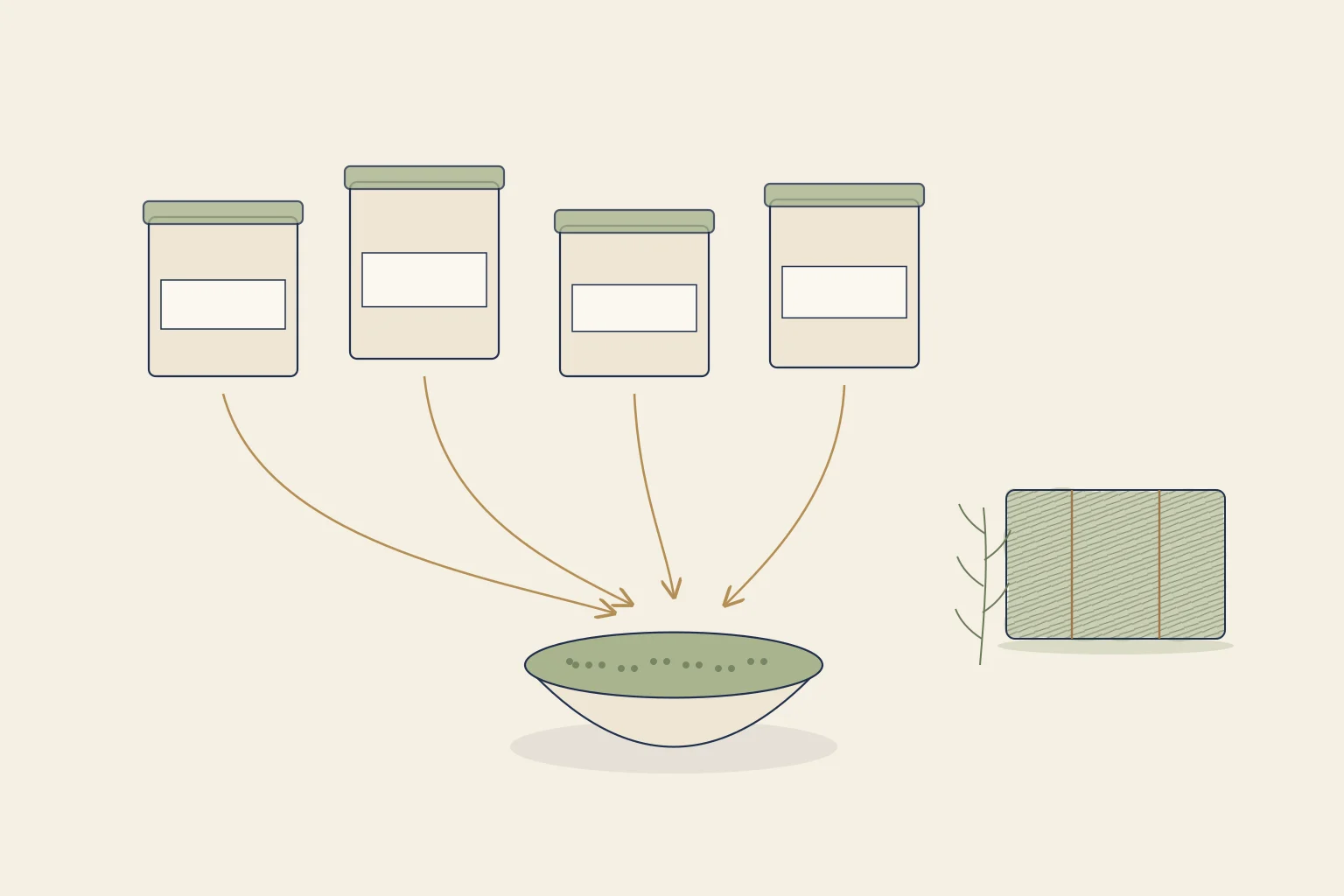
The short answer
Whether several supplements go together is shown by the total of their contributions. For each product, convert the declared contents using the actual daily amount, add hay and concentrates and compare the result with requirements 12. Trace elements contained in several products are particularly critical; the permitted maximum contents refer to the entire ration 3.
Why supplements overlap
Mineral feed, mineralised muesli, lick blocks and many specialist supplements contain the same trace elements. Each product is correctly declared in its own right; the maximum contents for additives, however, refer to the entire daily ration, including the natural contents of the forage 31.
If you feed several products, you therefore have to add up the contributions yourself. No pack says what the horse already gets from other sources 4.
Step 1: Take stock with real daily amounts
Write down every product your horse receives regularly, including lick blocks, herbs and treats in larger amounts. Weigh the daily amount rather than deriving it from the measuring scoop or the pack recommendation. The declaration lists additives and analytical constituents per kilogram 1.
- Product name and type (mineral feed, muesli, specialist supplement)
- Weighed daily amount in grams
- Declared contents per kg, especially trace elements
- How long and for what purpose it has been fed
Step 2: Add up contributions per nutrient
Multiply each declared content by the daily amount in kilograms and add up all products as well as hay and concentrates. You compare the total with your horse's requirements 2.
| Source | Content | Daily amount | Contribution per day |
|---|---|---|---|
| Mineral feed | 2,000 mg/kg | 50 g | 100 mg |
| Hoof supplement | 3,000 mg/kg | 30 g | 90 mg |
| Mineralised muesli | 150 mg/kg | 1 kg | 150 mg |
| Total from supplements | 340 mg plus zinc from hay |
Freely chosen example for zinc; not product declarations and not a dosage recommendation.
Where overlaps become critical
Selenium has a narrow range between requirement and excess; the permitted total content is 0.50 mg per kg of complete feed with 12% moisture 5. Chronic excess has been described with damage to the mane, tail and hooves 6.
Besides mineral feed, iodine also enters the ration via iodised salt and seaweed. Large amounts of dried seaweed have been linked to cases of goitre in mares and foals 78.
Forage usually provides plenty of iron; iron deficiency is rare in adult horses, and an additional iron source needs a specific justification 9.
What stays, what can go?
Go through each product with the same question: which calculated gap does it fill that no other feed already fills? A product without a clear purpose is a candidate for dropping; two products for the same gap can often be combined.
- Stays: fills a documented gap that would otherwise remain open.
- Check: overlaps with another product for the same substances.
- Can go: no calculated purpose, or only a promise of effect.
- Do not change on your own: products prescribed by a vet.
How do you change over sensibly?
Feed changes should be made gradually 10. Change one thing at a time where possible and note what you changed and when. That way you can later trace which change accompanied which observation.
When is a professional review worthwhile?
In metabolic diseases, recurrent colic, during growth, for sport horses in intensive training and for older horses, professional feeding advice is particularly useful. A warning sign is free advice that only ever recommends a particular product range 11.
Key takeaways
- Record every product with its weighed daily amount, not just the mineral feed 1.
- The same substances from different products add up 412.
- Selenium and iodine have the narrowest margin; seaweed can be a hidden source of iodine 78.
- Do not stop products prescribed by a vet on your own; discuss the calculation with the practice instead.
Frequently asked questions
Can I feed two mineral feeds at the same time?
It is not forbidden, but it is rarely necessary. Two complete mineral feeds provide many substances twice. Only the balance of both daily amounts, the hay and the other feeds shows whether the combination fits 43.
How do I notice oversupply?
Signs of oversupply are often non-specific and do not allow a remote diagnosis 13. The calculation is more reliable: it shows whether intake is above requirements or maximum contents. If you notice anything unusual in your horse, have it investigated by a vet.
Sources & studies
The content is based on the references listed below. It does not replace individual veterinary or feeding advice.
Show list of sources (13)
- Verordnung (EG) Nr. 767/2009Placing on the market and use of feed, labelling and claims; definitions of complete feed (Art. 3(2)(i)) and complementary feed (point (j)), content of feed additives (Art. 8), feeding instructions (Annex II No. 4). Link to the current EUR-Lex consolidated version (as of 26 December 2018).
- Bayerische Landesanstalt für Landwirtschaft (LfL): Gruber Tabelle zur PferdefütterungPractical reference table with requirement and feed values based on the GfE recommendations; the basis of many ration calculations in German-speaking countries. Chapter 9.3, Table 39: most common poisonous plants for horses with habitat, toxicity and risk level (after Kamphues et al. 2014)
- Verordnung (EG) Nr. 1831/2003Feed additives – authorisation and use; “daily ration” based on 12% moisture (Art. 2(2)(f)), renewal of authorisation and automatic continuation (Art. 14(4)), general conditions of use (Annex IV: natural plus added amount; complementary feed, diluted as specified, at most at the level for complete feed). Link to the current EUR-Lex consolidated version (as of 27 March 2021).
- Coenen M, Vervuert I (2020): Pferdefütterung. Begründet von H. Meyer. 6., aktualisierte Aufl., Georg Thieme Verlag, Stuttgart. ISBN 978-3-13-241778-6Standard reference work on equine nutrition in German-speaking countries; Table 4.17 mineral recommendations (recommended supply and minimum requirement), Table 4.18 derived sweat volumes per work level and weight class, Table 4.19 electrolyte performance requirement per sweat volume (in addition to maintenance requirement)
- Durchführungsverordnung (EU) 2019/49Authorisation of sodium selenite (3b801), coated granulated sodium selenite (3b802) and zinc-L-selenomethionine (3b818) for all animal species; total maximum content of selenium 0.50 mg/kg complete feed (12% moisture), for 3b818 at most 0.2 mg/kg of added organic selenium. Authorisation expires according to the Annex on 3 February 2029.
- Merck Veterinary Manual: Selenium Toxicosis in AnimalsStandard veterinary reference work (toxicology): chronic selenosis/alkali disease with hair loss and breakage in the mane, tail and neck, plus coronary band swelling, separation of the hoof wall and horizontal hoof cracks; notes that the neurological disease “blind staggers” historically attributed to selenium is more likely polioencephalomalacia due to high sulphur intake. The horse-specific acute single dose is documented by the primary study Miller and Williams (1940).
- Merck Veterinary Manual: Nutritional Requirements of Horses and Other EquidsSummary of the NRC recommendations: water requirement 5 litres per 100 kg body mass per day at maintenance, sweat losses of around 3.1 g sodium, 5.3 g chloride and 1.6 g potassium per litre, salt recommendation 1.6–1.8 g per kg feed dry matter at a maximum of 6% of the ration; from a 50% forage share potassium is adequately covered. Also covers the selenium requirement (0.1 mg/kg feed dry matter or at least 1 mg/day for a 500 kg horse, selenium as a component of glutathione peroxidase together with vitamin E) and the strong location-dependent variation of selenium in forage (grass forage on average 0.194 ppm, range 0–1.2 ppm); some regions are markedly low in selenium and may need supplementation. Also gives the iodine requirement (0.35 mg/kg feed dry matter, mares in late pregnancy 0.4), iodine poisoning of pregnant mares from around 40 mg/day, documented goitre cases in mares and their foals associated with large amounts of dried seaweed (kelp), that iodised salt easily covers the requirement, and that iodine supplementation is usually unnecessary except in severely iodine-deficient regions
- Merck Veterinary Manual: Goiter in AnimalsStandard veterinary reference work (endocrinology): goitre (struma) occurs both with iodine deficiency (low hormone levels → increased TSH → hyperplasia) and with iodine excess (high iodine concentrations inhibit organification and hormone release); the foetal thyroid reacts more sensitively than the adult one; foals receive excess iodine in the womb and via milk, because mares on an iodine-rich ration secrete more iodine into their milk; mineral supplements containing kelp are a common source of iodine excess; goitrogenic plants (cabbage, rapeseed, kale, turnips, soya) can promote goitre. Goitre is therefore not a clear indicator of iodine supply.
- Merck Veterinary Manual: Nutritional Diseases of Horses (Eisen)Iron deficiency is rare in adult horses; forage practically always supplies plenty of iron, and supplementation is only indicated where there is a specific reason
- Liburt NR (2026): Feeding Practices in Horses and Other Equids. Merck Veterinary ManualSpecialist overview, as of February 2026: forage basis, concentrates as required, bran/mash and Ca:P balance, gradual feed changes. No efficacy study on commercial mash products.
- Go4Vet: Futterberatung fürs Pferd – Ablauf, Kosten & NutzenGuide from a veterinary platform: “Futterberater” (feed adviser) is not a protected professional title in Germany and Austria; advice is particularly useful for metabolic disorders (EMS, Cushing's), recurrent colic, during growth, for sport horses in intensive training and for older horses; a warning sign is free advice that only recommends a particular product range
- NRC – Nutrient Requirements of Horses, 6th ed.International reference for the nutrient requirements of horses (National Research Council)
- Liburt NR (2026): Nutritional Diseases of Horses and Other Equids. Merck Veterinary ManualSpecialist overview, as of February 2026: energy surplus, non-specific signs of deficiency and risks of oversupplementation; no basis for a remote diagnosis.