

This article has not yet been professionally approved. The information is based on the sources listed below.
Haylage for horses: benefits, risks and the right amount
How haylage differs from hay and silage, what to look out for regarding hygiene and opened bales, and how to convert the amount into your ration via dry matter.
The short answer
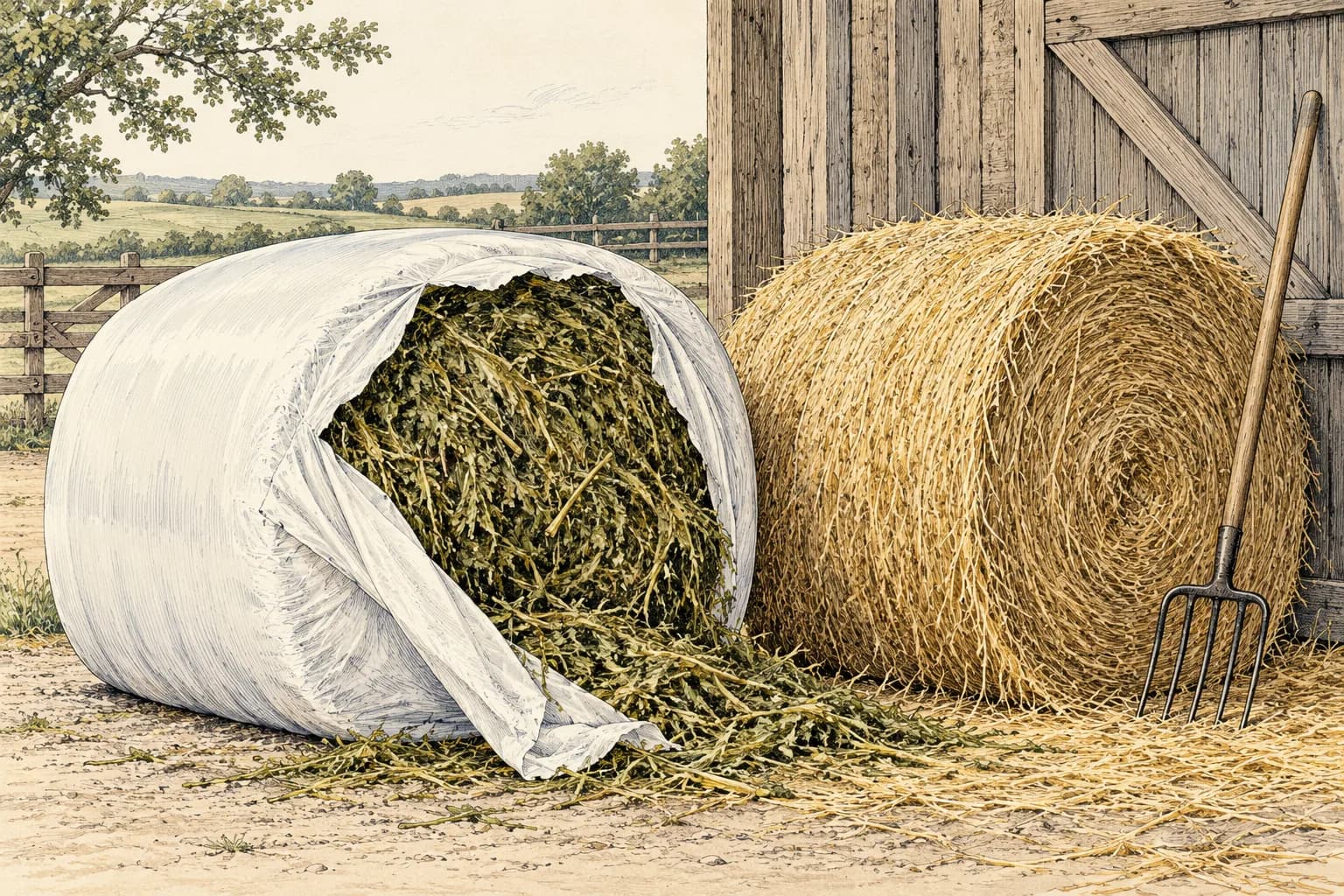
Haylage is wilted grass wrapped airtight in film, with about 50–70% dry matter, placing it between hay and silage. It is very low in dust 1. Hygiene is what matters: mould, soil, carcass remains or poor fermentation make haylage risky, up to and including botulism 234. Because haylage contains more water, you convert the amount via dry matter.
What is the difference between hay, haylage and silage?
The most important difference is the water content. As a guide, the LfL (Bavarian State Research Center for Agriculture) gives around 860 g of dry matter per kg for hay, 500–700 g for haylage and 300–400 g for grass silage. Haylage is wilted and preserved airtight; the low moisture slows fermentation 12. That is why its pH value may be higher than that of silage 1.
The specialist literature draws the boundaries slightly differently: there, feed below 500 g of dry matter per kg counts as silage, and above that up to 840 g as haylage. Silage contains more fermentation products such as lactic acid and is more acidic 2. According to the LfL, grass silage should not be the only forage for horses 1.
| Forage | Dry matter per kg | pH guide | Preservation |
|---|---|---|---|
| Hay | approx. 860 g | – | Drying |
| Haylage | 500–700 g | below 5.0 | wilted, wrapped, weak fermentation |
| Grass silage | 300–400 g | 4.0–4.8 | stronger lactic acid fermentation |
Guide values from the LfL (Gruber Table). Individual batches can differ considerably.
What are the benefits of haylage?
The most frequently cited benefit is the low dust content. The LfL describes haylage as very low in dust and therefore names it as a low-dust alternative 1. In a study summarised in a doctoral thesis, even hay that looked good contained more respirable particles than haylage or silage 3. Whether and how a horse with a cough should be fed is something to clarify with your vet.
For digestion in healthy horses, research has so far found no fundamental difference: in a trial, hay, haylage and silage from the same cut led to a similar microbial and chemical composition in the hindgut and droppings 32. So the cut, cutting date and hygiene matter more than the method of preservation.
Which hygiene risks do you need to know about?
With haylage, hygiene is the crux. Mould spores can burden the airways, mycotoxins can cause poisoning, and Clostridium botulinum can be fatal through its toxin 2. The bacterium can get into the feed via soil or animal carcasses 4.
How large the botulism risk is, is assessed differently. A US specialist reference generally advises against very moist haylage and silage with 50% moisture or more 5. A Swedish doctoral thesis, by contrast, found no clear link with silage as such; the cases described involved poorly fermented feed with a high pH value or carcass remains 3. Both agree: spoiled feed does not belong in the hay rack.
Butyric acid is an indication of poor fermentation and clostridial activity. The LfL advises not feeding silage with a high butyric acid content 1.
- Have bales wrapped in several layers; the LfL gives 8-fold wrapping 1.
- Tape holes in the film immediately; protect bales stored outdoors from birds with nets 1.
- Store round bales on their flat ends and stack them no more than two high 1.
- Do not feed anything containing soil, carcass remains, mould or a putrid smell.
How do you handle an opened bale?
As soon as air reaches the haylage, yeasts and moulds can grow. Haylage can heat up quickly after opening 3. Particularly in small yards, a large bale is often used too slowly; there are hardly any robust studies on how long opened bales keep 2.
The LfL advises using opened bales quickly. Haylage with over 60% dry matter should be shaken out before feeding and not covered with film, while feed with about 50% dry matter is better kept compact. Mouldy bales should be discarded entirely 1. A Swiss advisory service gives 2 days after opening as a guide, at most 5 days in winter 4.
- Choose a bale size that suits the number of horses and the daily amount.
- Write the opening date on the bale.
- Smell and feel before every feed: warm, musty or visibly mouldy means do not feed.
How do you convert haylage into the ration?
You compare nutrients and amounts on a dry matter basis. A freely chosen worked example, not a feeding recommendation: 10 kg of hay with 86% dry matter provides 8.6 kg of dry matter. For the same dry matter from haylage with 60% dry matter, you need 8.6 ÷ 0.6 = around 14.3 kg as-fed. Simply replacing 10 kg of hay with 10 kg of haylage means feeding less feed 1.
The dry matter content varies widely. In a Swedish-Norwegian study, the wrapped bales fed ranged from 179 to 951 g of dry matter per kg 7. A table value therefore does not replace a measured value for your batch. Also calculate nutrients such as energy, protein and minerals only with values on the same reference basis 1.
How do you switch to haylage – and what about free faecal water?
A changeover takes time. The LfL recommends blending feeds and introducing new feeds over about one to two weeks 1. A Swiss advisory service advises increasing the amount of haylage slowly over several weeks 4. A new bale from a different batch can also have a different composition, for example due to a different cutting date 7.
On free faecal water: in a survey, 58% of owners of affected horses reported less free faecal water after switching from wrapped bales to hay. These are owner reports without a control group 8. In a case-control study, affected and unaffected horses ate the same haylage; the researcher therefore does not consider wrapped bales to be a general cause 7.
- Mix hay and haylage at first and increase the proportion of haylage gradually.
- Record amounts during the changeover both as-fed and as dry matter.
- Observe droppings, eating behaviour and feed leftovers and note them with the date.
What does a haylage analysis show?
The haylage nutrient package of LUFA Nord-West (a German agricultural testing laboratory) includes, among other things, dry matter, metabolisable energy, crude protein, prececal digestible crude protein, fibre fractions, sugar, fructan and the pH value. Fermentation quality with lactic, acetic and butyric acid is a separate additional test. Microbial counts and clostridia, including detection of Clostridium botulinum, are also ordered separately. A hygiene sample only makes sense after 10–12 weeks of storage 9.
As with hay, the sample should come from several bales and layers, not just material from the outside. Haylage is sent in a plastic bag from which you press out the air 910. A sensory check also helps: according to the LfL, good haylage is light green to green and smells aromatic, slightly sour and bready 1.
Key takeaways
- Compare hay and haylage on a dry matter basis: the same fresh weight is not the same amount of feed 1.
- Hygiene is decisive: intact film, no soil, no mould and quick use after opening 12.
- An analysis with dry matter and, if needed, fermentation quality and microbial counts replaces estimates with measured values for your batch 9.
Frequently asked questions
How much haylage instead of hay?
Enough to keep the dry matter the same. A freely chosen worked example: 10 kg of hay with 86% dry matter provides 8.6 kg of dry matter. With haylage at 60% dry matter, you need around 14.3 kg as-fed for this. Use the measured value of your batch for your calculation, because the dry matter of haylage varies widely 17.
How long does an opened haylage bale keep?
No generally valid time limit is documented; there is hardly any research on it 2. The LfL advises using opened bales quickly 1. A Swiss advisory service gives 2 days as a guide, at most 5 days in winter 4. If the feed smells or feels warm, musty or mouldy, do not feed it.
Is haylage dangerous because of botulism?
The risk depends on feed hygiene. A US specialist reference generally advises against very moist haylage and silage because of botulism 5. A Swedish doctoral thesis found no clear link with silage as such in the literature; the cases described involved poorly fermented feed or carcass remains 3.
Sources & studies
The content is based on the references listed below. It does not replace individual veterinary or feeding advice.
Show list of sources (10)
- Bayerische Landesanstalt für Landwirtschaft (LfL): Gruber Tabelle zur PferdefütterungPractical reference table with requirement and feed values based on the GfE recommendations; the basis of many ration calculations in German-speaking countries. Chapter 9.3, Table 39: most common poisonous plants for horses with habitat, toxicity and risk level (after Kamphues et al. 2014)
- Müller CE (2018): Silage and haylage for horses. Grass and Forage Science 73(4):815–827Review (SLU Uppsala), abstract checked on 30 September 2026: silage < 500 g DM/kg, haylage > 500–840 g DM/kg; silage with more fermentation products and lower pH. Differences between silage, haylage and hay have not so far been shown to affect digestion and hindgut function differently. Hardly any studies on the shelf life of opened bales. High hygienic quality is crucial because of mould spores, mycotoxins, Clostridium botulinum and Listeria.
- Müller CE (2007): Wrapped forages for horses. Doctoral thesis, Acta Universitatis Agriculturae Sueciae 2007:44, SLU Uppsala. ISBN 978-91-576-7343-5Checked on 30 September 2026. p. 3: hay, haylage and silage from the same cut with no difference in microbial and chemical composition in the large intestine and faeces (fistulated horses, 21 days). pp. 11–12: even hay that looked good contained more respirable particles than haylage or silage (after Vandenput et al. 1997). pp. 14–15: C. botulinum rare in silage; no clear link between silage feeding and botulism evident in the literature; cases involving silage concerned poorly fermented feed with a high pH or carcass remains. p. 30: haylage can heat up quickly after opening.
- Achermann L: Mythos oder Fakt? Heulage für Pferde. Landwirtschaftliches Zentrum Liebegg (Kanton Aargau)Advisory article without a date, checked on 30 September 2026: feed opened haylage bales within 2 days, in winter within a maximum of 5 days; Clostridium botulinum can enter feed via soil contamination or carcasses; increase the amount of haylage slowly over several weeks when changing over. Practical recommendation, not a study.
- Liburt NR (2026): Feeding Practices in Horses and Other Equids. Merck Veterinary ManualSpecialist overview, as of February 2026: forage basis, concentrates as required, bran/mash and Ca:P balance, gradual feed changes. No efficacy study on commercial mash products.
- Stämpfli HR (2026): Botulism in Horses. Merck Veterinary Manual, Horse OwnersSpecialist overview, as of July 2026, checked on 30 September 2026: the pathogen multiplies in, among other things, rotting plant material such as grass, hay, grain or spoiled silage; signs are progressive paralysis, difficulty chewing and swallowing, and general weakness; death usually from paralysis of breathing or the heart.
- Lindroth K (2021): Free faecal liquid in horses – Faecal composition and associations with feeding and management. Doctoral Thesis No. 2020:65, Acta Universitatis agriculturae Sueciae, SLU Uppsala. ISBN 978-91-7760-649-9Checked on 30 September 2026. pp. 17–18: definition (solid faeces and free fluid), skin irritation; clinically usually without fever, dehydration or weight loss. pp. 24–26: suspected factors not yet systematically demonstrated; dental and parasite findings without difference. pp. 29–30: pro- and prebiotics with moderate, temporary or no success. pp. 45–46: DM of the wrapped bales fed 179–951 g/kg. pp. 48–50: wrapped bales as such unlikely to be a general cause; only half of the owners had a feed analysis; analysis and ration calculation as the first step. p. 55: causes still unknown.
- Lindroth KM, Johansen A, Båverud V, Dicksved J, Lindberg JE, Müller CE (2020): Differential Defecation of Solid and Liquid Phases in Horses – A Descriptive Survey. Animals 10(1):76Web-based survey in Sweden and Norway with 339 horses with free faecal water, mostly fed wrapped bales (haylage/silage). Owner reports: less free faecal water after switching from wrapped bales to hay 58% (n = 197), to pasture 46% (n = 156), after changing the feed batch 17% (n = 58); previous colic 23%. No control group, no causal conclusion. Abstract checked on 30 September 2026.
- LUFA Nord-West: Untersuchungsauftrag Pferdefutter 2026/27p. 1: analysis packages and prices per sample plus VAT; p. 2: scope of analysis, sample quantities and shipping. Prices for 2026/27, checked on 28 September 2026; not an Equivora offer.
- LUFA Nord-West: Probenahme Pferdefutter – Wie gehe ich korrekt vor?Laboratory instructions: representative samples from several bales and layers, identical labelling of sample and order. Checked online on 28 September 2026.