

This article has not yet been professionally approved. The information is based on the sources listed below.
Forage – the foundation
Horses are designed for continuous fibre intake. Chewing produces saliva – the most important buffer for the stomach. Good hay is often more important than any supplement.
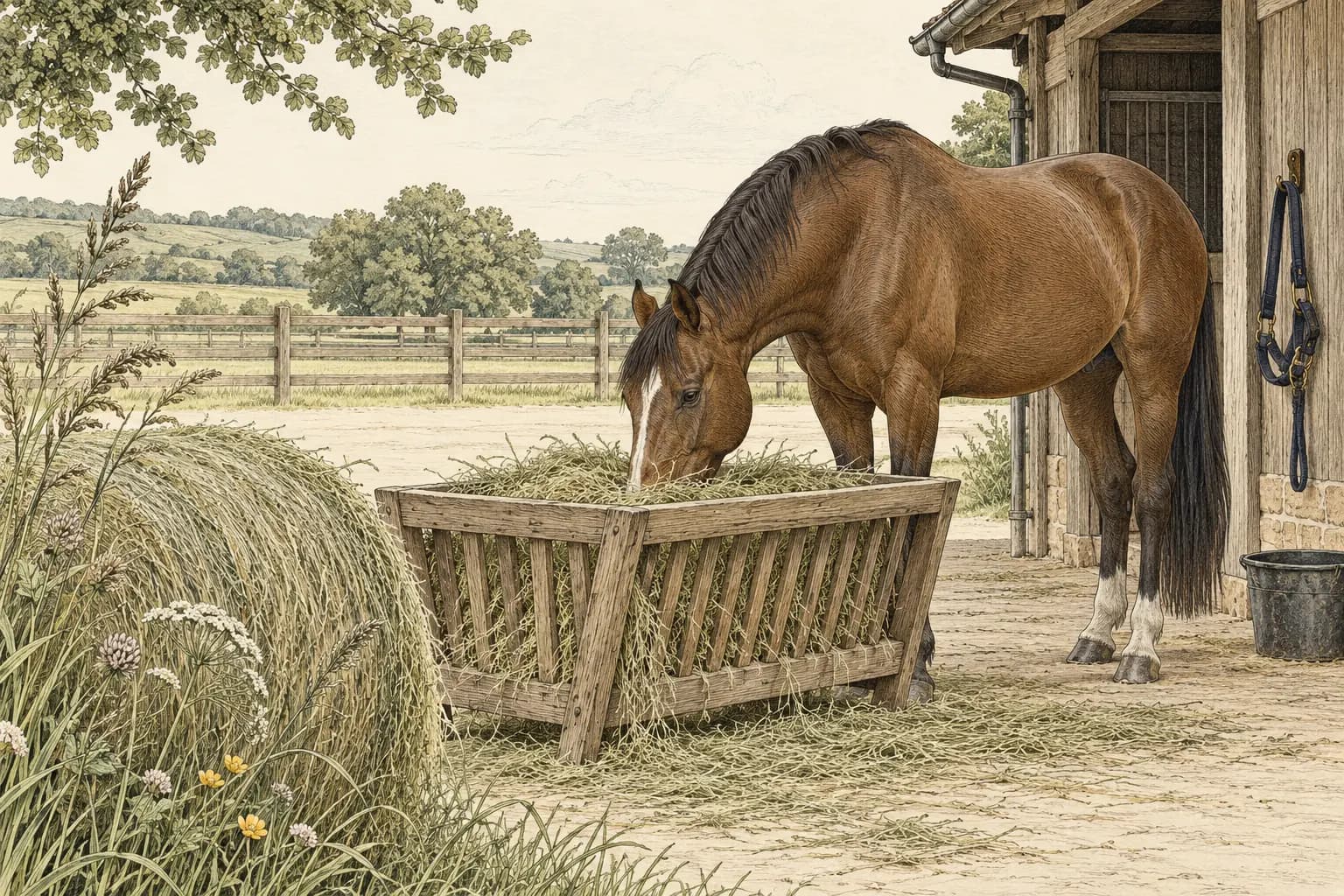
Horses are trickle feeders: their digestive system is designed for an almost continuous intake of fibre-rich feed. Forage such as hay, grass or haylage forms the basis of the ration 1.
What matters is not only the amount but also chewing activity: saliva contains bicarbonate and is the body’s most important stomach buffer. It is only produced during chewing – and hay requires considerably more chewing movements than concentrates 12.
Chewing strokes and chewing time per kg of feed. The values come from a study with eight Haflinger horses.
Why long breaks between meals are a problem
If the proportion of forage falls below the recommended minimum, structured crude fibre is lacking. Saliva secretion drops sharply and the continuously produced stomach acid is less well neutralised – this promotes gastric ulcers and stereotypic behaviours 1.
- Good hay is often more important than any complementary feed product.
- The quantity and quality of forage affect weight, digestion and mineral supply.
- With overweight, “feeding less” is not enough: look at eating times, energy content and pasture access together.
Sources & studies
The content is based on the references listed below. It does not replace individual veterinary or feeding advice.
Show list of sources (4)
- Coenen M, Vervuert I (2020): Pferdefütterung. Begründet von H. Meyer. 6., aktualisierte Aufl., Georg Thieme Verlag, Stuttgart. ISBN 978-3-13-241778-6Standard reference work on equine nutrition in German-speaking countries; Table 4.17 mineral recommendations (recommended supply and minimum requirement), Table 4.18 derived sweat volumes per work level and weight class, Table 4.19 electrolyte performance requirement per sweat volume (in addition to maintenance requirement)
- Agroscope (2017): Was leisten Ergänzungsfuttermittel für die Kautätigkeit von Pferden? Agrarforschung SchweizComparison of chewing strokes and chewing time for hay versus complementary feed and concentrates
- GfE (2014) – Empfehlungen zur Energie- und Nährstoffversorgung von PferdenSpecialist reference in German-speaking countries (GfE, German Society of Nutrition Physiology), Committee for Requirement Standards
- NRC – Nutrient Requirements of Horses, 6th ed.International reference for the nutrient requirements of horses (National Research Council)