

This article has not yet been professionally approved. The information is based on the sources listed below.
Hay cubes for horses: soaking, quantity and ration
How to prepare hay cubes safely, record their dry starting quantity and clarify which part of the current feeding they are meant to replace.
The short answer
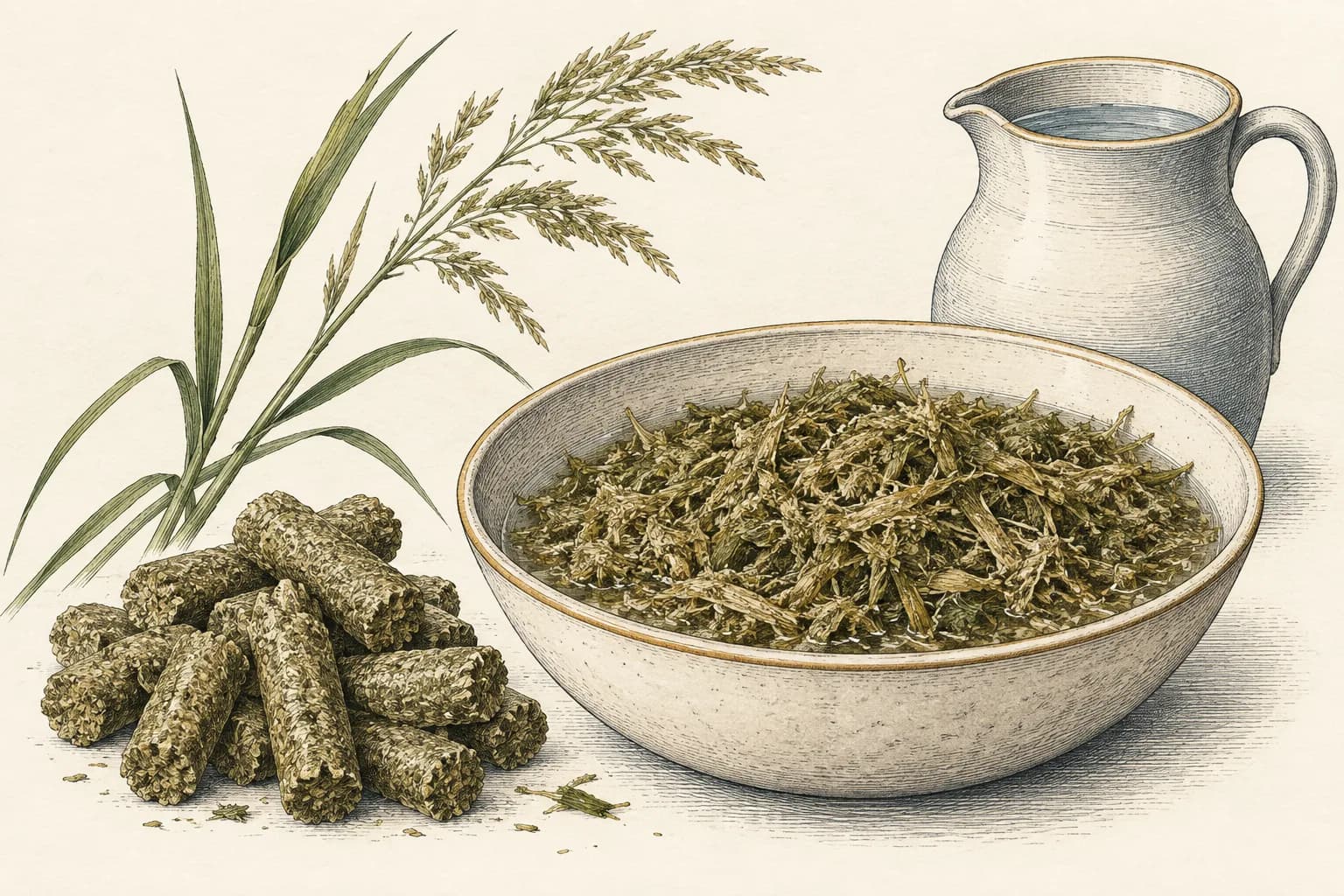
Hay cubes can be a forage component, for example if a horse has difficulty chewing long hay. For such horses, the specialist overview describes soaked forage cubes as a possible alternative 1. How much is appropriate depends on the rest of the ration. Weigh the cubes before soaking and follow the preparation instructions for the specific product 2.
When are hay cubes a relevant question?
Forage cubes are a topic especially when eating long hay causes difficulties. The animal nutrition overview names horses that chew poorly as a possible target group. The reason for the chewing problems and the suitability of the alternative must be clarified 1.
- Note which problem you want to solve with the change.
- Record whether hay is to be replaced or the existing amount supplemented.
- With dental or swallowing problems: first discuss the findings and the suitable consistency with your vet.
How do you prepare the cubes?
Read the instructions before the first batch. AGROBS recommends always soaking its Wiesencobs (meadow grass cubes) and states 1.5–3 litres of water per kg. According to the manufacturer, warm water shortens the soaking time; the actual duration also depends on how tightly they are pressed. These manufacturer details describe the preparation of this product, not superiority over other feeds 2.
- Portion the dry cubes using scales.
- Use a clean container and add water according to the product instructions.
- Allow them to swell sufficiently and check for remaining hard pieces before feeding.
- Only offer fresh, hygienically sound portions and remove leftovers 1.
Why does the quantity before soaking count?
A worked example for documentation, not a feeding dose: you weigh out 500 g of cubes. Under the manufacturer's instructions mentioned, 0.75–1.5 litres of water would be used for this. The filled bucket then weighs considerably more but still contains the nutrients of the 500 g of starting feed. Your feeding log therefore lists the quantity of cubes and the water separately 2.
The dry starting quantity is not automatically the analytical dry matter: dry feed also contains residual moisture. To compare with hay or haylage, you need the same reference basis and the matching analysis values. A kilogram of wet mash is not a usable unit of comparison for a hay bale 3.
Do the cubes replace hay or are they added?
Go through both options explicitly: how much hay is dropped, how many cubes are added, and what is actually eaten? For the ration assessment, the nutrient contributions of all components are combined. Changes in forage can therefore also alter the mineral and protein balance 3.
- Record hay, haylage, pasture and cubes separately.
- Use current product values instead of an arbitrary average for all grass cubes.
- Mark unknown intake and missing analysis values.
- After a change, also check the current mineral feed.
What needs to be clarified when hay is completely replaced?
The forage supply and the distribution of feed intake belong together. The gastric guideline explicitly treats forage quantity and gaps between meals as different aspects. A large soaked portion therefore does not yet answer the question of how the horse is supplied over the rest of the day 4.
- Discuss suitable portions and feeding intervals with your feeding adviser.
- Document leftovers and actual intake.
- If complete hay replacement is necessary, or with dental problems or weight loss, the change should be made with specialist support.
Key takeaways
Frequently asked questions
How long do hay cubes need to soak?
Follow the instructions on the pack and check the consistency. The manufacturer in our preparation example states roughly 20–30 minutes; more tightly pressed cubes take longer. This is not a universal time for all products 2.
Can I feed hay cubes without soaking?
The manufacturer in our preparation example recommends always soaking its cubes 2. What counts is the feeding recommendation for your product. If it does not explicitly allow dry feeding, soak the cubes and, if in doubt, ask the manufacturer.
How many hay cubes does my horse need each day?
First establish whether they replace hay or are fed in addition, how much other forage is eaten and what the horse's requirement is. The quantity planning follows from this; a general daily dose cannot be derived from the name hay cubes 3.
Are hay cubes the same as mash?
No. Forage cubes and mixes for a moist meal can have different compositions. Compare ingredients and declarations rather than concluding from the soaked consistency that the nutrients are identical 1.
Sources & studies
The content is based on the references listed below. It does not replace individual veterinary or feeding advice.
Show list of sources (4)
- Liburt NR (2026): Feeding Practices in Horses and Other Equids. Merck Veterinary ManualSpecialist overview, as of February 2026: forage basis, concentrates as required, bran/mash and Ca:P balance, gradual feed changes. No efficacy study on commercial mash products.
- AGROBS: Fragen und Antworten zur Zubereitung von Pre Alpin WiesencobsManufacturer's instructions, checked on 29 September 2026: always soak, 1.5–3 litres of water per kg of cubes; time and consistency depend on the product and water temperature. Only evidence of preparation, not an independent assessment of efficacy or quality.
- Bayerische Landesanstalt für Landwirtschaft (LfL): Gruber Tabelle zur PferdefütterungPractical reference table with requirement and feed values based on the GfE recommendations; the basis of many ration calculations in German-speaking countries. Chapter 9.3, Table 39: most common poisonous plants for horses with habitat, toxicity and risk level (after Kamphues et al. 2014)
- Sykes BW, Hewetson M, Hepburn RJ, Luthersson N, Tamzali Y (2015): European College of Equine Internal Medicine Consensus Statement – Equine Gastric Ulcer Syndrome in Adult Horses. Journal of Veterinary Internal Medicine 29(5):1288–1299European specialist guideline: minimum of 1.5 kg forage dry matter per 100 kg body weight per day, avoid breaks in feeding of more than 6 hours, starch below 2 g/kg BW/day and below 1 g/kg BW/meal; gastroscopy as the only reliable diagnosis in the living horse; oral antacids act for ≤ 2 hours