

This article has not yet been professionally approved. The information is based on the sources listed below.
Laminitis in horses: recognise the emergency, adjust feeding
How to recognise a laminitis emergency, why insulin plays a role in most cases and how hay values, soaking, weight and grazing fit into a feeding plan supervised by your vet.
The short answer
Laminitis is an emergency: if you suspect it, a vet needs to see the horse immediately 1. Most cases are linked to raised insulin, which rises mainly due to sugar, fructan and starch from feed and pasture 2. Feeding therefore relies on low-NSC hay, no cereals, no treats, limited grazing and a balanced mineral supply, agreed with your vet.
How do you recognise a laminitis emergency?
Acute laminitis is a medical emergency because the pedal bone can shift quickly. If you suspect it, you should call your vet immediately 1. A typical sign is a stance in which the horse shifts its weight onto the hindquarters and places its front legs forward. This is often accompanied by a bounding digital pulse at the fetlock and warm hooves 3.
Laminitis can also develop gradually, without lameness being noticeable straight away. The guideline therefore recommends radiographs to detect changes in the hoof, even if the horse is not lame 2.
- The horse is reluctant to move or tries to take weight off the affected hooves 1.
- It shifts its weight onto the hindquarters and places its front legs forward 3.
- The hooves are warm and the pulse at the fetlock is clearly palpable 3.
- The horse seems dull or eats less 1.
- The signs appear after colic, intestinal inflammation, an infection or, in a mare, after retained placenta. These are also known triggers 1.
Why does insulin play such a big role in laminitis?
According to the expert group, insulin-associated laminitis is the most common form in horses and ponies, accounting for over 90% of cases. The term replaces the older names pasture-associated laminitis and endocrinopathic laminitis. It can begin unnoticed and often becomes chronic with recurring episodes 2. The veterinary reference overview also names endocrine disorders as the probably most common underlying cause 3.
Non-structural carbohydrates (NSC), i.e. sugar, fructan and starch, are the most important trigger of insulin release. A ration rich in NSC is considered a risk factor for insulin dysregulation and insulin-associated laminitis regardless of predisposition 2. Overweight increases the risk but is absent in some affected horses; testing is therefore not limited to fat horses 2.
Other forms have other triggers, such as too much cereal, severe infections or overloading of one leg when the other is injured 3. PPID is also one of the risk factors: about 30% of PPID horses have insulin dysregulation, and horses over ten years of age should be tested for both 2.
What do sugar, fructan and starch in hay mean for a laminitic horse?
For horses with insulin dysregulation, the guidelines recommend hay with less than 10% NSC 24. NSC is the sum of water-soluble carbohydrates and starch. An NFC value calculated by difference is not a substitute 2. In the laboratory order form reviewed, the hay nutrient package includes sugar and fructan; starch is ordered as an extra 5.
Even suitable hay is no guarantee: some severely affected horses show an excessive insulin response even at less than 10% NSC 2. Whether the ration suits your horse is therefore shown by veterinary follow-up checks, not by the lab value alone.
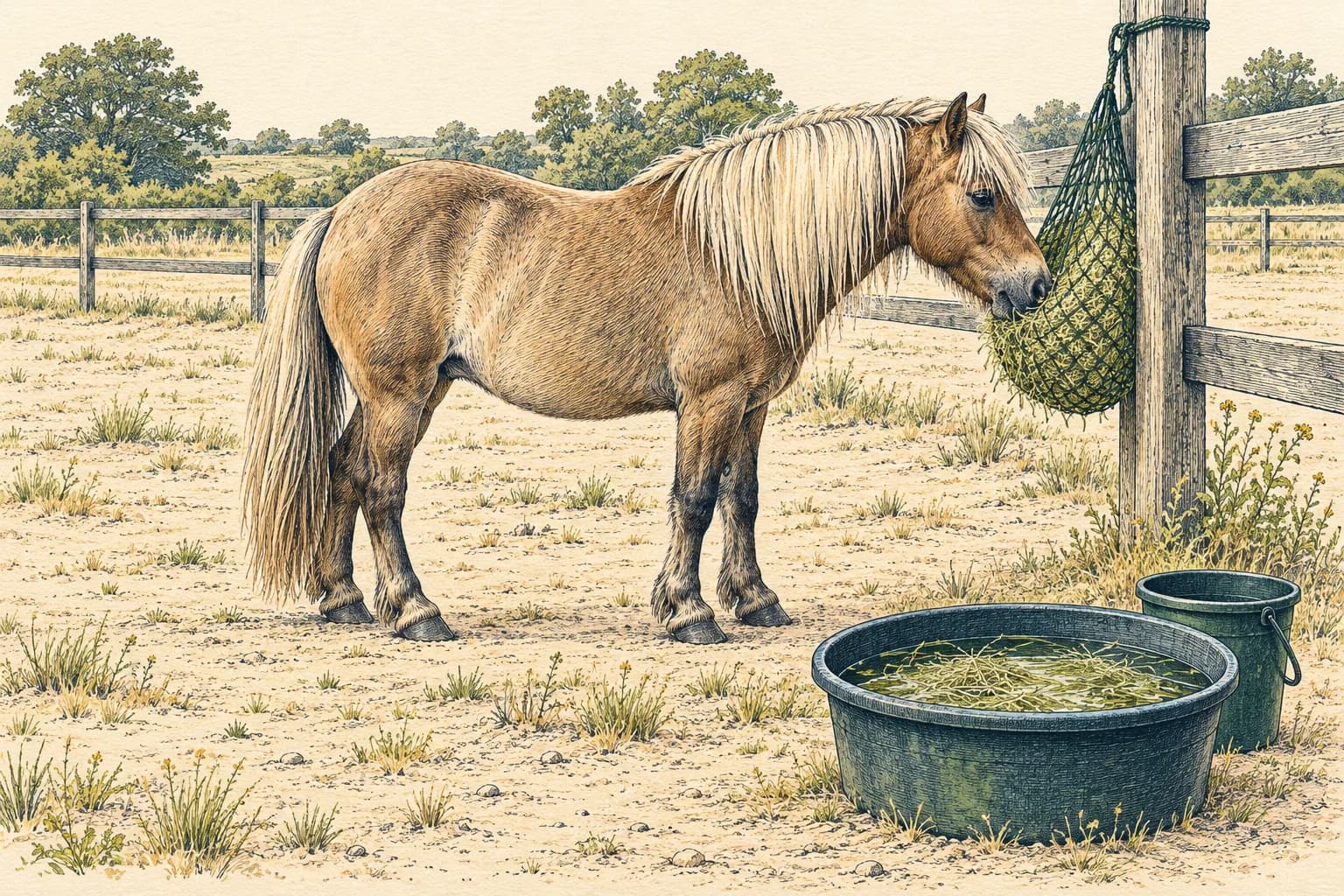
Further points from the guideline: offer forage via slow feeders such as a small-mesh hay net or in several small portions so that there are no long gaps between meals. High-quality straw can replace part of the hay but must be introduced over at least two weeks, while watching droppings and signs of colic 2.
What does soaking hay achieve – and where are its limits?
The guideline recommends soaking hay for at least 60 minutes in cold water if it contains more than 10% NSC or has not been analysed 2. How much sugar is actually lost varies widely: in a study with soaking times of up to 16 hours at about 8 °C, water-soluble carbohydrates fell by an average of 27%, within a range of 6 to 54%. Seven of the hays tested were still above 100 g per kg dry matter afterwards 6.
Soaking has side effects on the ration. With longer soaking, phosphorus, potassium and magnesium fell considerably; after twelve hours, phosphorus needed to be balanced, whereas 15 to 60 minutes did not lead to a calculated deficiency for a 500 kg horse in light work in the study 7. Long soaking in warm surroundings also raises concerns about microbial growth; under warm conditions, the EMS consensus advises 1 to 2 hours 4. Steaming does not change the sugar content to any meaningful extent 8.
| Method | What studies show | Limitation |
|---|---|---|
| Soaking, long (up to 16 h, cold) | Water-soluble carbohydrates −27% on average, range 6–54% 6 | Result unpredictable; several hays stayed above 100 g/kg DM 6 |
| Soaking, short (15–60 min) | Lower mineral losses than with long soaking 7 | Sugar reduction varies from hay to hay; analysis is still needed 2 |
| Steaming | Mainly a hygiene effect, sugar barely changed 8 | No substitute for low-NSC hay |
Study results cannot be applied to every hay; the analysis of your batch remains the basis.
How do you deal with overweight without starving the horse?
Overweight is not the same as EMS, but it is considered an aggravating factor for insulin dysregulation 42. For overweight horses with insulin dysregulation, the guideline names as the starting point for weight loss low-NSC hay in an amount of 1.5% of current body weight as dry matter. Weight is checked every 30 days and the amount is only reduced gradually, down to a lower limit, if no weight is lost. Stress should be avoided as far as possible because of the risk of hyperlipaemia 2.
A freely chosen worked example of the reference basis, not a recommendation for your horse: 1.5% of 500 kg is 7.5 kg dry matter. If the hay has 85% dry matter, this corresponds to just under 8.8 kg of hay as fed 9. Rules of thumb that give a percentage of body weight without a reference basis are therefore imprecise. Have your vet determine the amount and pace.
Exercise helps with overweight and insulin sensitivity, but only without acute laminitis. After laminitis, workload is only built up again once the hoof is stable and while watching for lameness 2. As insulin values can be higher in winter, the guideline advises avoiding overfeeding and NSC-rich supplements especially then 2.
When can a horse go back out on pasture after laminitis?
At first, the guideline recommends severely restricting grazing, for example on a small paddock with little grass and with companions, or doing without it entirely in cases of severe insulin dysregulation 2. Whether and how much grazing is possible again is only decided once the signs of laminitis have subsided, on the basis of an insulin test after about two hours of grazing. This is followed by gradual reintroduction with a grazing muzzle, paddock track or similar systems. If laminitis recurs, grazing is stopped 2.
Grass is not a constant: its sugar and protein content varies with temperature, sunlight, rainfall and fertilisation 2. Horses eat faster when grazing time is short 10, and the effect of a grazing muzzle differed greatly between two studies 1112. Short grazing times are therefore not reliable protection.
How do you keep the mineral supply covered with restrictive feeding?
If you limit the amount of hay or soak hay, you also change nutrient intake. Forage can be low in protein, and soaking washes out minerals and vitamins. These nutrients should be balanced in a targeted way 4. The guideline names a low-sugar mineral, vitamin and protein supplement for this 2.
More is not automatically better. For magnesium and chromium, the EMS consensus describes isolated indications of improved insulin regulation that other studies have not confirmed 4. So calculate the total ration from hay analysis, hay amount and all supplements against requirements instead of adding another product across the board 9.
- Note the hay analysis of the batch being fed and the daily hay amount.
- State whether and for how long hay is soaked.
- Record all supplements with their declaration and daily amount.
- Discuss calculated gaps and possible double supply with a specialist.
Key takeaways
Frequently asked questions
Is laminitis an emergency?
Yes. Acute laminitis is considered a medical emergency because the pedal bone can shift quickly. If you suspect it, you should contact your vet immediately 1.
What can a horse with laminitis eat?
For the most common, insulin-associated form, the specialist guideline names as the basis hay with less than 10% NSC, no cereals and no treats, severely limited or no grazing and a low-sugar supplement of minerals, vitamins and protein 2. You decide on amounts and routine together with your vet.
How long do I need to soak hay for a laminitic horse?
For insulin-associated laminitis, the guideline recommends at least 60 minutes in cold water if the hay has more than 10% NSC or has not been analysed 2. Long soaking in warm surroundings raises concerns about microbial growth 4, and longer soaking washes out more minerals 7.
When can a horse go back out on pasture after laminitis?
According to the guideline, only once the signs of laminitis have subsided, and on the basis of an insulin test after grazing. Access to pasture is then reintroduced gradually and in limited amounts, for example with a grazing muzzle 2.
Sources & studies
The content is based on the references listed below. It does not replace individual veterinary or feeding advice.
Show list of sources (12)
- Belknap JK (2019, aktualisiert 2024): Disorders of the Foot in Horses – Laminitis. Merck Veterinary Manual (Horse Owners)Owner information, checked on 30 September 2026: acute laminitis is a medical emergency because the pedal bone can displace rapidly; contact a vet immediately if suspected. Triggers include too much grain, lush pasture (especially ponies and overweight horses), infections, retained placenta, colitis, colic, corticosteroids; signs include reluctance to move, weight shifting, warm hoof; prognosis guarded.
- Bertin FR, Bailey S, Burns T, de Laat M, Durham A, Frank N, Kritchevsky J, Menzies-Gow N (Equine Endocrinology Group, 2024): Recommendations for the Diagnosis and Management of Equine Metabolic Syndrome (EMS) and Insulin Dysregulation. Revised June 2024Veterinary expert recommendation, checked on 30 September 2026. Table 1: HAL is by far the most common form of laminitis at over 90%; NSC = water-soluble carbohydrates plus starch, NFC subtraction formulas no longer recommended; NSC as the main trigger of insulin release. Risk factors: NSC-rich ration, age, PPID; overweight aggravating but not consistently. Table 5: hay < 10% NSC; for weight loss 1.5% of body mass as dry matter (1.7% as fed), check every 30 days, lower limit 1.2%; avoid stress because of the risk of hyperlipaemia; straw up to approx. 50% introduced gradually; soak hay in cold water for ≥ 60 min if NSC > 10% or not analysed; hay net/small meals; low-sugar mineral/vitamin/protein balancer; restrict grazing, resume only after laminitis has subsided and an insulin test; pasture NSC varies with temperature, light, rainfall, fertilisation; higher insulin values in winter; exercise only without active laminitis. FAQ: insulin dysregulation in about 30% of PPID horses; test for PPID and ID from 10 years of age. Recommendation for vets, not a guide for owners.
- Beasley B (2024): Laminitis in Horses. Merck Veterinary Manual (Professional Version)Specialist overview, as of June 2024, checked on 30 September 2026: typical stance with weight shifted onto the hindquarters and forelegs placed forward, bounding digital pulses at the fetlock, warm hooves in the acute phase; forms: feed/sepsis-associated, endocrinopathic (hyperinsulinaemia, EMS, PPID), supporting-limb laminitis; endocrine disorders probably the most common underlying cause. No feeding guide.
- Durham AE et al. (2019): ECEIM consensus statement on equine metabolic syndrome. Journal of Veterinary Internal Medicine 33:335–349Sections 2–3 and 7: overweight is not an EMS diagnosis; ration adjustment, monitoring and exercise in at-risk horses must be supervised by a vet. Clinical restriction protocols are not adopted as a general recommendation for owners.
- LUFA Nord-West: Untersuchungsauftrag Pferdefutter 2026/27p. 1: analysis packages and prices per sample plus VAT; p. 2: scope of analysis, sample quantities and shipping. Prices for 2026/27, checked on 28 September 2026; not an Equivora offer.
- Longland AC, Ince J, Harris PA (2011): Effects of soaking on the water-soluble carbohydrate and crude protein content of hay. Veterinary Record 168(23):618Soaking (up to 16 h, ~8 °C) reduces water-soluble carbohydrates by 27% on average (range 6–54%, fructan ~24%), crude protein remains statistically unchanged
- Martinson K, Jung H, Hathaway M, Sheaffer C (2012): The effect of soaking on protein and mineral loss in Orchardgrass and Alfalfa hay. Journal of Equine Veterinary Science 32(12):776–782Soaking (15–60 min or 12 h) reduces potassium (up to 80%), phosphorus (up to 65%) and magnesium (up to 45%) depending on duration/temperature; effect on crude protein inconsistent/small
- Moore-Colyer MJS, Lumbis K, Longland A, Harris P (2014): The Effect of Five Different Wetting Treatments on the Nutrient Content and Microbial Concentration in Hay for Horses. PLOS ONE 9(11):e114079Steaming does not significantly change sugar, nitrogen and mineral contents (incl. Na, Ca, Mg, P, K) – the effect is essentially hygienic (dust, microbes)
- Bayerische Landesanstalt für Landwirtschaft (LfL): Gruber Tabelle zur PferdefütterungPractical reference table with requirement and feed values based on the GfE recommendations; the basis of many ration calculations in German-speaking countries. Chapter 9.3, Table 39: most common poisonous plants for horses with habitat, toxicity and risk level (after Kamphues et al. 2014)
- Glunk EC, Pratt-Phillips SE, Siciliano PD (2013): Effect of Restricted Pasture Access on Pasture Dry Matter Intake Rate, Dietary Energy Intake, and Fecal pH in Horses. Journal of Equine Veterinary ScienceMeasures the rate of pasture grass intake with 3, 6, 9 and 24 h of pasture access: 1.96 / 1.52 / 1.12 / 0.57 g DM per kg body weight per hour (± 0.207). Horses eat considerably faster when time is short – intake therefore increases much less than proportionally to grazing time
- Longland AC, Barfoot C, Harris PA (2011): The effect of wearing a grazing muzzle vs not wearing a grazing muzzle on pasture dry matter intake by ponies. Journal of Equine Veterinary Science 31(5–6):282–283A grazing muzzle reduced ponies' pasture intake at a sward height of 8–15 cm by around 83%; measured over a few hours, without recording daily intake or weight development
- Glunk EC, Sheaffer CC, Hathaway MR, Martinson KL (2014): Interaction of Grazing Muzzle Use and Grass Species on Forage Intake of Horses. Journal of Equine Veterinary Science 34(7):930–933A grazing muzzle reduced pasture intake at a sward height of 15–20 cm by around 30% on average – markedly less than in Longland et al. (2011). The range between the two studies is too wide for a robust calculation factor