

This article has not yet been professionally approved. The information is based on the sources listed below.
Accounting for pasture grass in the ration
Pasture grass is forage. Why grazing time, season and sward visibly change the ration – and why recording several grazing months matters.
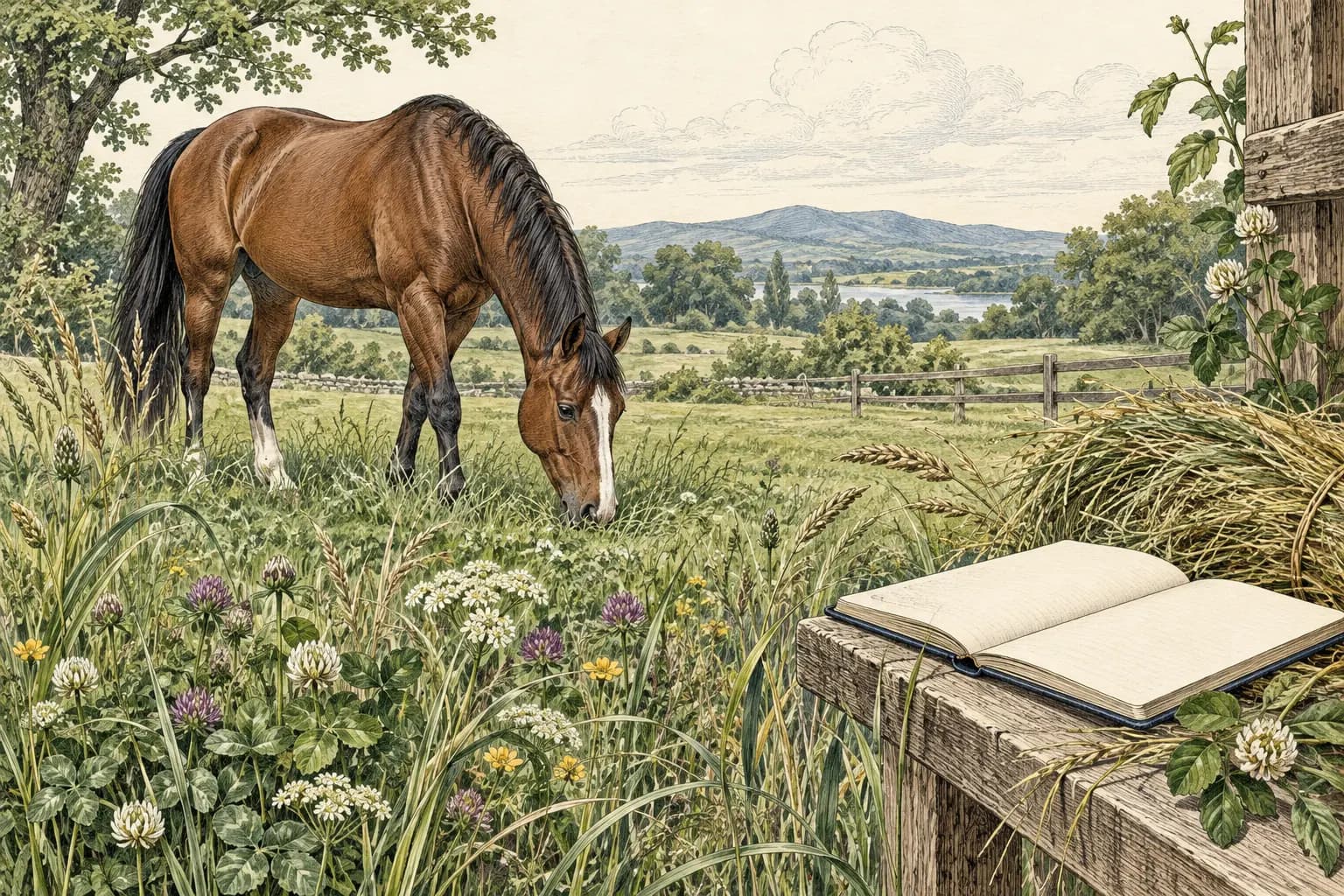
Pasture grass is part of the basic ration: even a few hours of access can supply a relevant amount of dry matter. Actual intake, however, depends not only on the duration but also on body weight, sward, season and individual grazing behaviour 12.
That is why grazing months are recorded as a period rather than a single cut-off date. Fresh spring growth differs considerably in energy and protein content from overmature summer or autumn grass; a ration therefore always remains a seasonal estimate 34.
What matters when entering data
- Mark all months in which there is regular pasture access.
- Give a realistic figure for the average hours per day.
- Consider the condition of the sward: grazed-down or wintry pastures provide hardly any usable feed 4.
- A grazing muzzle reduces intake, but its individual effect is too variable for a blanket calculation factor 56.
Sources & studies
The content is based on the references listed below. It does not replace individual veterinary or feeding advice.
Show list of sources (6)
- Glunk EC, Pratt-Phillips SE, Siciliano PD (2013): Effect of Restricted Pasture Access on Pasture Dry Matter Intake Rate, Dietary Energy Intake, and Fecal pH in Horses. Journal of Equine Veterinary ScienceMeasures the rate of pasture grass intake with 3, 6, 9 and 24 h of pasture access: 1.96 / 1.52 / 1.12 / 0.57 g DM per kg body weight per hour (± 0.207). Horses eat considerably faster when time is short – intake therefore increases much less than proportionally to grazing time
- GfE (2014) – Empfehlungen zur Energie- und Nährstoffversorgung von PferdenSpecialist reference in German-speaking countries (GfE, German Society of Nutrition Physiology), Committee for Requirement Standards
- Dowler LE, Siciliano PD, Pratt-Phillips SE, Poore M (2012): Determination of Pasture Dry Matter Intake Rates in Different Seasons and Their Application in Grazing Management. Journal of Equine Veterinary Science 32(2):85–92Seasonal intake rates in eight horses (576 ± 32 kg) in North Carolina: October 1.7 – May 1.1 – February 0.9 g DM/kg BW/h. The ranking reflects the local warm-season swards there and is NOT transferable to Central European grassland; here it serves only as evidence that intake rate varies seasonally
- Coenen M, Vervuert I (2020): Pferdefütterung. Begründet von H. Meyer. 6., aktualisierte Aufl., Georg Thieme Verlag, Stuttgart. ISBN 978-3-13-241778-6Standard reference work on equine nutrition in German-speaking countries; Table 4.17 mineral recommendations (recommended supply and minimum requirement), Table 4.18 derived sweat volumes per work level and weight class, Table 4.19 electrolyte performance requirement per sweat volume (in addition to maintenance requirement)
- Longland AC, Barfoot C, Harris PA (2011): The effect of wearing a grazing muzzle vs not wearing a grazing muzzle on pasture dry matter intake by ponies. Journal of Equine Veterinary Science 31(5–6):282–283A grazing muzzle reduced ponies' pasture intake at a sward height of 8–15 cm by around 83%; measured over a few hours, without recording daily intake or weight development
- Glunk EC, Sheaffer CC, Hathaway MR, Martinson KL (2014): Interaction of Grazing Muzzle Use and Grass Species on Forage Intake of Horses. Journal of Equine Veterinary Science 34(7):930–933A grazing muzzle reduced pasture intake at a sward height of 15–20 cm by around 30% on average – markedly less than in Longland et al. (2011). The range between the two studies is too wide for a robust calculation factor