

This article has not yet been professionally approved. The information is based on the sources listed below.
Muesli for horses: when it fits and how to check it
Horse muesli is a compound feed made of cereals, fibre, oilseeds and often minerals. When it makes sense, how to read starch, sugar and additives on the label and why it has to match the mineral feed.
The short answer
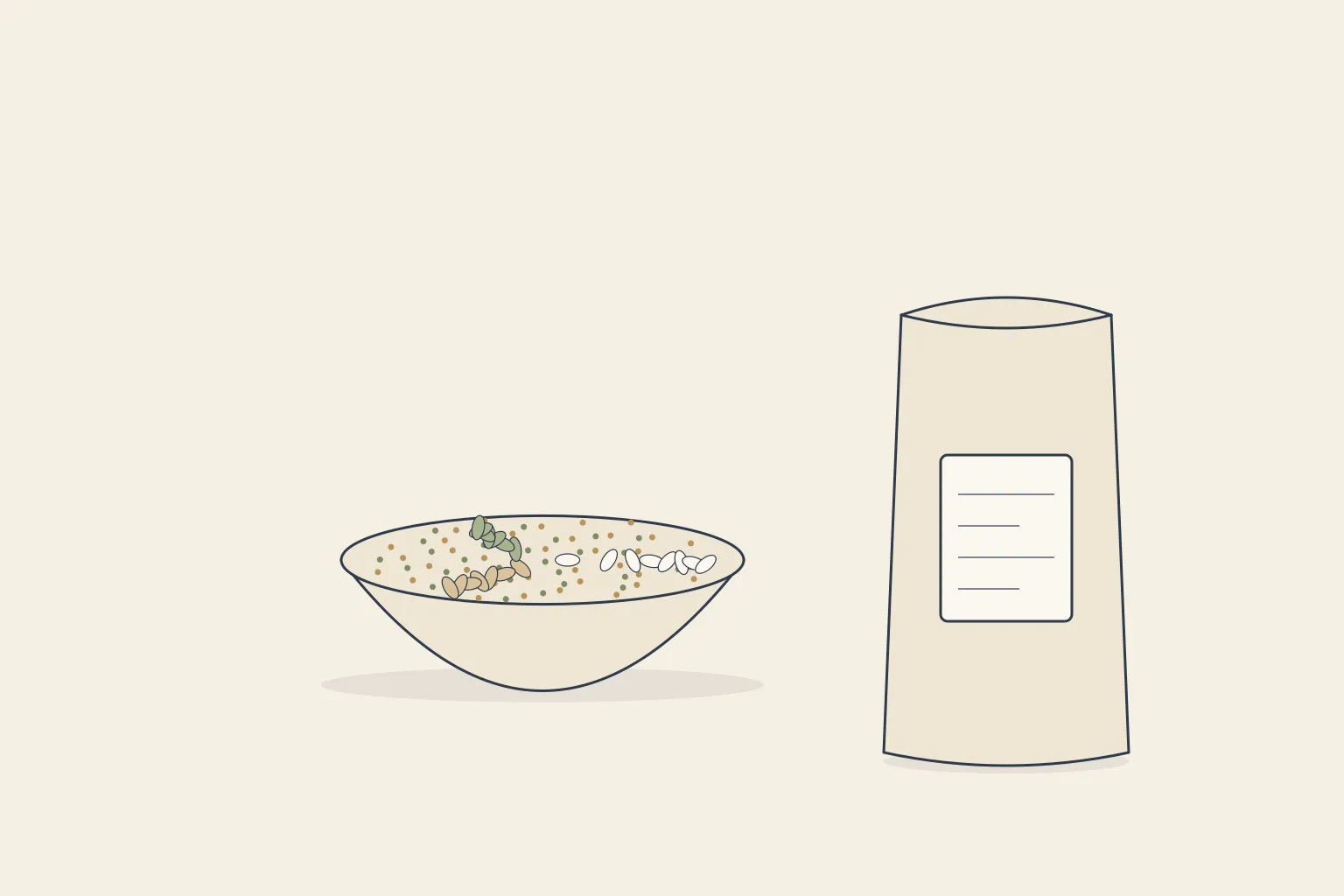
Muesli is a compound feed. Whether it fits depends on two questions: does your horse need concentrates at all, and what is in it? The label lists the feed materials in descending order of their proportion by weight 12. Pay attention to starch and sugar per meal and calculate mineralised muesli together with the mineral feed 3.
What horse muesli is
Muesli is a compound feed made from several feed materials, often cereal flakes, fibre, oilseeds, molasses and pellets. The label must list all feed materials it contains in descending order of their proportion by weight; the percentages can be requested from the manufacturer 12.
Most mueslis are complementary feeds. They only meet requirements together with forage 2.
First, the question of need
Many leisure horses need few or no concentrates 4. Muesli is then an additional source of energy that can contribute to excess weight. It makes sense when a forage-based ration does not cover energy needs, for example with heavy work or for poor doers.
Reading the label
Limit starch per meal
The European specialist guideline recommends less than 1 g of starch per kg of body weight per meal and less than 2 g per kg of body weight per day 3. For a 500 kg horse, that is no more than 500 g of starch per meal. You should therefore split larger amounts of muesli across several meals.
Mineralised muesli plus mineral feed
Many mueslis contain vitamins and trace elements. If the horse also receives a mineral feed, the contents add up 5. The maximum levels for additives refer to the whole ration 6.
Key takeaways
Frequently asked questions
Does my horse need muesli?
Not automatically. Many leisure horses manage with good forage and a suitable mineral feed 4. Concentrates become important with heavy work, in breeding and lactation or for poor doers.
How do I recognise a muesli with little sugar?
Read the composition: molasses or sugar near the top means a high proportion 1. If starch and sugar are not declared, you can ask the manufacturer for the values; the Gruber Table points out that percentages can be requested.
Is grain-free muesli better?
For horses that tolerate little starch, it can make sense. But grain-free does not automatically mean low in sugar or low in energy. What matters are the declared contents and the amount per meal 3.
Sources & studies
The content is based on the references listed below. It does not replace individual veterinary or feeding advice.
Show list of sources (6)
- Bayerische Landesanstalt für Landwirtschaft (LfL): Gruber Tabelle zur PferdefütterungPractical reference table with requirement and feed values based on the GfE recommendations; the basis of many ration calculations in German-speaking countries. Chapter 9.3, Table 39: most common poisonous plants for horses with habitat, toxicity and risk level (after Kamphues et al. 2014)
- Verordnung (EG) Nr. 767/2009Placing on the market and use of feed, labelling and claims; definitions of complete feed (Art. 3(2)(i)) and complementary feed (point (j)), content of feed additives (Art. 8), feeding instructions (Annex II No. 4). Link to the current EUR-Lex consolidated version (as of 26 December 2018).
- Sykes BW, Hewetson M, Hepburn RJ, Luthersson N, Tamzali Y (2015): European College of Equine Internal Medicine Consensus Statement – Equine Gastric Ulcer Syndrome in Adult Horses. Journal of Veterinary Internal Medicine 29(5):1288–1299European specialist guideline: minimum of 1.5 kg forage dry matter per 100 kg body weight per day, avoid breaks in feeding of more than 6 hours, starch below 2 g/kg BW/day and below 1 g/kg BW/meal; gastroscopy as the only reliable diagnosis in the living horse; oral antacids act for ≤ 2 hours
- Coenen M, Vervuert I (2020): Pferdefütterung. Begründet von H. Meyer. 6., aktualisierte Aufl., Georg Thieme Verlag, Stuttgart. ISBN 978-3-13-241778-6Standard reference work on equine nutrition in German-speaking countries; Table 4.17 mineral recommendations (recommended supply and minimum requirement), Table 4.18 derived sweat volumes per work level and weight class, Table 4.19 electrolyte performance requirement per sweat volume (in addition to maintenance requirement)
- NRC – Nutrient Requirements of Horses, 6th ed.International reference for the nutrient requirements of horses (National Research Council)
- Verordnung (EG) Nr. 1831/2003Feed additives – authorisation and use; “daily ration” based on 12% moisture (Art. 2(2)(f)), renewal of authorisation and automatic continuation (Art. 14(4)), general conditions of use (Annex IV: natural plus added amount; complementary feed, diluted as specified, at most at the level for complete feed). Link to the current EUR-Lex consolidated version (as of 27 March 2021).