

This article has not yet been professionally approved. The information is based on the sources listed below.
How much hay does a horse need per day?
The amount of hay depends on weight, work and hay quality. Which minimum and guide values apply, how to convert from dry matter to as-fed weight and why you should weigh hay.
The short answer
The lower limit is 1.5 kg dry matter per 100 kg body weight per day, which for typical hay is at least around 1.7 kg of hay per 100 kg 12. For a 500 kg horse, that is at least about 8.5 kg of hay. How much more is appropriate depends on work, body condition and the energy content of the hay. Weigh the hay instead of estimating the amount.
The lower limit
For forage, the European specialist guideline and the Gruber Table (a German feed value table) give the same lower limit: at least 1.5 kg dry matter per 100 kg body weight per day 21. For hay, that corresponds to at least around 1.7 kg as fed per 100 kg, for haylage with 70% dry matter at least 2 kg 1.
| Horse | Hay per day |
|---|---|
| 300 kg | around 5 kg |
| 400 kg | around 7 kg |
| 500 kg | around 8.5 kg |
| 600 kg | around 10 kg |
| 700 kg | around 12 kg |
Minimum amounts based on the rule of thumb of 1.7 kg of hay per 100 kg body weight; not a level that covers the requirement of every horse 1.
How much is eaten in total
According to the GfE (German Society of Nutrition Physiology), average dry matter intake at maintenance is around 20 g per kg body weight per day, and around 27 g with work 13. For a 500 kg horse at maintenance, that is about 10 kg dry matter from all feeds together, i.e. around 11.5 kg of hay if it only gets hay.
These values are averages. Good doers on energy-rich hay quickly gain weight with them, while poor doers need more or more energy-rich feed. What decides is the body condition over time 4.
From dry matter to as-fed weight
Hay usually contains around 85 to 90% dry matter. Divide the amount of dry matter by this proportion: 7.5 kg dry matter ÷ 0.88 gives around 8.5 kg of hay. If your lab report states a different dry matter content, use that one.
Spreading it over the day
The daily amount alone is not enough. There should be no breaks of more than six hours between forage feeds; in a study, longer intervals were associated with findings in the non-glandular stomach lining 52. Small-holed hay nets extend feeding time.
Weighing hay
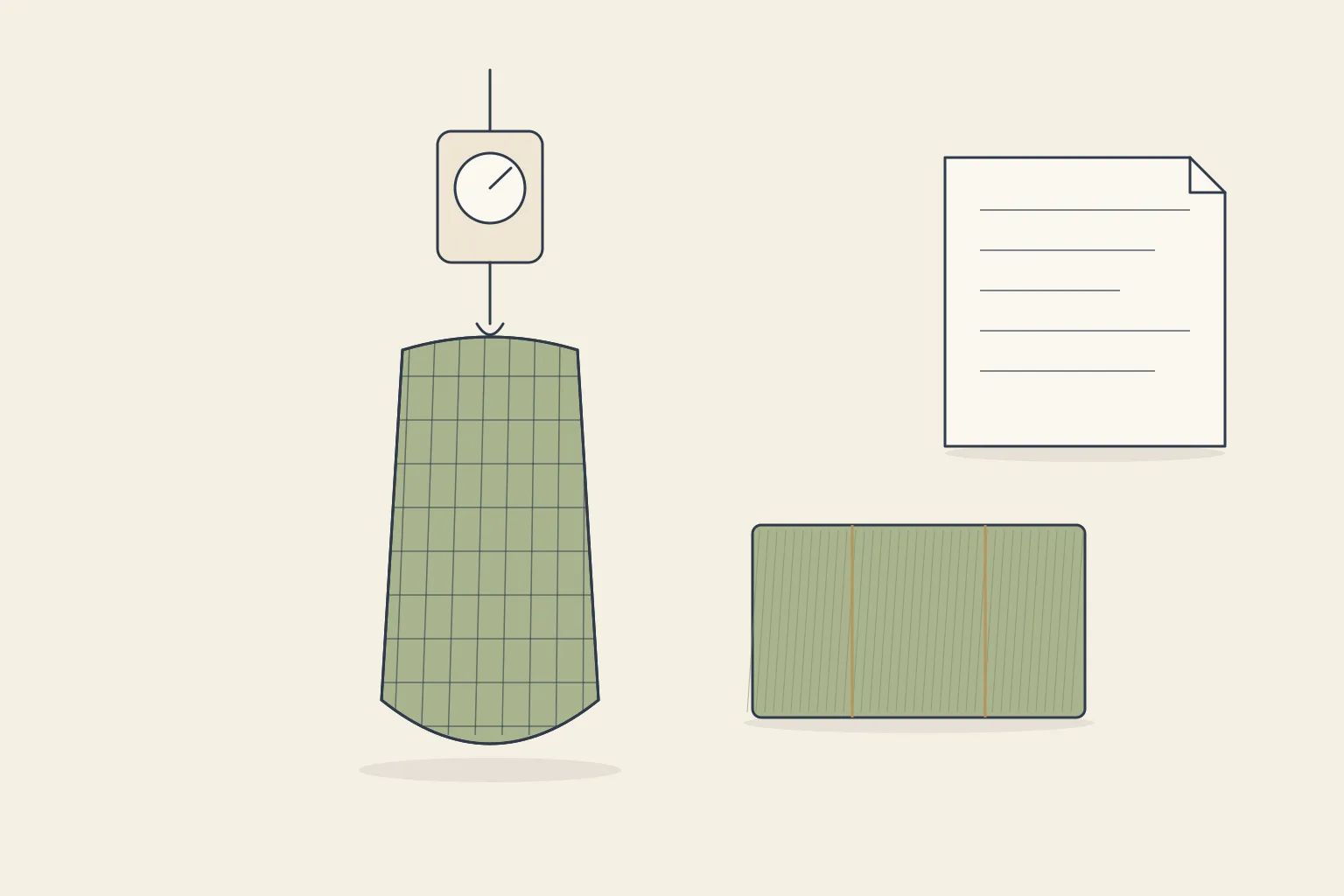
Bales, forkfuls and nets vary in density. Weigh the daily ration a few times with a hanging scale and note what a full net weighs. The Gruber Table contains practical measuring aids for this 1.
Key takeaways
Frequently asked questions
How much hay does a 600 kg horse need?
At least around 10 kg of hay per day, calculated with the lower limit of 1.7 kg of hay per 100 kg body weight 1. Whether more is needed is shown by work, body condition and the energy content of your hay.
Can I cut back the hay a lot for an overweight horse?
Not below the lower limit of 1.5 kg dry matter per 100 kg body weight 2. For overweight horses, it is better to adjust via lower-energy hay, feeding time and exercise, and to have the approach supported by a specialist.
Can I feed hay by eye?
That is inaccurate, because bales and portions vary in density. Weigh the daily ration a few times with a hanging scale and remember how much a net or a forkful weighs 1.
Sources & studies
The content is based on the references listed below. It does not replace individual veterinary or feeding advice.
Show list of sources (6)
- Bayerische Landesanstalt für Landwirtschaft (LfL): Gruber Tabelle zur PferdefütterungPractical reference table with requirement and feed values based on the GfE recommendations; the basis of many ration calculations in German-speaking countries. Chapter 9.3, Table 39: most common poisonous plants for horses with habitat, toxicity and risk level (after Kamphues et al. 2014)
- Sykes BW, Hewetson M, Hepburn RJ, Luthersson N, Tamzali Y (2015): European College of Equine Internal Medicine Consensus Statement – Equine Gastric Ulcer Syndrome in Adult Horses. Journal of Veterinary Internal Medicine 29(5):1288–1299European specialist guideline: minimum of 1.5 kg forage dry matter per 100 kg body weight per day, avoid breaks in feeding of more than 6 hours, starch below 2 g/kg BW/day and below 1 g/kg BW/meal; gastroscopy as the only reliable diagnosis in the living horse; oral antacids act for ≤ 2 hours
- GfE (2014) – Empfehlungen zur Energie- und Nährstoffversorgung von PferdenSpecialist reference in German-speaking countries (GfE, German Society of Nutrition Physiology), Committee for Requirement Standards
- Henneke DR, Potter GD, Kreider JL, Yeates BF (1983): Relationship between condition score, physical measurements and body fat percentage in mares. Equine Veterinary Journal 15(4):371–372Original publication on the body condition score; bibliographically checked. Its application and limits are additionally supported by horse-specific specialist reviews.
- Luthersson N, Nielsen KH, Harris P, Parkin TDH (2009): Risk factors associated with equine gastric ulceration syndrome (EGUS) in 201 horses in Denmark. Equine Veterinary Journal 41(7):625–630Cross-sectional study of 201 horses from 23 Danish yards. Significant risk factors: straw as the only forage, starch intake above 2 g/kg BW/day or above 1 g/kg BW/meal, no access to water in the turnout area; for the non-glandular mucosa additionally a feeding interval of more than 6 hours. Associations, not proof of causation
- Coenen M, Vervuert I (2020): Pferdefütterung. Begründet von H. Meyer. 6., aktualisierte Aufl., Georg Thieme Verlag, Stuttgart. ISBN 978-3-13-241778-6Standard reference work on equine nutrition in German-speaking countries; Table 4.17 mineral recommendations (recommended supply and minimum requirement), Table 4.18 derived sweat volumes per work level and weight class, Table 4.19 electrolyte performance requirement per sweat volume (in addition to maintenance requirement)