

This article has not yet been professionally approved. The information is based on the sources listed below.
Creating a feeding plan for your horse: contents, example, template
A good feeding plan says what your horse gets, when and in what amount. What belongs in it, which guide values apply to forage, breaks between feeds and starch, and what an example plan looks like.
The short answer
A feeding plan sets out for each horse which feed it gets, when and in what amount, ideally in kilograms and grams. The basis is the forage: the lower limit is 1.5 kg dry matter per 100 kg body weight per day, distributed so that there are no breaks in feeding of more than six hours 1. Concentrates and supplements only come after that.
What a feeding plan should do
A feeding plan translates the ration into everyday yard routine. It answers three questions: what, how much and when. This makes it usable for everyone who feeds, including holiday cover or changing yard staff.
The plan is only as good as the amounts in it. Whether the ration covers the requirement is clarified by a ration calculation; the feeding plan puts the result into practice 2.
These details belong in it
- Name of the horse, stable or paddock and body weight
- Forage: type, amount in kg and distribution over the day
- Turnout time on pasture, if any
- Concentrates: product, amount in grams per meal
- Mineral feed and supplements: product, grams, time
- Water and salt source
- Valid from, contact person and reason for the last change
Guide values for planning
For forage, the European specialist guideline gives a lower limit of 1.5 kg dry matter per 100 kg body weight per day 1. Forage is the basis of the ration; concentrates are only added if the requirement calls for them 34.
There should be no breaks of more than six hours between forage feeds. In a study of 201 horses, longer intervals were associated with findings in the non-glandular stomach lining 51. For concentrates, the guideline recommends less than 1 g starch per kg body weight per meal and less than 2 g per kg body weight per day 1.
Clean water is available at all times; at maintenance, the guide value is around 5 litres per 100 kg body weight per day, considerably more in warm weather and with work 6.
Example: feeding plan for a leisure horse
The following example only shows the structure. Amounts and products are freely chosen and not a recommendation for a specific horse.
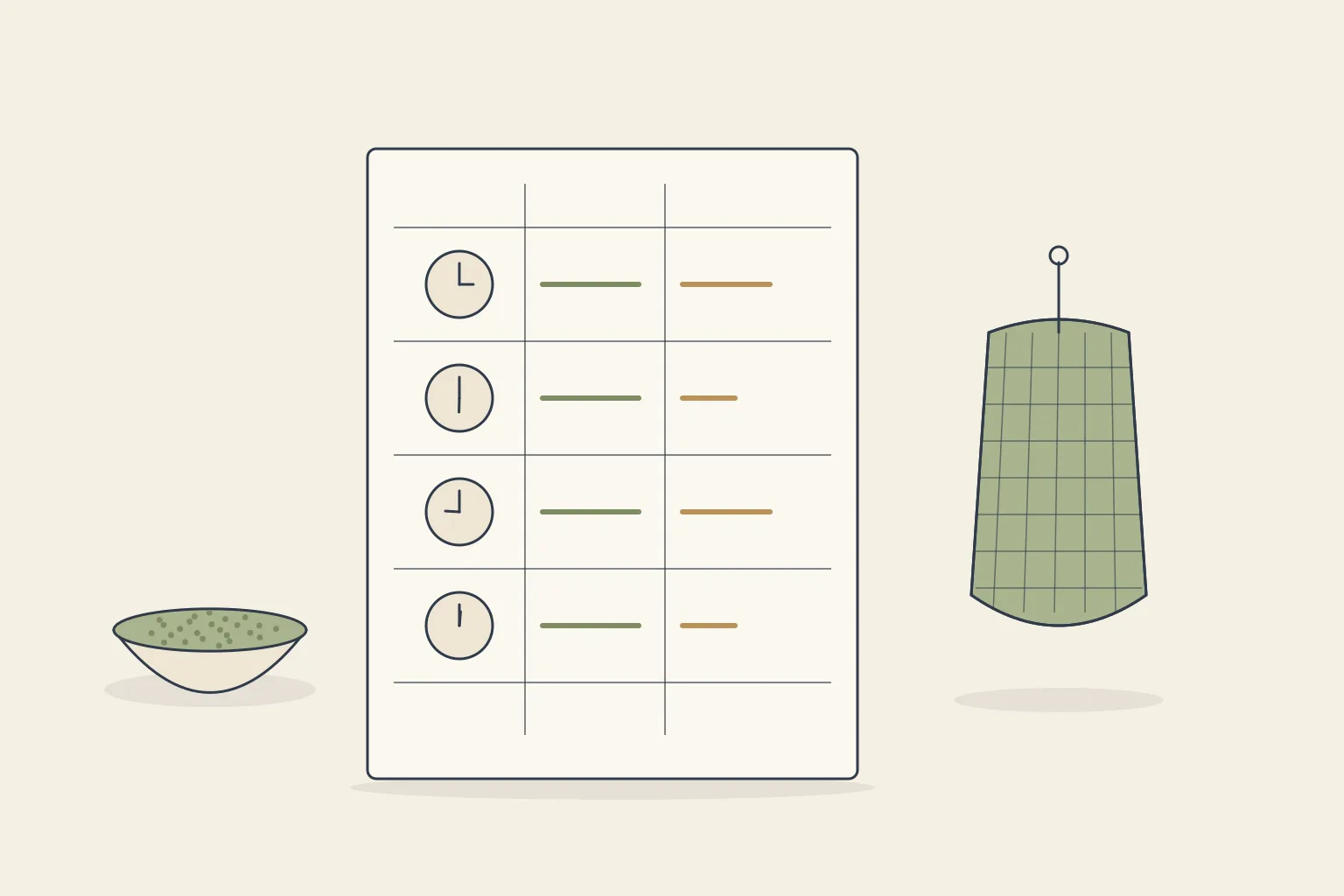
| Time | Forage | Concentrates and supplements |
|---|---|---|
| 06:30 | 2.5 kg hay | – |
| 11:30 | 2 kg hay | 300 g oats, mineral feed according to calculation |
| 16:30 | 2 kg hay | – |
| 21:30 | 3.5 kg hay in a small-holed net, lasts until morning | – |
Example plan for a hypothetical 500 kg horse in light work; hay amount above the lower limit, concentrates kept small.
Template to copy
For the yard, one sheet per horse with fixed columns is enough. What matters are clear amounts instead of “one scoop” and a date from which the plan applies.
| Feed | Amount | Time and note |
|---|---|---|
| Hay | … kg | Net, rack or floor |
| Concentrates | … g | Only if planned |
| Mineral feed | … g | Daily with the same meal |
| Other supplements | … g | Note the purpose |
Blank template; add columns as needed.
When to change the plan
A new batch of hay, changes in weight, more or less work and the switch between grazing and stabling season are good reasons for a new calculation. You should make changes to the feed gradually 7 and record them in the plan with the date.
Key takeaways
Frequently asked questions
How much hay belongs in the feeding plan?
The European specialist guideline gives a lower limit of 1.5 kg forage dry matter per 100 kg body weight per day 1. For a 500 kg horse that is 7.5 kg dry matter; with hay at 88% dry matter, around 8.5 kg of hay. The actual requirement depends on work, body condition and hay quality.
How many meals does a horse need?
There is no fixed number. What matters is that there are no breaks of more than six hours between forage feeds 15. Spread concentrates so that each meal provides less than 1 g starch per kg body weight 1.
Do mineral feed and supplements belong in the feeding plan?
Yes, with the amount in grams and the time. The feeding instructions on the declaration refer to the daily amount 8. Whether the sum of all supplements suits the hay is shown by a ration calculation.
Sources & studies
The content is based on the references listed below. It does not replace individual veterinary or feeding advice.
Show list of sources (8)
- Sykes BW, Hewetson M, Hepburn RJ, Luthersson N, Tamzali Y (2015): European College of Equine Internal Medicine Consensus Statement – Equine Gastric Ulcer Syndrome in Adult Horses. Journal of Veterinary Internal Medicine 29(5):1288–1299European specialist guideline: minimum of 1.5 kg forage dry matter per 100 kg body weight per day, avoid breaks in feeding of more than 6 hours, starch below 2 g/kg BW/day and below 1 g/kg BW/meal; gastroscopy as the only reliable diagnosis in the living horse; oral antacids act for ≤ 2 hours
- Bayerische Landesanstalt für Landwirtschaft (LfL): Gruber Tabelle zur PferdefütterungPractical reference table with requirement and feed values based on the GfE recommendations; the basis of many ration calculations in German-speaking countries. Chapter 9.3, Table 39: most common poisonous plants for horses with habitat, toxicity and risk level (after Kamphues et al. 2014)
- GfE (2014) – Empfehlungen zur Energie- und Nährstoffversorgung von PferdenSpecialist reference in German-speaking countries (GfE, German Society of Nutrition Physiology), Committee for Requirement Standards
- Coenen M, Vervuert I (2020): Pferdefütterung. Begründet von H. Meyer. 6., aktualisierte Aufl., Georg Thieme Verlag, Stuttgart. ISBN 978-3-13-241778-6Standard reference work on equine nutrition in German-speaking countries; Table 4.17 mineral recommendations (recommended supply and minimum requirement), Table 4.18 derived sweat volumes per work level and weight class, Table 4.19 electrolyte performance requirement per sweat volume (in addition to maintenance requirement)
- Luthersson N, Nielsen KH, Harris P, Parkin TDH (2009): Risk factors associated with equine gastric ulceration syndrome (EGUS) in 201 horses in Denmark. Equine Veterinary Journal 41(7):625–630Cross-sectional study of 201 horses from 23 Danish yards. Significant risk factors: straw as the only forage, starch intake above 2 g/kg BW/day or above 1 g/kg BW/meal, no access to water in the turnout area; for the non-glandular mucosa additionally a feeding interval of more than 6 hours. Associations, not proof of causation
- Merck Veterinary Manual: Nutritional Requirements of Horses and Other EquidsSummary of the NRC recommendations: water requirement 5 litres per 100 kg body mass per day at maintenance, sweat losses of around 3.1 g sodium, 5.3 g chloride and 1.6 g potassium per litre, salt recommendation 1.6–1.8 g per kg feed dry matter at a maximum of 6% of the ration; from a 50% forage share potassium is adequately covered. Also covers the selenium requirement (0.1 mg/kg feed dry matter or at least 1 mg/day for a 500 kg horse, selenium as a component of glutathione peroxidase together with vitamin E) and the strong location-dependent variation of selenium in forage (grass forage on average 0.194 ppm, range 0–1.2 ppm); some regions are markedly low in selenium and may need supplementation. Also gives the iodine requirement (0.35 mg/kg feed dry matter, mares in late pregnancy 0.4), iodine poisoning of pregnant mares from around 40 mg/day, documented goitre cases in mares and their foals associated with large amounts of dried seaweed (kelp), that iodised salt easily covers the requirement, and that iodine supplementation is usually unnecessary except in severely iodine-deficient regions
- Liburt NR (2026): Feeding Practices in Horses and Other Equids. Merck Veterinary ManualSpecialist overview, as of February 2026: forage basis, concentrates as required, bran/mash and Ca:P balance, gradual feed changes. No efficacy study on commercial mash products.
- Verordnung (EG) Nr. 767/2009Placing on the market and use of feed, labelling and claims; definitions of complete feed (Art. 3(2)(i)) and complementary feed (point (j)), content of feed additives (Art. 8), feeding instructions (Annex II No. 4). Link to the current EUR-Lex consolidated version (as of 26 December 2018).