

This article has not yet been professionally approved. The information is based on the sources listed below.
Salt and electrolytes for horses
Salt is a year-round job; an electrolyte product is not. How the basic supply according to Coenen/Vervuert and additional sweat losses interact, and why a salt lick is an offer, not a dose.
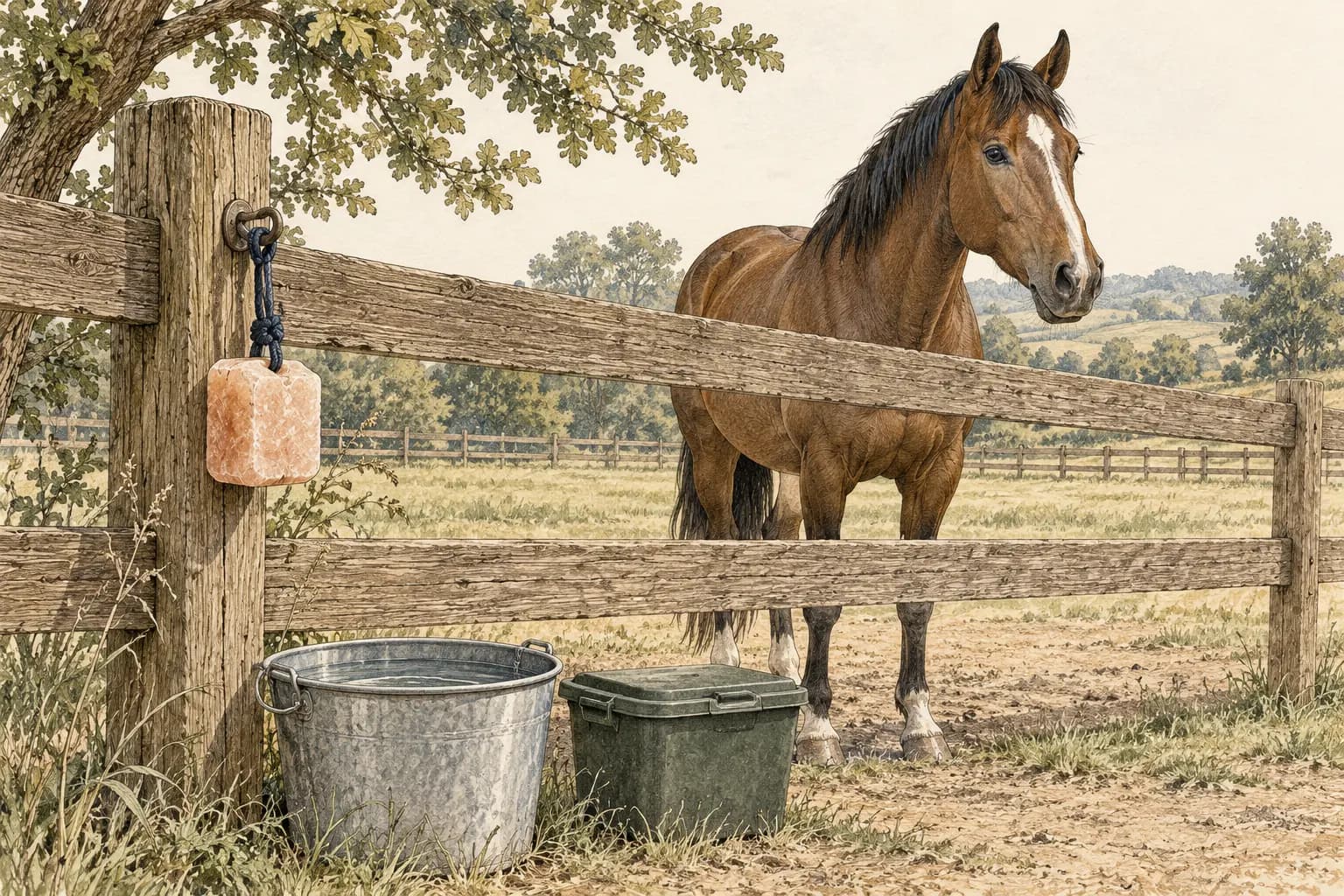
“Electrolytes” is a collective term, and that is exactly where the confusion starts. Behind it are mainly three substances – sodium, chloride and potassium – which behave completely differently in feeding. Two of them are normally present in abundance. Only one regularly runs short.
That is why a clear distinction helps: your horse needs a source of sodium all year round. It only needs an electrolyte product beyond plain salt when it is genuinely sweating a lot. Marketing likes to merge these two statements into one – wrongly.
Basic supply according to Coenen/Vervuert
For adult horses, we calculate the basic supply of sodium, chloride and potassium according to Coenen/Vervuert based on metabolic body weight. Per kg body weight to the power of 0.75, that is 0.187 g sodium, 0.235 g chloride and 0.203 g potassium per day.
For 500 kg, this gives around 19.8 g sodium, 24.8 g chloride and 21.5 g potassium. For 600 kg, it is around 22.7 g sodium, 28.5 g chloride and 24.6 g potassium. Sweat at rest is already accounted for in this basic supply and is not added a second time.
This calculation applies to adult horses at maintenance and in work. Breeding and growth remain outside this change and belong in specialist advice.
Forage and the usual concentrates often supply little sodium. That is why a measured salt source is not a purely seasonal measure but part of the plannable basic supply.
Chloride and potassium: almost always covered
Chloride is well absorbed in horses and efficiently reabsorbed by the kidneys. In forage-based rations it is often already present in abundance, but with significant sweat losses the requirement rises further.
Forage usually supplies plenty of potassium. The additional losses during work are real, but with a typical hay ration they often remain covered by the forage. That is why the salt module contains sodium chloride and no blanket potassium addition.
What sweat actually costs
Horse sweat contains a lot of sodium, chloride and potassium. For the requirement calculation, an additional 4.0 g sodium, 5.5 g chloride and 1.6 g potassium are allowed for each litre of exercise sweat.
These exercise values are added to the basic supply. For a 600 kg horse, this gives around 34.7 g sodium for light work, 50.7 g for moderate, 78.7 g for heavy and 106.7 g for very heavy work.
For calcium and magnesium, on the other hand, there is no work-related allowance. A blanket additional requirement for all minerals cannot be derived from heavier sweating.
A salt lick is an offer, not a dose
This is the point with the greatest practical consequences in this article. Horses voluntarily take in very different amounts of salt: in a long-term measurement over up to 45 weeks, intake ranged between 19 and 143 g per day. Some took in nothing at all. In a study of six sport horses, the range was from 0 to 62 mg per kg body weight per day.
The form of presentation is not the reason: a comparison of salt lick and loose salt in 16 horses found no effect of the form, but a clear effect of the individual animal. Intake ranged from 2 to 135 g per day, and over half of the horses took in less than their requirement would have called for.
When a product can do more than salt
An electrolyte product makes sense where really large amounts of sweat are lost and replacement is to take place immediately around the exercise. Anything that can be planned over days can be covered with measured table salt in the feed.
Two things are worth checking on the label. First, osmolarity: oral solutions should be hypotonic. A target of around 200 mOsm/l is given, because higher concentrations can inhibit gastric emptying. Second, the sugar content. Whether dextrose improves absorption has not been conclusively settled.
The simple arithmetic behind it remains: the more sugar a product contains, the less electrolyte there is in the same serving. If dextrose or glucose is near the top of the composition, you need a larger serving for the same amount of sodium.
The method of administration determines the risk
There are two controlled studies on electrolytes and the stomach lining that seem contradictory at first glance – in fact, they examine two completely different practices.
In one, 14 horses received 56.7 g of electrolyte powder in just 60 ml of water by oral syringe every hour for eight hours; the number and severity of lesions in the non-glandular part of the stomach increased. In the other, 15 stallions received 600 g of salt pellets daily with their feed over two periods of 19 days, without clinically relevant negative effects on the stomach lining.
So the statement that can be supported is not “electrolytes harm the stomach”, but: highly concentrated, repeated and given without feed by syringe is something different from measured salt in the feed bucket. A high salt dose needs a reason; it should not be a habit.
Sources & studies
The content is based on the references listed below. It does not replace individual veterinary or feeding advice.
Show list of sources (18)
- Merck Veterinary Manual: Nutritional Requirements of Horses and Other EquidsSummary of the NRC recommendations: water requirement 5 litres per 100 kg body mass per day at maintenance, sweat losses of around 3.1 g sodium, 5.3 g chloride and 1.6 g potassium per litre, salt recommendation 1.6–1.8 g per kg feed dry matter at a maximum of 6% of the ration; from a 50% forage share potassium is adequately covered. Also covers the selenium requirement (0.1 mg/kg feed dry matter or at least 1 mg/day for a 500 kg horse, selenium as a component of glutathione peroxidase together with vitamin E) and the strong location-dependent variation of selenium in forage (grass forage on average 0.194 ppm, range 0–1.2 ppm); some regions are markedly low in selenium and may need supplementation. Also gives the iodine requirement (0.35 mg/kg feed dry matter, mares in late pregnancy 0.4), iodine poisoning of pregnant mares from around 40 mg/day, documented goitre cases in mares and their foals associated with large amounts of dried seaweed (kelp), that iodised salt easily covers the requirement, and that iodine supplementation is usually unnecessary except in severely iodine-deficient regions
- Maier I, Kienzle E (2025): A Meta-Analysis on Quantitative Sodium, Potassium and Chloride Metabolism in Horses and Ponies. Animals 15(2):191Meta-analysis of Na, K and Cl metabolism; sodium and chloride are the electrolytes relevant to sweat and are considered together. Chloride is almost completely absorbed (median 94% in horses, 98% in ponies); published sodium maintenance recommendations for a 500 kg horse range from 3 to 13 g per day
- GfE (2014) – Empfehlungen zur Energie- und Nährstoffversorgung von PferdenSpecialist reference in German-speaking countries (GfE, German Society of Nutrition Physiology), Committee for Requirement Standards
- NRC – Nutrient Requirements of Horses, 6th ed.International reference for the nutrient requirements of horses (National Research Council)
- Bayerische Landesanstalt für Landwirtschaft (LfL): Gruber Tabelle zur PferdefütterungPractical reference table with requirement and feed values based on the GfE recommendations; the basis of many ration calculations in German-speaking countries. Chapter 9.3, Table 39: most common poisonous plants for horses with habitat, toxicity and risk level (after Kamphues et al. 2014)
- Coenen M, Vervuert I (2020): Pferdefütterung. Begründet von H. Meyer. 6., aktualisierte Aufl., Georg Thieme Verlag, Stuttgart. ISBN 978-3-13-241778-6Standard reference work on equine nutrition in German-speaking countries; Table 4.17 mineral recommendations (recommended supply and minimum requirement), Table 4.18 derived sweat volumes per work level and weight class, Table 4.19 electrolyte performance requirement per sweat volume (in addition to maintenance requirement)
- Verein Futtermitteltest (VFT) e.V.: Neuerungen zum Mineralstoff- und Vitaminbedarf und zur Versorgung in der Pferdefütterung (Merkblatt MB 287)Summary of the GfE 2014 changes; contains the mineral requirement per work level (600 kg) according to Coenen/Vervuert 6th ed. and GfE 2014, the sweat electrolyte losses (3.1 g Na and 5.5 g Cl per litre) and the GfE 2014 daily vitamin supply (600 kg warmblood: vitamin E 610–1,220 mg maintenance, 1,220–2,420 mg work), and the note that forage has only low vitamin contents, especially after prolonged storage. Secondary source; primary works are listed separately in the source list.
- Kerr MG, Snow DH (1983): Composition of sweat of the horse during prolonged epinephrine (adrenaline) infusion, heat exposure, and exercise. American Journal of Veterinary Research 44(8):1571 ff.Equine sweat was hypertonic for sodium, potassium and chloride under all three stimuli; the ion ratios depend on the triggering stimulus
- McCutcheon LJ, Geor RJ (1998): Sweating. Fluid and ion losses and replacement. Veterinary Clinics of North America: Equine Practice 14(1):75–95Equine sweat is an isotonic to slightly hypertonic secretion with sodium, chloride and potassium as the main ions; its composition depends largely on sweat rate and is influenced by ambient conditions and exercise intensity
- Lindinger MI (2022): Oral Electrolyte and Water Supplementation in Horses. Veterinary Sciences 9(11):626Review of oral electrolyte and water administration: equine sweat contains considerably more sodium, chloride and potassium than human sweat; oral solutions should be hypotonic (target around 200 mOsm/l), because higher osmolarity inhibits gastric emptying. Highly concentrated doses without sufficient water draw fluid from the blood into the digestive tract
- Schryver HF, Parker MT, Daniluk PD, Pagan KI, Williams J, Soderholm LV, Hintz HF (1987): Salt consumption and the effect of salt on mineral metabolism in horses. Cornell Veterinarian 77(2):122–131Voluntary salt intake of adult, non-working horses over up to 45 weeks: 19–143 g per day, on average 53 g, inversely proportional to total salt intake. Salt up to 5% of the ration did not impair the metabolism of other minerals
- Jansson A, Dahlborn K (1999): Effects of feeding frequency and voluntary salt intake on fluid and electrolyte regulation in athletic horses. Journal of Applied Physiology 86(5):1610–16166 sport horses; voluntary salt intake 0–62 mg per kg body mass per day – some horses took in no salt at all
- Murphy B, Catalano DN (2026): Effect of form on equine salt intake. Journal of Equine Veterinary Science 163:10592316 horses, four periods of 7 days: block vs loose salt with no effect of the form offered, but a strong individual animal effect. Intake 2–135 g per day; more than half of the horses took in less than their requirement
- Holbrook TC, Simmons RD, Payton ME, MacAllister CG (2005): Effect of repeated oral administration of hypertonic electrolyte solution on equine gastric mucosa. Equine Veterinary Journal 37(6):501–50414 horses: 56.7 g electrolyte powder in only 60 ml water, given hourly by oral syringe over 8 hours, significantly increased the number and severity of lesions in the non-glandular region of the stomach compared with placebo
- Alshut F, Venner M, Martinsson G, Vervuert I (2023): The effects of feeding sodium chloride pellets on the gastric mucosa, acid-base, and mineral status in exercising horses. Journal of Veterinary Internal MedicinePlacebo-controlled crossover in 15 warmblood stallions over two periods of 19 days: 600 g of salt pellets daily with feed showed no clinically relevant negative effects on the gastric mucosa; serum magnesium and calcium fell slightly but significantly
- Pagan JD, Waldridge BM, Lange J, Brown-Douglas CG, Huntington PJ (2012): Effect of Dextrose Supplementation on Electrolyte and Water Absorption in Resting Thoroughbreds. Proceedings of the Australasian Equine Science Symposium 44 Thoroughbred geldings: dextrose affected neither the rate nor the duration of the rise in sodium after electrolyte administration. Conference paper from a commercial research company, very small number of animals – a single finding, not robust counter-evidence
- Maier I, Kienzle E (2024): A Meta-Analysis on Quantitative Calcium, Phosphorus and Magnesium Metabolism in Horses and Ponies. Animals 14(19):2765 (LMU München)Meta-analysis: sweat losses of Ca, P and Mg are so small that no additional work-related requirement is applied. For Mg it calculates the replacement of endogenous faecal losses and separates by weight (horses > 300 kg: 37, ponies < 300 kg: 11 mg/kg metabolic body mass; a pony that was temporarily heavier remained in the pony group); the comparison factors (horses around 1.9×, ponies around ½) refer to Kienzle & Burger (20 mg/kg), not to the GfE
- Verordnung (EG) Nr. 767/2009Placing on the market and use of feed, labelling and claims; definitions of complete feed (Art. 3(2)(i)) and complementary feed (point (j)), content of feed additives (Art. 8), feeding instructions (Annex II No. 4). Link to the current EUR-Lex consolidated version (as of 26 December 2018).