

This article has not yet been professionally approved. The information is based on the sources listed below.
Trace elements in horse feed: understanding manganese
Manganese as a starting point for trace element supply: check forage, reference requirements and supplements, with links to zinc, copper, selenium and iodine.
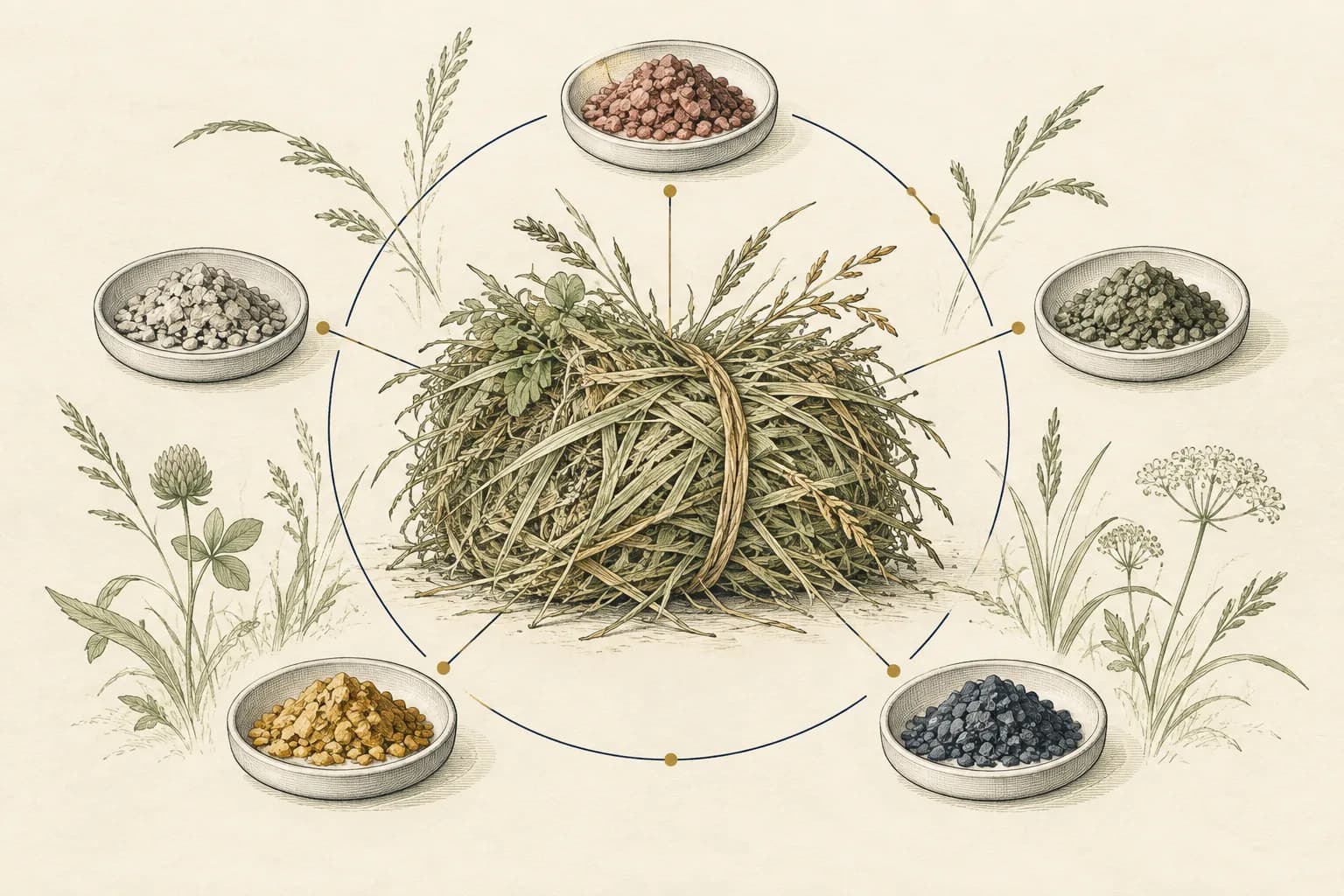
The short answer
Manganese is one of the essential trace elements. Typical forages may already supply enough manganese; however, that is not a measured result for your hay. Check the contribution of all feeds before supplementing. The horse-specific evidence on requirements is limited: a reference figure is not an individual deficiency diagnosis 1.
Why does the trace element question start with forage?
Trace elements are needed in small amounts but must be assessed across the whole ration. Nutrient content, daily quantity and an added mineral are different quantities. The Gruber Table presents supply recommendations and feed values separately; the figure on a complementary feed bag alone therefore does not answer a question about requirements 2.
- Collect the hay report, concentrate declarations and all supplements.
- Match up the stated units and the reference basis.
- Mark each contribution as measured, declared or estimated.
- Explicitly record trace elements that were not tested as open.
What does a horse need manganese for?
Among other things, manganese is involved in enzyme systems of carbohydrate and fat metabolism. At the same time, the Merck overview stresses that exact requirements for horses are not well established and that typical forage levels are often sufficient 1. Neither a general need to supplement nor a guarantee for a specific hay batch should be inferred from this.
What does a manganese reference value mean?
For a 600 kg warmblood at maintenance, the Gruber Table gives 505.4 mg of manganese per day, based on GfE (German Society of Nutrition Physiology) 2014. The row for work gives the same value. This tabulated supply recommendation is not a dose of a manganese product and not a laboratory limit in blood 2.
An explicitly made-up worked example: 10 kg of hay with 85% dry matter and 60 mg manganese/kg dry matter supplies 510 mg of manganese per day by calculation. These example values prove nothing about your horse; they show why forage quantity and reference basis must be clarified before choosing a product 2.
Which trace element question leads to which article?
Use the following articles according to the open question in your ration. Belonging to the trace elements does not mean that requirement, measurement or safety margin are interchangeable 2.
How do you investigate a possible deficiency?
General changes in coat, willingness to work or body condition do not prove a specific trace element deficiency. The specialist overview describes many signs of deficiency as non-specific and assessment as difficult where several deficits are possible 3. Have anything unusual assessed by your vet before giving a high dose of a single substance.
- First check whether manganese was included in the lab order at all 4.
- Compile ration data and lab results with date and batch.
- Discuss the limits of what the data can show and any further diagnostics needed with the specialist.
Key takeaways
Frequently asked questions
Does manganese have to be fed in addition?
Only a well-founded ration assessment can place a supplement in context. Typical forages often supply enough; a measured value for your batch and the daily quantity are more meaningful than a general assumption 1.
Is manganese included in every hay analysis?
No. In the LUFA 2026/27 order form we reviewed, manganese is part of the separately selectable trace element packages. Check the actual scope of your testing 4.
Does a dull coat prove a manganese deficiency?
No. Non-specific signs cannot be attributed to a single nutrient and should be investigated by a professional 3.
Sources & studies
The content is based on the references listed below. It does not replace individual veterinary or feeding advice.
Show list of sources (4)
- Merck Veterinary Manual: Nutritional Requirements of Horses and Other EquidsSummary of the NRC recommendations: water requirement 5 litres per 100 kg body mass per day at maintenance, sweat losses of around 3.1 g sodium, 5.3 g chloride and 1.6 g potassium per litre, salt recommendation 1.6–1.8 g per kg feed dry matter at a maximum of 6% of the ration; from a 50% forage share potassium is adequately covered. Also covers the selenium requirement (0.1 mg/kg feed dry matter or at least 1 mg/day for a 500 kg horse, selenium as a component of glutathione peroxidase together with vitamin E) and the strong location-dependent variation of selenium in forage (grass forage on average 0.194 ppm, range 0–1.2 ppm); some regions are markedly low in selenium and may need supplementation. Also gives the iodine requirement (0.35 mg/kg feed dry matter, mares in late pregnancy 0.4), iodine poisoning of pregnant mares from around 40 mg/day, documented goitre cases in mares and their foals associated with large amounts of dried seaweed (kelp), that iodised salt easily covers the requirement, and that iodine supplementation is usually unnecessary except in severely iodine-deficient regions
- Bayerische Landesanstalt für Landwirtschaft (LfL): Gruber Tabelle zur PferdefütterungPractical reference table with requirement and feed values based on the GfE recommendations; the basis of many ration calculations in German-speaking countries. Chapter 9.3, Table 39: most common poisonous plants for horses with habitat, toxicity and risk level (after Kamphues et al. 2014)
- Liburt NR (2026): Nutritional Diseases of Horses and Other Equids. Merck Veterinary ManualSpecialist overview, as of February 2026: energy surplus, non-specific signs of deficiency and risks of oversupplementation; no basis for a remote diagnosis.
- LUFA Nord-West: Untersuchungsauftrag Pferdefutter 2026/27p. 1: analysis packages and prices per sample plus VAT; p. 2: scope of analysis, sample quantities and shipping. Prices for 2026/27, checked on 28 September 2026; not an Equivora offer.