

This article has not yet been professionally approved. The information is based on the sources listed below.
Iodine in horses: needs, sources and safe supplementation
Selenium's twin – except that here both ends are dangerous. How much the GfE and NRC recommend (and why, for once, they disagree), why goitre can signal too little as well as too much iodine, why seaweed is the most common oversupply trap and why iodine is only supplemented on the basis of a lab value.
Like selenium, iodine is a trace element with a narrow window – but with one crucial difference: with iodine, both ends are dangerous. Too little and too much lead to the same visible sign, and that is exactly what makes supplementation tricky.
Functionally, iodine is an essential building block of the thyroid hormones thyroxine (T4) and triiodothyronine (T3); these hormones control basal metabolism as well as growth and development 1. If iodine is lacking, the thyroid cannot produce enough hormone – the body responds with more TSH, and the gland enlarges 1.
How much does a horse need?
Here, for once, the references disagree – unlike selenium, where the GfE and NRC meet. Based on GfE 2014 (German Society of Nutrition Physiology), the Gruber Table gives 1.8 mg iodine per day for a 600 kg warmblood at maintenance 23. The NRC calculates with 0.35 mg per kg feed dry matter, which gives around 4.2 mg a day for the same horse 45 – more than double.
| Reference | 500 kg | 600 kg |
|---|---|---|
| GfE 2014 (Gruber Table 20) | – | 1.8 mg/day |
| NRC 2007 (0.35 mg/kg DM) | ≈ 3.5 mg/day | ≈ 4.2 mg/day |
Iodine maintenance requirement. GfE as a tabulated daily value, NRC as a concentration per kg feed dry matter. The two references differ considerably here.
The U-curve: too little and too much end the same way
This is the core of the article. Iodine deficiency reduces hormone production, drives TSH up and makes the thyroid swell – goitre with signs of hypothyroidism 1. But too much iodine also leads to goitre and hypothyroidism: high iodine concentrations inhibit hormone production in the gland itself, and above a critical amount production collapses 1.
An enlarged goitre is therefore precisely not a clear sign of “too little iodine” – it occurs at both ends of the curve. Blind topping up can therefore make the problem worse instead of solving it.
The kelp trap and the pregnant mare
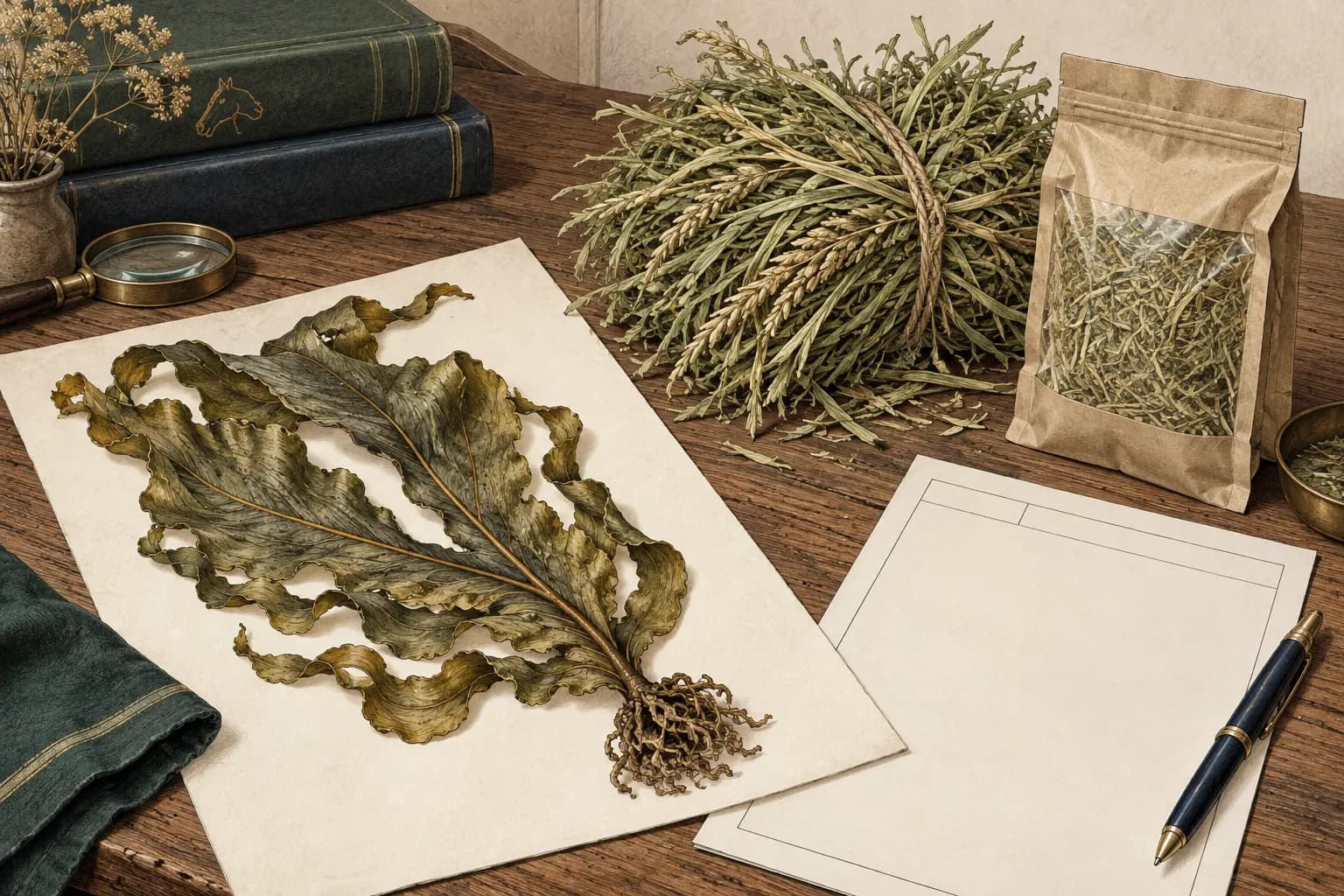
The most common source of oversupply is mineral supplements made from seaweed (kelp): their iodine content is very high and varies greatly by species, harvest time and drying, so their effect is hard to predict. Several documented cases of goitre in mares and foals were associated with large amounts of dried seaweed in the feed 15.
The unborn and newborn foal is particularly sensitive: the foetal thyroid reacts more strongly than the adult one, and the mare passes iodine on via the placenta and milk – disproportionately so on an iodine-rich ration 1. As a result, the foal gets too much iodine both in the womb and through the milk. Iodine poisoning has been observed in pregnant mares from around 40 mg per day 5 – measured against a requirement of a few milligrams, that is only a factor of about 10.
How much is too much – and why the EU limit is not what counts
For equines, there is a legal maximum content of 4 mg iodine per kg complete feed (at 12% moisture), with 3 mg/kg recommended 6. Unlike selenium, however, this legal limit is not the first one to take effect for iodine: there is plenty of room between the requirement (around 0.15–0.35 mg/kg DM) and the EU limit. The real guide rail is biological tolerance – and for pregnant mares and foals this is considerably tighter than the law 5.
Merck draws a clear conclusion from this: except in regions proven to be severely iodine-deficient, iodine supplementation is usually not necessary in horses 5.
Sources – and why only with a lab value
Forage grown on soils that are not iodine-poor generally covers the iodine requirement; iodised salt and common mineral feeds or concentrates cover it easily 5. The reverse conclusion matters for your own ration: pure, non-iodised table salt provides no iodine – our salt module deliberately consists of pure sodium chloride and therefore contributes nothing to iodine supply. If you cover iodine, you do so via iodised salt or a mineral feed containing iodine – and then need to make sure that several sources (mineral feed, kelp, iodised salt) do not add up.
Because goitre does not reveal the direction (see above) and the window is narrow in both directions, the rule is: no blanket topping up. Whether the ration provides iodine is shown by a feed or ration analysis, not by the horse's appearance 78. We therefore only release an automatic iodine dosage recommendation with a documented lab value – without an analysis, the iodine module is dropped from the recommendation altogether, even if the calculation shows a gap. This is the same logic as for selenium.
Requirement peaks and limits of the statement
In breeding and growth, the iodine requirement according to the GfE rises only moderately – the Gruber Table gives around 1.8 mg each for pregnant and lactating mares and up to 2 mg per day for growing horses 2. The real danger in these groups is not a tight requirement but sensitivity to excess.
Foals, young horses during rearing and pregnant and lactating mares therefore belong in veterinary and breeding advice and sit behind the safety and advice gate. Goitre and thyroid disorders are not a feeding project to solve yourself, but a case for the vet 1.
Sources & studies
The content is based on the references listed below. It does not replace individual veterinary or feeding advice.
Show list of sources (8)
- Merck Veterinary Manual: Goiter in AnimalsStandard veterinary reference work (endocrinology): goitre (struma) occurs both with iodine deficiency (low hormone levels → increased TSH → hyperplasia) and with iodine excess (high iodine concentrations inhibit organification and hormone release); the foetal thyroid reacts more sensitively than the adult one; foals receive excess iodine in the womb and via milk, because mares on an iodine-rich ration secrete more iodine into their milk; mineral supplements containing kelp are a common source of iodine excess; goitrogenic plants (cabbage, rapeseed, kale, turnips, soya) can promote goitre. Goitre is therefore not a clear indicator of iodine supply.
- Bayerische Landesanstalt für Landwirtschaft (LfL): Gruber Tabelle zur PferdefütterungPractical reference table with requirement and feed values based on the GfE recommendations; the basis of many ration calculations in German-speaking countries. Chapter 9.3, Table 39: most common poisonous plants for horses with habitat, toxicity and risk level (after Kamphues et al. 2014)
- GfE (2014) – Empfehlungen zur Energie- und Nährstoffversorgung von PferdenSpecialist reference in German-speaking countries (GfE, German Society of Nutrition Physiology), Committee for Requirement Standards
- NRC – Nutrient Requirements of Horses, 6th ed.International reference for the nutrient requirements of horses (National Research Council)
- Merck Veterinary Manual: Nutritional Requirements of Horses and Other EquidsSummary of the NRC recommendations: water requirement 5 litres per 100 kg body mass per day at maintenance, sweat losses of around 3.1 g sodium, 5.3 g chloride and 1.6 g potassium per litre, salt recommendation 1.6–1.8 g per kg feed dry matter at a maximum of 6% of the ration; from a 50% forage share potassium is adequately covered. Also covers the selenium requirement (0.1 mg/kg feed dry matter or at least 1 mg/day for a 500 kg horse, selenium as a component of glutathione peroxidase together with vitamin E) and the strong location-dependent variation of selenium in forage (grass forage on average 0.194 ppm, range 0–1.2 ppm); some regions are markedly low in selenium and may need supplementation. Also gives the iodine requirement (0.35 mg/kg feed dry matter, mares in late pregnancy 0.4), iodine poisoning of pregnant mares from around 40 mg/day, documented goitre cases in mares and their foals associated with large amounts of dried seaweed (kelp), that iodised salt easily covers the requirement, and that iodine supplementation is usually unnecessary except in severely iodine-deficient regions
- Durchführungsverordnung (EU) 2015/861Authorisation of potassium iodide, anhydrous calcium iodate and coated granulated calcium iodate (identification numbers 3b201 to 3b203); total maximum content of iodine for equids 4 mg/kg complete feed (12% moisture). Under other provisions, the Annex additionally gives a recommended maximum content of 3 mg/kg (not the binding value). Authorisation expires according to the Annex on 24 June 2025; for the renewal procedure see the EFSA opinion. According to the EU Register of Feed Additives (as of 15 October 2026), an application for renewal under Art. 14 of Regulation (EC) No 1831/2003 has been submitted; the authorisation remains valid.
- Weender Futtermittelanalyse (Weender Analysensystem)Standard method for determining crude nutrients (crude protein, crude fibre, crude fat, crude ash) as the basis of feed and hay analyses
- VDLUFA – Methodenbuch III (Futtermittel)Reference methods of agricultural testing laboratories (LUFA) for the analysis of feeds and forages