

This article has not yet been professionally approved. The information is based on the sources listed below.
Lucerne for horses: hay, cubes and chaff in the ration
Lucerne (alfalfa) supplies plenty of protein, lysine and calcium, but little sugar and starch. When lucerne hay, cubes or chaff fit into the ration, which amounts serve as a guide and what you should keep an eye on.
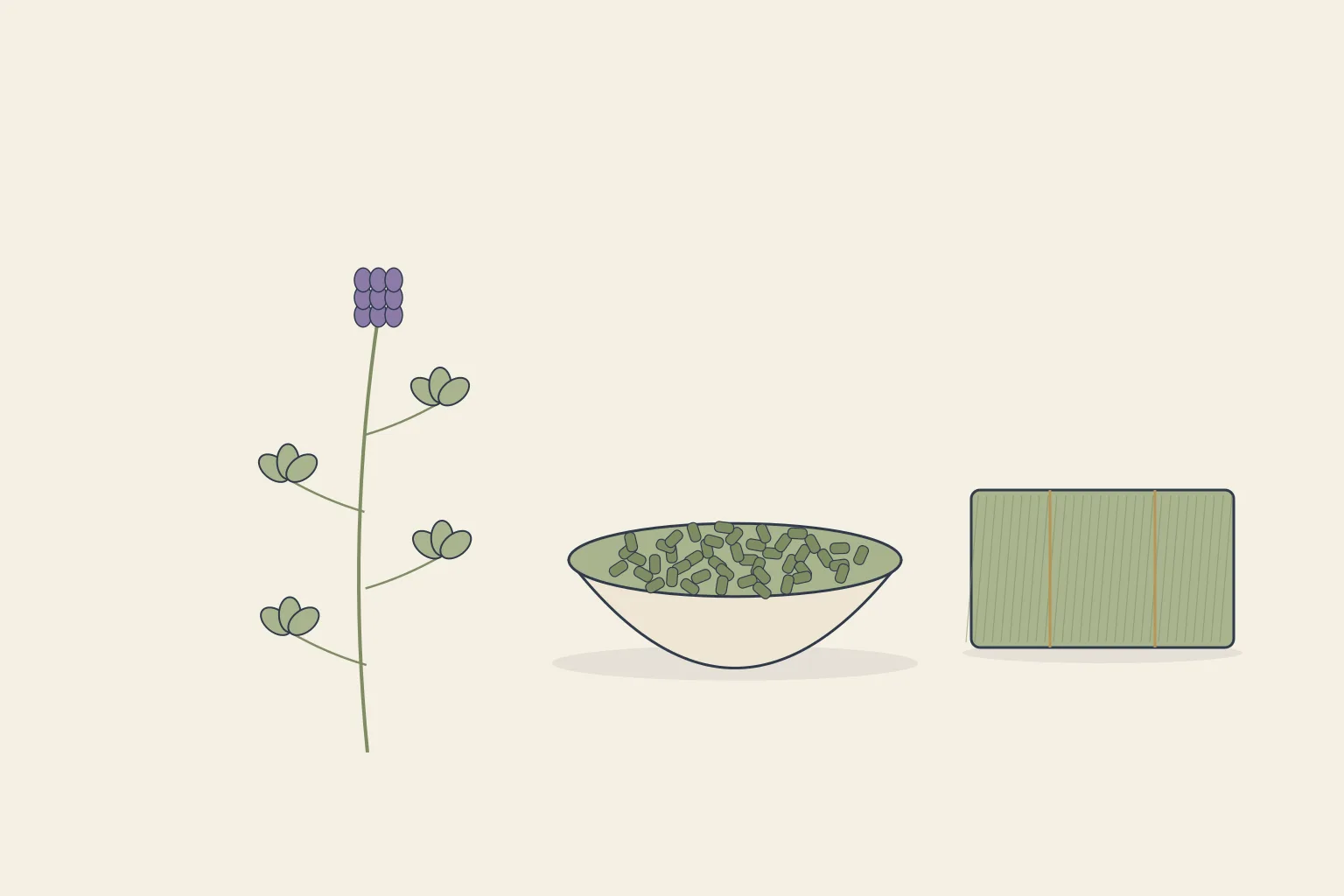
The short answer
Lucerne (alfalfa) is a legume with more protein, lysine and calcium than grass hay, but little sugar and starch 1. The Gruber Table (a German feed value table) gives 200 to 300 g per day as a fibre supplement and 0.5 to 2 kg as a protein supplement, for example for lactating mares. It is unsuitable as the sole forage, because too much protein and calcium quickly enters the ration.
What distinguishes lucerne from grass hay
Lucerne is a legume. Compared with grasses, it has a high protein, fibre and calcium content, particularly a lot of the essential amino acid lysine, but little sugar and starch. The nutrient content depends heavily on the weather and the stage of growth 1.
How large the difference in protein is can be seen in the ration literature: for lucerne hay, around 91 g prececal digestible crude protein and 4.6 g digestible lysine per kg of feed are given, for a late first-cut meadow hay around 39 g and 1.5 g 2.
| Feed | pcd crude protein | pcd lysine |
|---|---|---|
| Lucerne hay | 91 g | 4.6 g |
| Meadow hay, 2nd cut | 77 g | 3.1 g |
| Meadow hay, late 1st cut | 39 g | 1.5 g |
Table values per kg of feed at 860 g dry matter; a guide, not an analysis of your batch 2.
Hay, chaff or cubes?
- Lucerne hay: good fibre structure, but usually high losses from crumbling leaves 1.
- Lucerne chaff (hot-air dried): can irritate the stomach lining; the Gruber Table therefore considers it unsuitable 13.
- Lucerne cubes or pellets: easy to dose; according to the Gruber Table, however, hay is preferable to pellets 1.
Guide amounts
The Gruber Table names two areas of use, as fed: 200 to 300 g per day as a fibre supplement or cereal alternative in the bucket feed, and 500 g to 2 kg per day as a protein supplement, for example for lactating mares 1. Lucerne should not be used as the sole source of forage, because this can quickly lead to an oversupply of protein and calcium.
Which horses lucerne is of interest for
Lucerne supplies high-quality protein without much starch. This makes it of interest when the ration supplies little protein or lysine, for example with late, stalky hay, for lactating mares or as a cereal alternative 14. For lean horses with PPID and normal insulin status, the guideline names lucerne-based feeds as one option 6.
Whether your horse benefits from it is shown by the calculation. If it already gets plenty of protein from grass hay, lucerne mainly adds a surplus.
Changing over
Introduce lucerne gradually like any new feed 7 and note the daily amount. With cubes, follow the soaking recommendation for the product.
Key takeaways
- Lucerne complements grass hay but does not replace it as the sole forage 1.
- A lot of calcium with similar phosphorus shifts the Ca:P of the ration 45.
- According to the Gruber Table, hay is preferable to pellets; coarse chaff can irritate the stomach lining 13.
- Plan amounts in grams and include the protein balance in the calculation.
Frequently asked questions
How much lucerne can a horse have per day?
As a guide, the Gruber Table gives 200 to 300 g as fed per day as a fibre supplement or cereal alternative and 0.5 to 2 kg per day as a protein supplement 1. Which amount suits your horse is shown by the protein and calcium balance of the overall ration.
Is lucerne good for the stomach?
The findings are mixed. In adult horses, stomach lining findings were lower after a lucerne hay ration than after grass hay alone 8. In weanlings, coarse lucerne chaff was associated with more findings than pellets 3. No general recommendation follows from this.
Is lucerne suitable for horses with Cushing's?
For lean horses with PPID and normal insulin status, the guideline names lucerne-based feeds as one way of providing more protein and energy 6. Whether this suits your horse should be clarified with your vet, taking the insulin status into account.
Do I need to soak lucerne cubes?
Follow the feeding recommendation for the product. For cubes, the general rule is that dry pellets should not be fed to greedy horses because of the risk of choke 1.
Sources & studies
The content is based on the references listed below. It does not replace individual veterinary or feeding advice.
Show list of sources (8)
- Bayerische Landesanstalt für Landwirtschaft (LfL): Gruber Tabelle zur PferdefütterungPractical reference table with requirement and feed values based on the GfE recommendations; the basis of many ration calculations in German-speaking countries. Chapter 9.3, Table 39: most common poisonous plants for horses with habitat, toxicity and risk level (after Kamphues et al. 2014)
- Kienzle, Pankratz & Zeyner (2023) – Kompendium zur Rationsberechnung für PferdeAuthor group Pferdewissen (Kienzle/Pankratz, LMU Munich; Zeyner, University of Halle-Wittenberg); self-published, Oberschleißheim, ISBN 978-3-00-075668-9. No link – self-published, not freely accessible.
- Vondran S, Venner M, Vervuert I (2016): Effects of two alfalfa preparations with different particle sizes on the gastric mucosa in weanlings – alfalfa chaff versus alfalfa pellets. BMC Veterinary Research 12:110Contrary finding on lucerne as a stomach buffer: in weanlings, higher ulcer scores at the pylorus after coarse chopped lucerne than after lucerne pellets with a smaller particle size; mechanical irritation is discussed. Weanlings, not adult horses
- Coenen M, Vervuert I (2020): Pferdefütterung. Begründet von H. Meyer. 6., aktualisierte Aufl., Georg Thieme Verlag, Stuttgart. ISBN 978-3-13-241778-6Standard reference work on equine nutrition in German-speaking countries; Table 4.17 mineral recommendations (recommended supply and minimum requirement), Table 4.18 derived sweat volumes per work level and weight class, Table 4.19 electrolyte performance requirement per sweat volume (in addition to maintenance requirement)
- NRC – Nutrient Requirements of Horses, 6th ed.International reference for the nutrient requirements of horses (National Research Council)
- Hart K, Bamford N, Bertin FR, Durham A, Frank N, McGowan C, Schott H (Equine Endocrinology Group, 2025): Recommendations for the Diagnosis and Management of Pituitary Pars Intermedia Dysfunction (PPID). Revised October 2025Veterinary expert recommendation, checked on 30 September 2026. Summary: age-related, slowly progressive disease; prevalence 20% in equids over 15 years, 30% in those over 30 years; hypertrichosis as the classic sign; diagnosis via ACTH, to be interpreted according to season; treatment with daily medication plus feeding management and wellness care. Table 1: clinical spectrum (incl. muscle wasting, polyuria/polydipsia, recurrent infections, HAL). Table 4: choice of feed by body condition and insulin status; with normal insulin status (dynamic test) no carbohydrate restriction needed; many PPID horses lean or with muscle wasting – more fat, protein and energy; frequent BCS checks; dental care, hoof care, parasite control; good quality of life, life expectancy not necessarily shortened. Table 5: efficacy of complementary feeds in PPID not scientifically demonstrated. Recommendation for vets, not a guide for owners.
- Liburt NR (2026): Feeding Practices in Horses and Other Equids. Merck Veterinary ManualSpecialist overview, as of February 2026: forage basis, concentrates as required, bran/mash and Ca:P balance, gradual feed changes. No efficacy study on commercial mash products.
- Nadeau JA, Andrews FM, Mathew AG, et al. (2000): Evaluation of diet as a cause of gastric ulcers in horses. American Journal of Veterinary Research 61(7):784–790Ration of lucerne hay plus concentrates: higher gastric pH in the first 6 hours after feeding and fewer and less severe lesions of the non-glandular mucosa than with Kentucky bluegrass hay alone. Adult horses