

This article has not yet been professionally approved. The information is based on the sources listed below.
Linseed oil for horses: energy, omega-3 and storage
What linseed oil provides in energy and fatty acids, which upper limits the specialist literature gives for oil, how to introduce and store it, and what the studies on coat and skin actually show.
The short answer
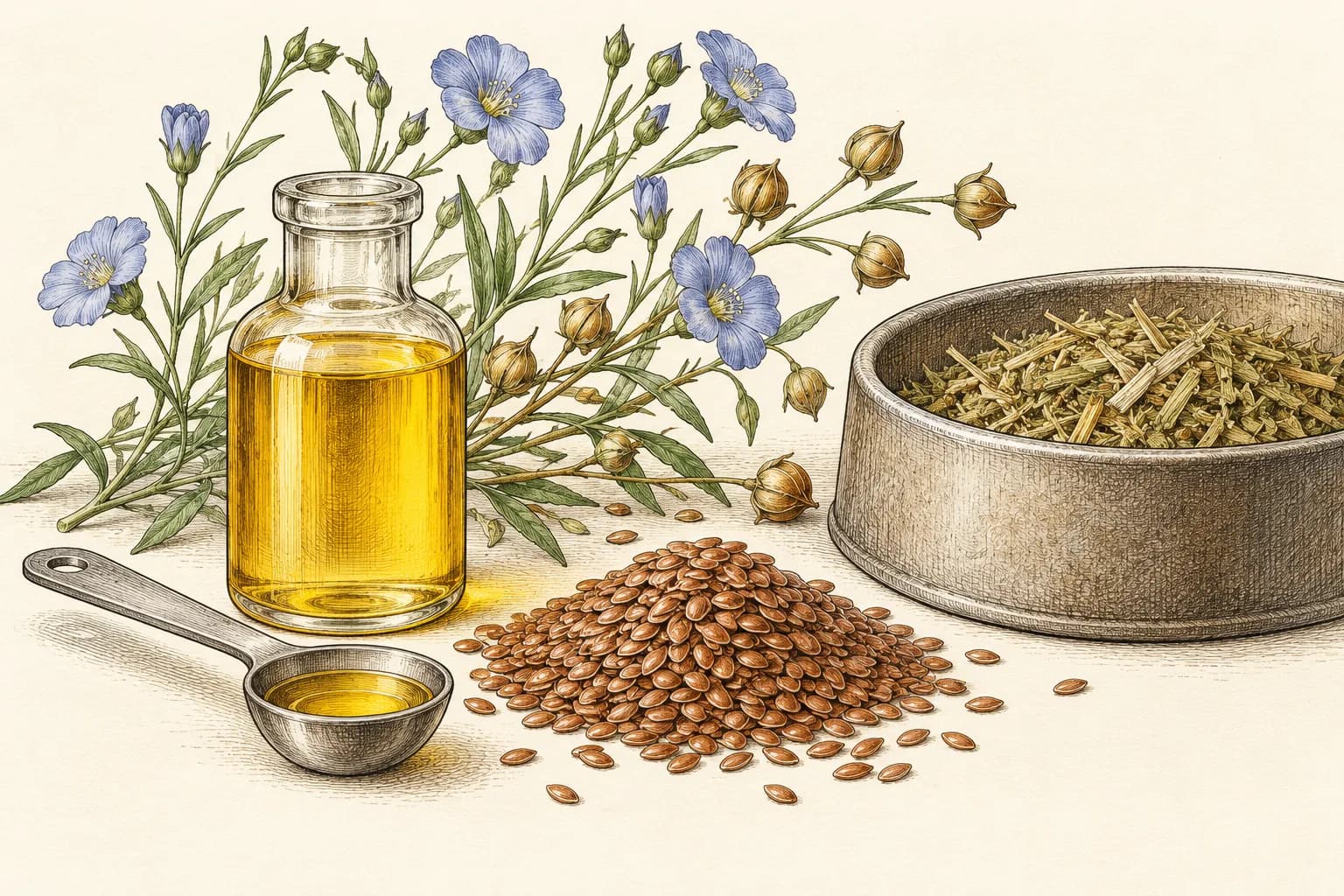
Linseed oil is pure fat: the Gruber Table gives 38.4 MJ metabolisable energy per kg of dry matter, roughly three times as much as oats 1. It mainly provides alpha-linolenic acid, a plant-based omega-3 fatty acid; in horse studies it did not raise DHA in the blood 2. Introduce oil slowly, store it fresh and count its energy in the total ration.
What does linseed oil provide in the ration?
Linseed oil consists almost entirely of fat. The Gruber Table gives 38.4 MJ metabolisable energy per kg of dry matter, with no protein, starch, calcium or phosphorus. According to the table, oils are about 90% digestible and provide roughly twice as much energy per gram of fat as a gram of starch 1.
Linseed is something different: besides fat, it also contains protein, fibre and minerals. In a ration calculation, oil and seed therefore need their own feed values 1.
| Per kg of dry matter | Linseed oil | Linseed | Oats |
|---|---|---|---|
| Metabolisable energy | 38.4 MJ | 19.8 MJ | 12.7 MJ |
| Crude fat | 999 g | 365 g | 52 g |
| Crude protein | 0 g | 248 g | 123 g |
| Starch | 0 g | 0 g | 447 g |
| Calcium | 0 g | 2.8 g | 1.2 g |
Table values per kg of dry matter from the Gruber Table (LfL); oats for comparison only.
What does the omega-3 fatty acid in linseed oil do?
Linseed oil mainly provides alpha-linolenic acid (ALA), a plant-based omega-3 fatty acid. In the linseed oil of a recent horse study, it made up 51 to 58% of the fatty acids 3. Linseed oil does not contain the long-chain omega-3 fatty acids EPA and DHA found in fish oil; the body first has to make them from ALA. According to a review, ALA intake in horse studies did not raise DHA in the blood, and at most raised EPA 2.
The individual studies are consistent with this. In a trial with twelve horses, plasma ALA and EPA rose with linseed oil, while the platelet function examined remained unchanged 4. In yearlings, fish oil changed the EPA and DHA proportions in blood and red blood cells much more than ground linseed 5. Measurable fatty acid patterns in the blood are not yet evidence of a health benefit.
How much linseed oil is possible?
The specialist literature gives upper limits, not a required amount. The preparatory project for the GfE recommendations considers up to 1 g of separately added vegetable oil per kg of body weight per day possible with slow adaptation, spread over at least three meals, and recommends at most 0.33 g per kg of body weight per meal. As the fat content rises, fibre digestibility falls 6. The Gruber Table likewise gives 0.1 kg per 100 kg of body weight per day, but no more than 0.5 kg per horse 1.
The American specialist reference is more cautious: at 1 g of soya oil per kg of body weight, fibre digestibility fell, and its upper limit is about 0.7 g per kg 7. These values describe the most a horse with a high energy requirement can tolerate, not what it needs.
A freely chosen worked example, not a dosage: according to the table value, 50 g of linseed oil provides around 1.9 MJ metabolisable energy. That corresponds to roughly 170 g of oats 1. For a horse that holds its weight well, this is additional energy that has to be accounted for elsewhere.
- Note whether you measure in millilitres or grams, and stick to one unit.
- Add up all fat sources: oil, linseed, high-fat compound feeds.
- Clarify beforehand which energy gap the oil is meant to fill.
How do you get your horse used to linseed oil?
The Gruber Table recommends a very slow introduction, careful mixing in, clean feed troughs and spreading the oil over at least three meals to avoid excessive passage rates and abnormal fermentation 1. For rations with a markedly increased fat content, the specialist reference gives three to four weeks until a horse has fully adapted 7.
We did not find a documented starting amount or fixed increments for linseed oil. So start well below your target amount, increase step by step and watch droppings consistency and eating behaviour.
- Mix the oil evenly into the feed rather than pouring it on top.
- Spread the daily amount over several meals.
- Do not leave feed leftovers with oil standing in the trough.
- If diarrhoea or feed refusal occurs, stop increasing and have the cause investigated.
Does your horse need more vitamin E when fed oil?
The veterinary specialist reference recommends additional vitamin E with high-fat feeding, because fat metabolism produces more reactive oxygen species 7. The Gruber Table points out that linseed oil contains many unsaturated fatty acids but only little protective vitamin E 1. In the linseed oil study with twelve horses, plasma malondialdehyde, a marker of fat oxidation, rose 4.
These sources do not give a specific amount of vitamin E per millilitre of oil. So check how much vitamin E your horse already gets from pasture, hay, mineral feed and other supplements before adding more.
How do you store linseed oil so it stays fresh?
Linseed oil is sensitive to oxidation: many unsaturated fatty acids meet little vitamin E 1. In a study of cold-pressed linseed oils, the acid value and peroxide value rose markedly by the end of the stated shelf life, even though the oils were kept in the fridge. Even the fresh oils differed in quality 8.
- Buy containers that you will use up within the stated shelf life after opening.
- Keep the oil closed and store it according to the storage instructions on the label; refrigeration alone did not prevent oxidation in the study 8.
- Write the opening date on the bottle.
- Do not feed oil that smells rancid or bitter.
What is documented about linseed oil, coat and skin?
The Gruber Table attributes a positive effect on skin and coat to the unsaturated fatty acids in linseed feeds, but cites no study for this 1. In a blinded study, 30 healthy horses received camelina, rapeseed or linseed oil for 16 weeks. Coat colour and coat quality improved in all groups compared with baseline, with no differences between the oils. There was no group without oil 3.
It follows that a glossier coat on linseed oil cannot be reliably attributed to the linseed oil itself. It may also be due to oil in general, the season or other changes. Itching, skin changes or a dull coat despite a balanced ration should be investigated by a vet rather than treated with oil.
Key takeaways
Frequently asked questions
How much linseed oil can a horse have per day?
There is no amount that every horse needs. The specialist literature gives upper limits: at most 1 g of fat per kg of body weight per day, spread over at least three meals 6; for soya oil about 0.7 g per kg 7. These upper limits are not target amounts. What matters is whether your ration needs the additional energy at all.
Which is better: linseed oil or linseed?
That depends on the ration question. Linseed oil is almost pure fat; linseed also contains protein, fibre and minerals and only around 365 g of fat per kg of dry matter 1. Seed raises its own questions about preparation and shelf life.
How long can you feed linseed oil?
We found no evidence for a time limit on feeding linseed oil. The Gruber Table's recommendation of a course refers to mucilaginous linseed feeds such as the seed 1. When oil is fed long term, energy, vitamin E supply and the freshness of the oil should be reviewed regularly 7.
Will linseed oil make my horse fat?
Oil is very energy-dense 1. If a good doer receives oil on top without energy being removed elsewhere, its energy intake rises. Whether that becomes a problem is shown by comparing it with requirements and body condition.
Sources & studies
The content is based on the references listed below. It does not replace individual veterinary or feeding advice.
Show list of sources (8)
- Bayerische Landesanstalt für Landwirtschaft (LfL): Gruber Tabelle zur PferdefütterungPractical reference table with requirement and feed values based on the GfE recommendations; the basis of many ration calculations in German-speaking countries. Chapter 9.3, Table 39: most common poisonous plants for horses with habitat, toxicity and risk level (after Kamphues et al. 2014)
- Hess T, Ross-Jones T (2014): Omega-3 fatty acid supplementation in horses. Revista Brasileira de Zootecnia 43(12):677–683Open-access review (invited review), DOI 10.1590/S1516-35982014001200008, full text checked on 30 September 2026: plant oils such as linseed oil supply alpha-linolenic acid; in horse studies increased ALA intake did not raise circulating DHA, and EPA at most slightly; low conversion efficiency. No dosage or efficacy statement adopted for any particular product.
- Richards T, Burron S, McCorkell TC, Trevizan L, Patterson K, Minikhiem D, Ma DWL, Pearson W, Shoveller AK (2023): Effects of dietary camelina, flaxseed, and canola oil supplementation on transepidermal water loss, skin and coat health parameters, and plasma prostaglandin E2, glycosaminoglycan, and nitric oxide concentrations in healthy adult horses. Journal of Animal Science 101:skad373Open-access full text checked on 30 September 2026, DOI 10.1093/jas/skad373: 30 healthy horses, 16 weeks each of 370 mg camelina, rapeseed or linseed oil per kg body weight, blinded coat assessment. Coat colour and quality increased in all groups compared with baseline, with no differences between the oils; no oil-free control group. ALA content of the linseed oil used 51.0–58.3%.
- Hansen RA, Savage CJ, Reidlinger K, Traub-Dargatz JL, Ogilvie GK, Mitchell D, Fettman MJ (2002): Effects of dietary flaxseed oil supplementation on equine plasma fatty acid concentrations and whole blood platelet aggregation. Journal of Veterinary Internal Medicine 16(4):457–463Abstract checked on 30 September 2026, DOI 10.1111/j.1939-1676.2002.tb01265.x: 12 healthy horses, 16 weeks of trial feeding with a pellet containing 10% linseed oil; rise in ALA, linoleic acid, EPA and malondialdehyde in plasma, platelet aggregation unchanged. Small number of animals; no dosage recommendation derived.
- Vineyard KR, Warren LK, Kivipelto J (2010): Effect of dietary omega-3 fatty acid source on plasma and red blood cell membrane composition and immune function in yearling horses. Journal of Animal Science 88(1):248–25718 Quarter Horse yearlings: encapsulated fish oil, ground linseed or control for 70 days. Evidence that marine and plant omega-3 sources affect the fatty acid profile differently
- Rodehutscord & Kirchhof (2011) – Schlussbericht BMELV-Projekt 514-33.23/08HS027Preparatory project for GfE (2014): development of supply recommendations for horses and sheep, in cooperation with the GfE Committee for Requirement Standards. Contains the derivations behind GfE 2014 (ME estimation equation, pcd CP/pcd amino acid concept); as of April 2011, not the adopted values of the 2014 publication
- Liburt NR (2026): Feeding Practices in Horses and Other Equids. Merck Veterinary ManualSpecialist overview, as of February 2026: forage basis, concentrates as required, bran/mash and Ca:P balance, gradual feed changes. No efficacy study on commercial mash products.
- Tańska M, Roszkowska B, Skrajda M, Dąbrowski G (2016): Commercial cold pressed flaxseed oils quality and oxidative stability at the beginning and the end of their shelf life. Journal of Oleo Science 65(2):111–121Abstract checked on 30 September 2026, DOI 10.5650/jos.ess15243: cold-pressed linseed oils tested fresh and after three months of refrigerated storage (end of the declared shelf life); acid value +18–40%, peroxide value +16–37%, shorter induction time; the fresh oils differed considerably. Food-grade oils, not a horse study.