

This article has not yet been professionally approved. The information is based on the sources listed below.
Salt lick, mineral lick or mineral feed: which fits?
How to tell a salt source, a mineral lick and a measured mineral feed apart, and how to check their contributions to the overall diet.
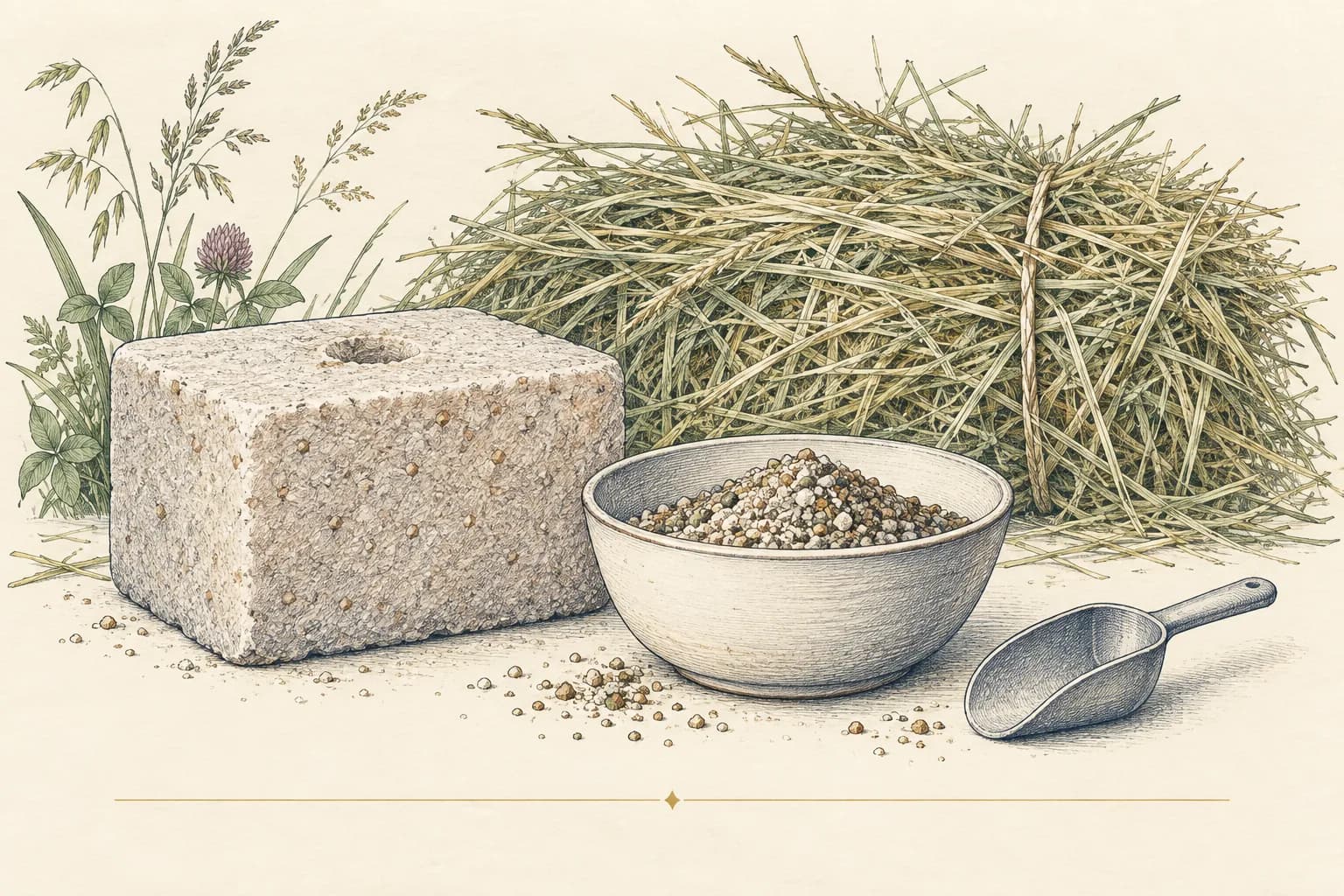
The short answer
What matters are the nutrients contained and the quantity actually eaten. A salt lick and a mineral feed do not automatically do the same job. Voluntary salt intake differs between horses; a block that is provided is therefore no proof of a particular daily intake 12.
What distinguishes the three options?
Start with the label, not with colour, shape or product name. Composition, analytical constituents, declared additives and directions for use give different information. A complementary feed is intended to be used together with other feeds 3.
| Option | What you look at | What may remain open |
|---|---|---|
| Salt source | Sodium/chloride and actual intake | Intake of the individual horse |
| Mineral lick | Nutrient declaration plus consumption | Distribution within a group of horses |
| Measured mineral feed | Declaration per kg and weighed daily quantity | Whether this quantity fits the basic ration |
Comparison questions for your stocktake; not an assessment of any specific product.
Can your horse choose the amount it needs by itself?
Differing visits to the salt block are described in a study on voluntary salt intake. This does not mean a horse can use a multi-nutrient lick to make up every individual trace element gap. Record the observed consumption instead of entering the mere availability as a fixed daily dose in the calculation 1.
- Weigh the block at the start and end of a documented period.
- Note which horses had access and whether any material was lost.
- Mark the intake as unknown if it cannot be assigned to the individual horse.
How do you calculate the contribution of a mineral feed?
The concentration in the product is not the daily intake. A freely chosen worked example: with 4,000 mg of zinc per kg of feed and 50 g daily, 0.05 kg × 4,000 mg/kg = 200 mg of zinc are supplied per day. This is neither a real product declaration nor a dosage recommendation. Then add the contributions of the rest of the ration; this overall view is exactly what a mineral assessment needs 2.
- Note the daily quantity in grams, not just the number of scoops.
- Convert every declared concentration using the same unit of quantity.
- Also check additives in concentrates and other supplementary products.
When should you have the choice professionally checked?
A mineral product only fits once forage, requirements and all supplements have been considered together. Oversupply is also part of the assessment 4. In the case of illness, unclear findings or several products fed in parallel, make your stocktake available to a qualified adviser before using further supplements.
Key takeaways
- Compare the declaration and daily intake, not the form of the product.
- Unless intake can be assigned to each horse, a lick shared by a group gives no measured individual quantity.
- Only decide on a supplement after taking stock of the whole ration 4.
Frequently asked questions
Does a mineral lick always replace mineral feed?
There is no general answer. Only the declaration, actual intake and nutrient contributions of the whole ration show whether a supplement is needed 2.
Do I have to record a salt lick as a mineral feed?
Record the actual product and its declaration. Sodium and chloride are nutrients in their own right; they do not stand in for all trace elements 4.
What do I do if consumption is unknown?
Mark the intake as unknown. An estimate can be documented as such, but should not become a pretend measured daily dose.
Does my horse need a salt lick?
A salt source is part of every horse's basic supply 5; a salt lick is a common form. How much a horse takes in from it differs between horses 1. With heavy sweating, around 3.1 g of sodium is lost per litre of sweat; it is then worth checking salt intake specifically 2.
Sources & studies
The content is based on the references listed below. It does not replace individual veterinary or feeding advice.
Show list of sources (5)
- Salt preferences of horses for types of NaCl offered (2024). Research in Veterinary Science, DOI 10.1016/j.rvsc.2024.105224Primary paper on salt provision and voluntary intake. The online excerpt checked shows individual differences in visits to the salt block; no extrapolation to intake covering the requirement for all trace elements.
- Merck Veterinary Manual: Nutritional Requirements of Horses and Other EquidsSummary of the NRC recommendations: water requirement 5 litres per 100 kg body mass per day at maintenance, sweat losses of around 3.1 g sodium, 5.3 g chloride and 1.6 g potassium per litre, salt recommendation 1.6–1.8 g per kg feed dry matter at a maximum of 6% of the ration; from a 50% forage share potassium is adequately covered. Also covers the selenium requirement (0.1 mg/kg feed dry matter or at least 1 mg/day for a 500 kg horse, selenium as a component of glutathione peroxidase together with vitamin E) and the strong location-dependent variation of selenium in forage (grass forage on average 0.194 ppm, range 0–1.2 ppm); some regions are markedly low in selenium and may need supplementation. Also gives the iodine requirement (0.35 mg/kg feed dry matter, mares in late pregnancy 0.4), iodine poisoning of pregnant mares from around 40 mg/day, documented goitre cases in mares and their foals associated with large amounts of dried seaweed (kelp), that iodised salt easily covers the requirement, and that iodine supplementation is usually unnecessary except in severely iodine-deficient regions
- Verordnung (EG) Nr. 767/2009Placing on the market and use of feed, labelling and claims; definitions of complete feed (Art. 3(2)(i)) and complementary feed (point (j)), content of feed additives (Art. 8), feeding instructions (Annex II No. 4). Link to the current EUR-Lex consolidated version (as of 26 December 2018).
- Bayerische Landesanstalt für Landwirtschaft (LfL): Gruber Tabelle zur PferdefütterungPractical reference table with requirement and feed values based on the GfE recommendations; the basis of many ration calculations in German-speaking countries. Chapter 9.3, Table 39: most common poisonous plants for horses with habitat, toxicity and risk level (after Kamphues et al. 2014)
- Coenen M, Vervuert I (2020): Pferdefütterung. Begründet von H. Meyer. 6., aktualisierte Aufl., Georg Thieme Verlag, Stuttgart. ISBN 978-3-13-241778-6Standard reference work on equine nutrition in German-speaking countries; Table 4.17 mineral recommendations (recommended supply and minimum requirement), Table 4.18 derived sweat volumes per work level and weight class, Table 4.19 electrolyte performance requirement per sweat volume (in addition to maintenance requirement)