This article has not yet been professionally approved. The information is based on the sources listed below.
Mineral feed for older horses: what changes with age
Why “senior” on the label is not a requirement level, what really changes in old horses (chewing, body condition, PPID) and how to check the ration for an older horse.
The short answer
The requirement values from GfE and NRC differentiate by weight, work, pregnancy, lactation and growth, not by age 12. An older horse therefore does not automatically need a senior mineral feed. What often changes are chewing, feed intake and body condition, plus conditions such as PPID 3. Check the ration if your horse is losing condition.
“Senior” is not a requirement level
The requirement recommendations from GfE (German Society of Nutrition Physiology) and NRC derive requirements from body weight, work and life stages such as pregnancy, lactation and growth 12. They do not include a separate level with different mineral values for older horses.
Labelling law does not set any nutrient values for the term “senior” 4. What a senior mineral feed contains is therefore only stated in its declaration. Check it against your ration like any other product.
What really changes with age
- Chewing: worn or missing teeth make it harder to break down hay.
- Feed intake: with late-cut, over-mature growth, old horses in particular may eat too little 5.
- Body condition: you can best recognise weight loss and muscle loss with a regular assessment using the body condition score 6.
- Conditions: PPID (Cushing's disease) is common in older horses and is often accompanied by insulin dysregulation 3.
When hay no longer works
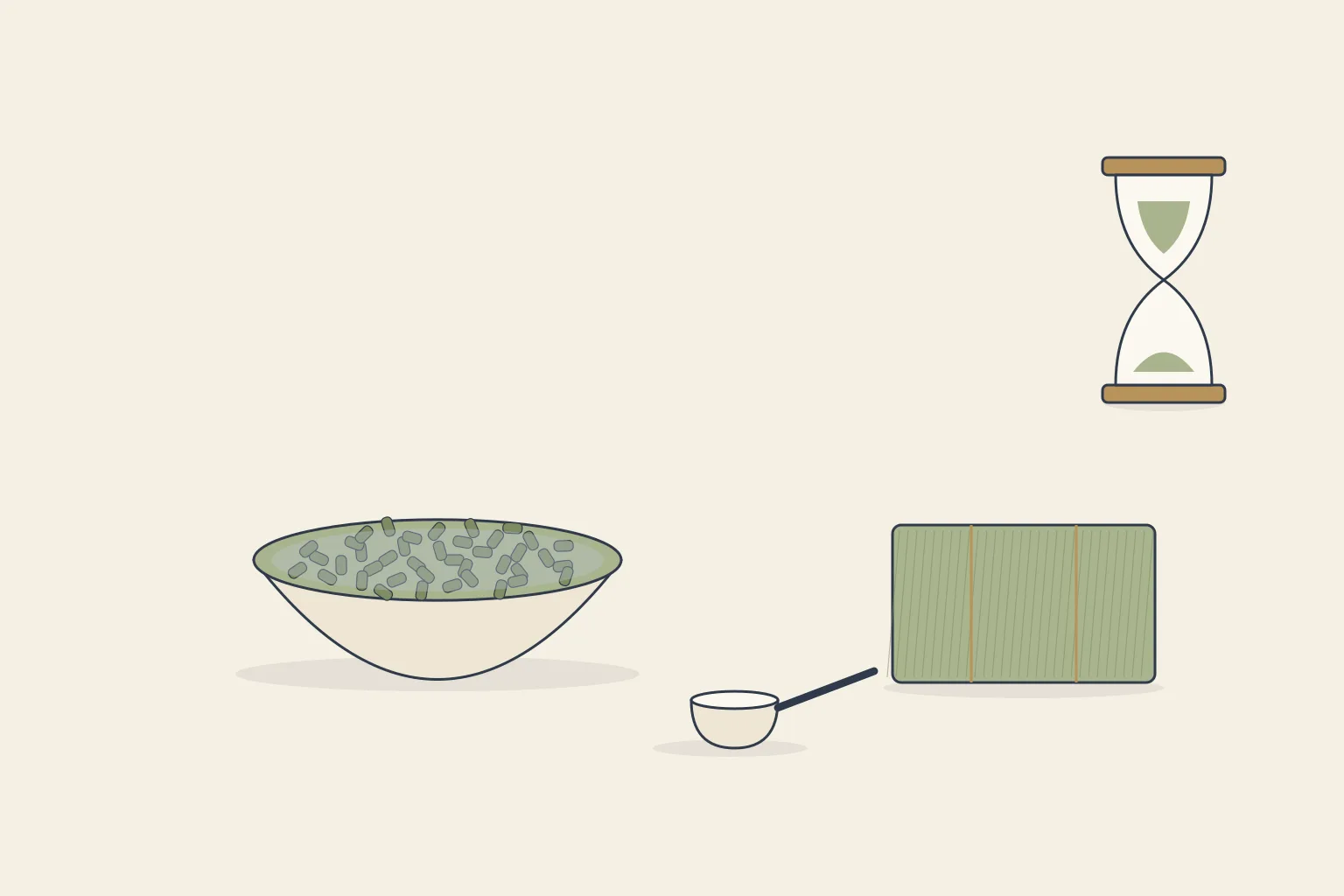
If a horse can no longer chew hay adequately, soaked hay cubes or chopped forage replace part of the forage. Dry cubes should not be fed to greedy horses because of the risk of choke 5.
The switch changes the ration. Cubes have different contents from your hay, and the amounts in kilograms are not directly comparable. So recalculate the new ration before you keep or change the mineral feed.
Clarify PPID and insulin status first
Whether an older horse needs to be fed low in sugar and starch is decided by its tested insulin status 37. A thin PPID horse with normal insulin status may benefit from more fat, protein and energy. If insulin dysregulation is also present, the additional energy comes from fat and high-quality fibre instead of cereals 7.
There is no evidence of efficacy for complementary feeds to treat PPID 3. What matters is the basic supply of the whole ration.
Key takeaways
- “Senior” on the label is not a defined nutrient level 4.
- Assess body condition regularly; loss of condition is a signal to check 6.
- With dental problems, soaked hay cubes or chopped forage help as a forage replacement 5.
- Have horses over ten years of age tested for PPID and insulin status before changing the ration 7.
Frequently asked questions
At what age is a horse a senior?
There is no fixed age limit for feeding. What matters is whether the horse still chews its feed well, holds its weight and is healthy. For horses over ten years of age, the specialist group recommends watching out for PPID and insulin dysregulation 7.
Does an old horse need more minerals?
The common requirement values do not include a separate age level 12. But if the ration changes, for example through less hay and more cubes, what needs to be supplemented also changes. Recalculate the new ration.
What should I feed an old horse that is losing weight?
First have teeth and health checked by your vet. For thin horses with PPID and normal insulin status, the guideline mentions more fat, protein and energy, for example via senior feed, fat or lucerne-based feeds 3. The amount follows from the ration calculation.
Sources & studies
The content is based on the references listed below. It does not replace individual veterinary or feeding advice.
Show list of sources (7)
- GfE (2014) – Empfehlungen zur Energie- und Nährstoffversorgung von PferdenSpecialist reference in German-speaking countries (GfE, German Society of Nutrition Physiology), Committee for Requirement Standards
- NRC – Nutrient Requirements of Horses, 6th ed.International reference for the nutrient requirements of horses (National Research Council)
- Hart K, Bamford N, Bertin FR, Durham A, Frank N, McGowan C, Schott H (Equine Endocrinology Group, 2025): Recommendations for the Diagnosis and Management of Pituitary Pars Intermedia Dysfunction (PPID). Revised October 2025Veterinary expert recommendation, checked on 30 September 2026. Summary: age-related, slowly progressive disease; prevalence 20% in equids over 15 years, 30% in those over 30 years; hypertrichosis as the classic sign; diagnosis via ACTH, to be interpreted according to season; treatment with daily medication plus feeding management and wellness care. Table 1: clinical spectrum (incl. muscle wasting, polyuria/polydipsia, recurrent infections, HAL). Table 4: choice of feed by body condition and insulin status; with normal insulin status (dynamic test) no carbohydrate restriction needed; many PPID horses lean or with muscle wasting – more fat, protein and energy; frequent BCS checks; dental care, hoof care, parasite control; good quality of life, life expectancy not necessarily shortened. Table 5: efficacy of complementary feeds in PPID not scientifically demonstrated. Recommendation for vets, not a guide for owners.
- Verordnung (EG) Nr. 767/2009Placing on the market and use of feed, labelling and claims; definitions of complete feed (Art. 3(2)(i)) and complementary feed (point (j)), content of feed additives (Art. 8), feeding instructions (Annex II No. 4). Link to the current EUR-Lex consolidated version (as of 26 December 2018).
- Bayerische Landesanstalt für Landwirtschaft (LfL): Gruber Tabelle zur PferdefütterungPractical reference table with requirement and feed values based on the GfE recommendations; the basis of many ration calculations in German-speaking countries. Chapter 9.3, Table 39: most common poisonous plants for horses with habitat, toxicity and risk level (after Kamphues et al. 2014)
- Henneke DR, Potter GD, Kreider JL, Yeates BF (1983): Relationship between condition score, physical measurements and body fat percentage in mares. Equine Veterinary Journal 15(4):371–372Original publication on the body condition score; bibliographically checked. Its application and limits are additionally supported by horse-specific specialist reviews.
- Bertin FR, Bailey S, Burns T, de Laat M, Durham A, Frank N, Kritchevsky J, Menzies-Gow N (Equine Endocrinology Group, 2024): Recommendations for the Diagnosis and Management of Equine Metabolic Syndrome (EMS) and Insulin Dysregulation. Revised June 2024Veterinary expert recommendation, checked on 30 September 2026. Table 1: HAL is by far the most common form of laminitis at over 90%; NSC = water-soluble carbohydrates plus starch, NFC subtraction formulas no longer recommended; NSC as the main trigger of insulin release. Risk factors: NSC-rich ration, age, PPID; overweight aggravating but not consistently. Table 5: hay < 10% NSC; for weight loss 1.5% of body mass as dry matter (1.7% as fed), check every 30 days, lower limit 1.2%; avoid stress because of the risk of hyperlipaemia; straw up to approx. 50% introduced gradually; soak hay in cold water for ≥ 60 min if NSC > 10% or not analysed; hay net/small meals; low-sugar mineral/vitamin/protein balancer; restrict grazing, resume only after laminitis has subsided and an insulin test; pasture NSC varies with temperature, light, rainfall, fertilisation; higher insulin values in winter; exercise only without active laminitis. FAQ: insulin dysregulation in about 30% of PPID horses; test for PPID and ID from 10 years of age. Recommendation for vets, not a guide for owners.