

This article has not yet been professionally approved. The information is based on the sources listed below.
Does every horse need complementary feed?
No – the basis is always forage, water and salt. Complementary feed only where there is a justified need, not on the principle of “the more, the better”. The better question is not “Which supplement?” but “What does the whole ration look like?”
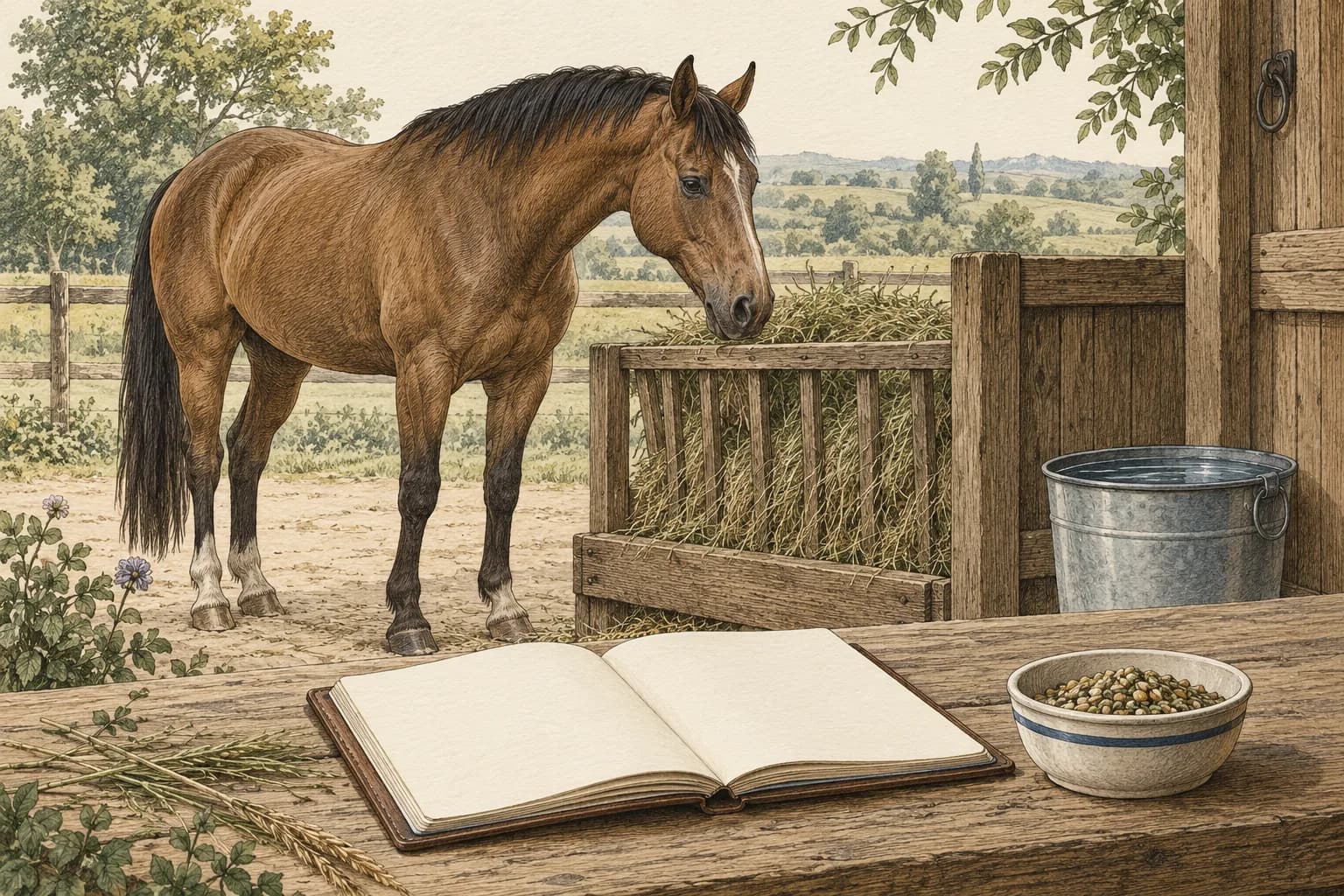
No. Not every horse automatically needs complementary feed. The basis of all horse feeding is sufficient forage, clean water, a source of salt, an appropriate energy intake, a monitored body condition, and exercise and species-appropriate housing 12.
Complementary feed can make sense if the ration does not supply enough of certain nutrients, if there is an increased requirement (e.g. work, breeding, age) or if a feeding goal is professionally justified 3. It never replaces a good basic ration.
Why “more” is not “better”
Many horses already receive several products at the same time. This can quickly lead to double supply – especially of minerals, trace elements and vitamins. Some trace elements have a narrow safety margin, so an excess may be not only unnecessary but risky 31.
Clarify the whole ration first
The most important question is therefore not “Which supplement does my horse need?” but starts with the whole ration. Only once the quantity and quality of the forage are clear can a sensible supplement be assessed 12.
- How much forage does the horse get – and of what quality?
- How much pasture grass does it take in?
- Is there any concentrate feed, and if so, how much per meal?
- What is the body condition (body condition score)?
- How much work does the horse do?
- Which complementary feeds are already being given?
- Are there any illnesses or veterinary findings?
Sources & studies
The content is based on the references listed below. It does not replace individual veterinary or feeding advice.
Show list of sources (4)
- GfE (2014) – Empfehlungen zur Energie- und Nährstoffversorgung von PferdenSpecialist reference in German-speaking countries (GfE, German Society of Nutrition Physiology), Committee for Requirement Standards
- Coenen M, Vervuert I (2020): Pferdefütterung. Begründet von H. Meyer. 6., aktualisierte Aufl., Georg Thieme Verlag, Stuttgart. ISBN 978-3-13-241778-6Standard reference work on equine nutrition in German-speaking countries; Table 4.17 mineral recommendations (recommended supply and minimum requirement), Table 4.18 derived sweat volumes per work level and weight class, Table 4.19 electrolyte performance requirement per sweat volume (in addition to maintenance requirement)
- NRC – Nutrient Requirements of Horses, 6th ed.International reference for the nutrient requirements of horses (National Research Council)
- Equine Nutrition (Überblick)Fundamentals of equine nutrition